2D7H | pdb_00002d7h

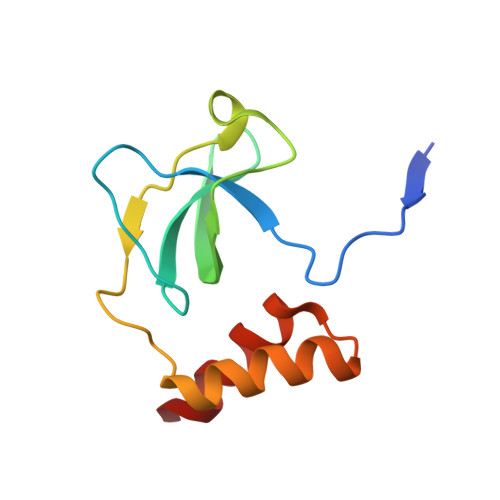
Crystal structure of the ccc complex of the N-terminal domain of PriA


Experimental Data Snapshot

  • Method: X-RAY DIFFRACTION
  • Resolution: 3.00 Å
  • R-Value Free: 
    0.293 (Depositor), 0.285 (DCC) 
  • R-Value Work: 
    0.238 (Depositor), 0.236 (DCC) 

wwPDB Validation 3D Report Full Report

Validation slider image for 2D7H

This is version 2.1 of the entry. See complete history

Literature

Structural basis of the 3'-end recognition of a leading strand in stalled replication forks by PriA.

Sasaki, K.Ose, T.Okamoto, N.Maenaka, K.Tanaka, T.Masai, H.Saito, M.Shirai, T.Kohda, D.

(2007) EMBO J 26: 2584-2593

  • DOI: https://doi.org/10.1038/sj.emboj.7601697
  • Primary Citation Related Structures: 
    2D7E, 2D7G, 2D7H, 2DWL, 2DWM, 2DWN

  • PubMed Abstract: 

    In eubacteria, PriA helicase detects the stalled DNA replication forks. This critical role of PriA is ascribed to its ability to bind to the 3' end of a nascent leading DNA strand in the stalled replication forks. The crystal structures in complexes with oligonucleotides and the combination of fluorescence correlation spectroscopy and mutagenesis reveal that the N-terminal domain of PriA possesses a binding pocket for the 3'-terminal nucleotide residue of DNA. The interaction with the deoxyribose 3'-OH is essential for the 3'-terminal recognition. In contrast, the direct interaction with 3'-end nucleobase is unexpected, considering the same affinity for oligonucleotides carrying the four bases at the 3' end. Thus, the N-terminal domain of PriA recognizes the 3'-end base in a base-non-selective manner, in addition to the deoxyribose and 5'-side phosphodiester group, of the 3'-terminal nucleotide to acquire both sufficient affinity and non-selectivity to find all of the stalled replication forks generated during DNA duplication. This unique feature is prerequisite for the proper positioning of the helicase domain of PriA on the unreplicated double-stranded DNA.


  • Organizational Affiliation
    • Division of Structural Biology, Medical Institute of Bioregulation, Kyushu University, Fukuoka, Japan.

Macromolecule Content 

  • Total Structure Weight: 47.93 kDa 
  • Atom Count: 3,234 
  • Modeled Residue Count: 407 
  • Deposited Residue Count: 423 
  • Unique protein chains: 1
  • Unique nucleic acid chains: 1

Macromolecules


Find similar proteins by:|  3D Structure
Entity ID: 1
MoleculeChains  Sequence LengthOrganismDetailsImage
Primosomal protein N'
A, B, C, D
105Escherichia coli K-12Mutation(s): 0 
Gene Names: priAb3935JW3906
EC: 3.6.4 (PDB Primary Data), 5.6.2.4 (UniProt)
UniProt
Find proteins for P17888 (Escherichia coli (strain K12))
Explore P17888 
Go to UniProtKB:  P17888
Entity Groups
Sequence Clusters30% Identity50% Identity70% Identity90% Identity95% Identity100% Identity
UniProt GroupP17888
Sequence Annotations
Expand
Reference Sequence
Find similar nucleic acids by:  Sequence
Entity ID: 2
MoleculeChains LengthOrganismImage
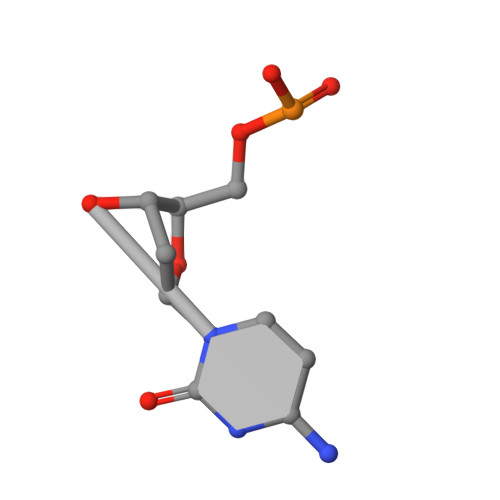
DNA (5'-D(P*CP*CP*C)-3')3synthetic construct
Sequence Annotations
Expand
Reference Sequence

Experimental Data & Validation

Experimental Data

  • Method: X-RAY DIFFRACTION
  • Resolution: 3.00 Å
  • R-Value Free:  0.293 (Depositor), 0.285 (DCC) 
  • R-Value Work:  0.238 (Depositor), 0.236 (DCC) 
Space Group: H 3 2
Unit Cell:
Length ( Å )Angle ( ˚ )
a = 111.151α = 90
b = 111.151β = 90
c = 260.483γ = 120
Software Package:
Software NamePurpose
HKL-2000data collection
SCALEPACKdata scaling
SHARPphasing
CNSrefinement
HKL-2000data reduction

Structure Validation

View Full Validation Report


Entry History 

Deposition Data

Revision History  (Full details and data files)

  • Version 1.0: 2006-11-07
    Type: Initial release
  • Version 1.1: 2008-04-30
    Changes: Version format compliance
  • Version 1.2: 2011-07-13
    Changes: Version format compliance
  • Version 1.3: 2019-02-27
    Changes: Data collection, Database references
  • Version 2.0: 2019-03-27
    Changes: Advisory, Atomic model, Data collection, Database references, Derived calculations, Non-polymer description, Polymer sequence, Source and taxonomy, Structure summary
  • Version 2.1: 2024-03-13
    Changes: Data collection, Database references