2D4C | pdb_00002d4c

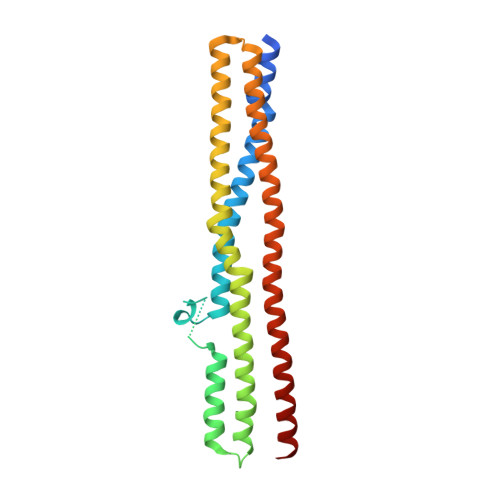
Crystal structure of the endophilin BAR domain mutant


Experimental Data Snapshot

  • Method: X-RAY DIFFRACTION
  • Resolution: 2.40 Å
  • R-Value Free: 
    0.270 (Depositor), 0.269 (DCC) 
  • R-Value Work: 
    0.215 (Depositor), 0.214 (DCC) 
  • R-Value Observed: 
    0.217 (Depositor) 

Starting Model: experimental
View more details

wwPDB Validation 3D Report Full Report

Validation slider image for 2D4C

This is version 1.3 of the entry. See complete history

Literature

Endophilin BAR domain drives membrane curvature by two newly identified structure-based mechanisms

Masuda, M.Takeda, S.Sone, M.Ohki, T.Mori, H.Kamioka, Y.Mochizuki, N.

(2006) EMBO J 25: 2889-2897

  • DOI: https://doi.org/10.1038/sj.emboj.7601176
  • Primary Citation Related Structures: 
    1X03, 1X04, 2D4C

  • PubMed Abstract: 

    The crescent-shaped BAR (Bin/Amphiphysin/Rvs-homology) domain dimer is a versatile protein module that senses and generates positive membrane curvature. The BAR domain dimer of human endophilin-A1, solved at 3.1 A, has a unique structure consisting of a pair of helix-loop appendages sprouting out from the crescent. The appendage's short helices form a hydrophobic ridge, which runs across the concave surface at its center. Examining liposome binding and tubulation in vitro using purified BAR domain and its mutants indicated that the ridge penetrates into the membrane bilayer and enhances liposome tubulation. BAR domain-expressing cells exhibited marked plasma membrane tubulation in vivo. Furthermore, a swinging-arm mutant lost liposome tubulation activity yet retaining liposome binding. These data suggested that the rigid crescent dimer shape is crucial for the tubulation. We here propose that the BAR domain drives membrane curvature by coordinate action of the crescent's scaffold mechanism and the ridge's membrane insertion in addition to membrane binding via amino-terminal amphipathic helix.


  • Organizational Affiliation
    • Department of Structural Analysis, National Cardiovascular Center Research Institute, Suita, Osaka, Japan.

Macromolecule Content 

  • Total Structure Weight: 116.27 kDa 
  • Atom Count: 7,402 
  • Modeled Residue Count: 898 
  • Deposited Residue Count: 1,024 
  • Unique protein chains: 1

Macromolecules

Find similar proteins by:|  3D Structure
Entity ID: 1
MoleculeChains  Sequence LengthOrganismDetailsImage
SH3-containing GRB2-like protein 2
A, B, C, D
256Homo sapiensMutation(s): 0 
EC: 2.3.1
Membrane Entity: Yes 
UniProt & NIH Common Fund Data Resources
Find proteins for Q99962 (Homo sapiens)
Explore Q99962 
Go to UniProtKB:  Q99962
PHAROS:  Q99962
GTEx:  ENSG00000107295 
Entity Groups
Sequence Clusters30% Identity50% Identity70% Identity90% Identity95% Identity100% Identity
UniProt GroupQ99962
Sequence Annotations
Expand
Reference Sequence

Small Molecules

Ligands 1 Unique
IDChains Name / Formula / InChI Key2D Diagram3D Interactions
CA

Query on CA


Download:Ideal Coordinates CCD File
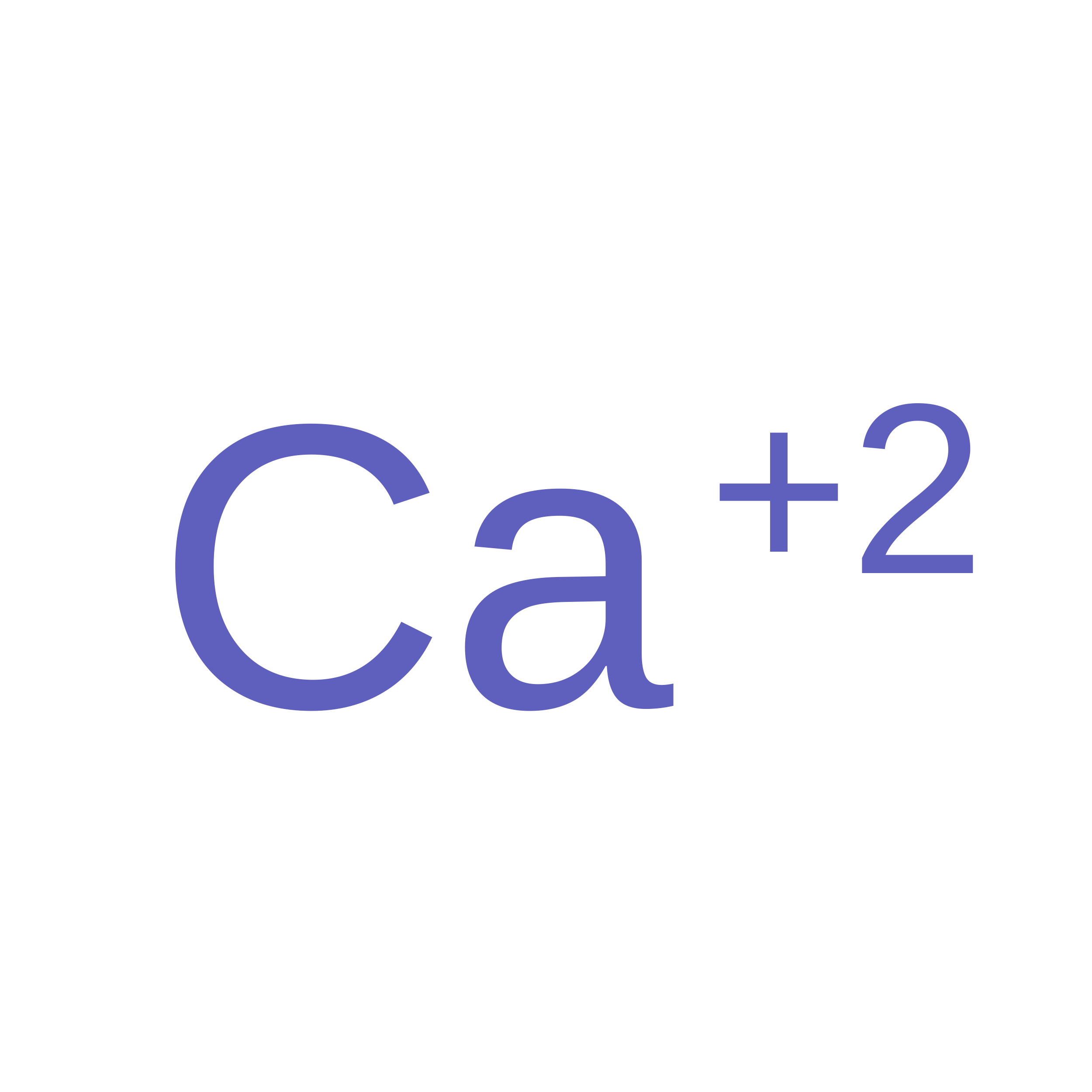
E [auth A]CALCIUM ION
Ca
BHPQYMZQTOCNFJ-UHFFFAOYSA-N

Experimental Data & Validation

Experimental Data

  • Method: X-RAY DIFFRACTION
  • Resolution: 2.40 Å
  • R-Value Free:  0.270 (Depositor), 0.269 (DCC) 
  • R-Value Work:  0.215 (Depositor), 0.214 (DCC) 
  • R-Value Observed: 0.217 (Depositor) 
Space Group: P 1 21 1
Unit Cell:
Length ( Å )Angle ( ˚ )
a = 44.344α = 90
b = 212.217β = 96.97
c = 54.317γ = 90
Software Package:
Software NamePurpose
DENZOdata reduction
SCALEPACKdata scaling
MOLREPphasing
CNSrefinement

Structure Validation

View Full Validation Report


Entry History 

Deposition Data

Revision History  (Full details and data files)

  • Version 1.0: 2006-07-11
    Type: Initial release
  • Version 1.1: 2008-04-30
    Changes: Version format compliance
  • Version 1.2: 2011-07-13
    Changes: Version format compliance
  • Version 1.3: 2023-10-25
    Changes: Data collection, Database references, Derived calculations, Refinement description