2D2O | pdb_00002d2o

Structure of a complex of Thermoactinomyces vulgaris R-47 alpha-amylase 2 with maltohexaose demonstrates the important role of aromatic residues at the reducing end of the substrate binding cleft


Experimental Data Snapshot

  • Method: X-RAY DIFFRACTION
  • Resolution: 2.10 Å
  • R-Value Free: 
    0.217 (Depositor), 0.222 (DCC) 
  • R-Value Work: 
    0.184 (Depositor), 0.191 (DCC) 
  • R-Value Observed: 
    0.184 (Depositor) 

wwPDB Validation 3D Report Full Report

Validation slider image for 2D2O

This is version 2.2 of the entry. See complete history. 

Literature

Structure of a complex of Thermoactinomyces vulgaris R-47 alpha-amylase 2 with maltohexaose demonstrates the important role of aromatic residues at the reducing end of the substrate binding cleft

Ohtaki, A., Mizuno, M., Yoshida, H., Tonozuka, T., Sakano, Y., Kamitori, S.

(2006) Carbohydr Res 341: 1041-1046

  • DOI: https://doi.org/10.1016/j.carres.2006.01.029
  • Primary Citation Related Structures: 
    2D2O

  • PubMed Abstract: 

    Thermoactinomyces vulgaris R-47 alpha-amylase 2 (TVAII) can efficiently hydrolyze both starch and cyclomaltooligosaccharides (cyclodextrins). The crystal structure of an inactive mutant TVAII in a complex with maltohexaose was determined at a resolution of 2.1A. TVAII adopts a dimeric structure to form two catalytic sites, where substrates are found to bind. At the catalytic site, there are many hydrogen bonds between the enzyme and substrate at the non-reducing end from the hydrolyzing site, but few hydrogen bonds at the reducing end, where two aromatic residues, Trp356 and Tyr45, make effective interactions with a substrate. Trp356 drastically changes its side-chain conformation to achieve a strong stacking interaction with the substrate, and Tyr45 from another molecule forms a water-mediated hydrogen bond with the substrate. Kinetic analysis of the wild-type and mutant enzymes in which Trp356 and/or Tyr45 were replaced with Ala suggested that Trp356 and Tyr45 are essential to the catalytic reaction of the enzyme, and that the formation of a dimeric structure is indispensable for TVAII to hydrolyze both starch and cyclodextrins.


  • Organizational Affiliation: 
    • Department of Biotechnology and Life Science, Tokyo University of Agriculture and Technology, 2-24-16 Naka-cho, Koganei, Tokyo 184-8588, Japan.

Macromolecule Content 

  • Total Structure Weight: 137.17 kDa 
  • Atom Count: 10,668 
  • Modeled Residue Count: 1,170 
  • Deposited Residue Count: 1,170 
  • Unique protein chains: 1

Macromolecules

Find similar proteins by:|  3D Structure
Entity ID: 1
MoleculeChains  Sequence LengthOrganismDetailsImage
Neopullulanase 2
A, B
585Thermoactinomyces vulgarisMutation(s): 1 
EC: 3.2.1.135
UniProt
Find proteins for Q08751 (Thermoactinomyces vulgaris)
Explore Q08751 
Go to UniProtKB:  Q08751
Entity Groups
Sequence Clusters30% Identity50% Identity70% Identity90% Identity95% Identity100% Identity
UniProt GroupQ08751
Sequence Annotations
Expand
Reference Sequence

Oligosaccharides

Help  
Entity ID: 2
MoleculeChains Length2D Diagram GlycosylationD Interactions
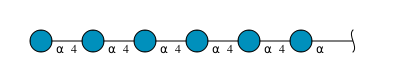
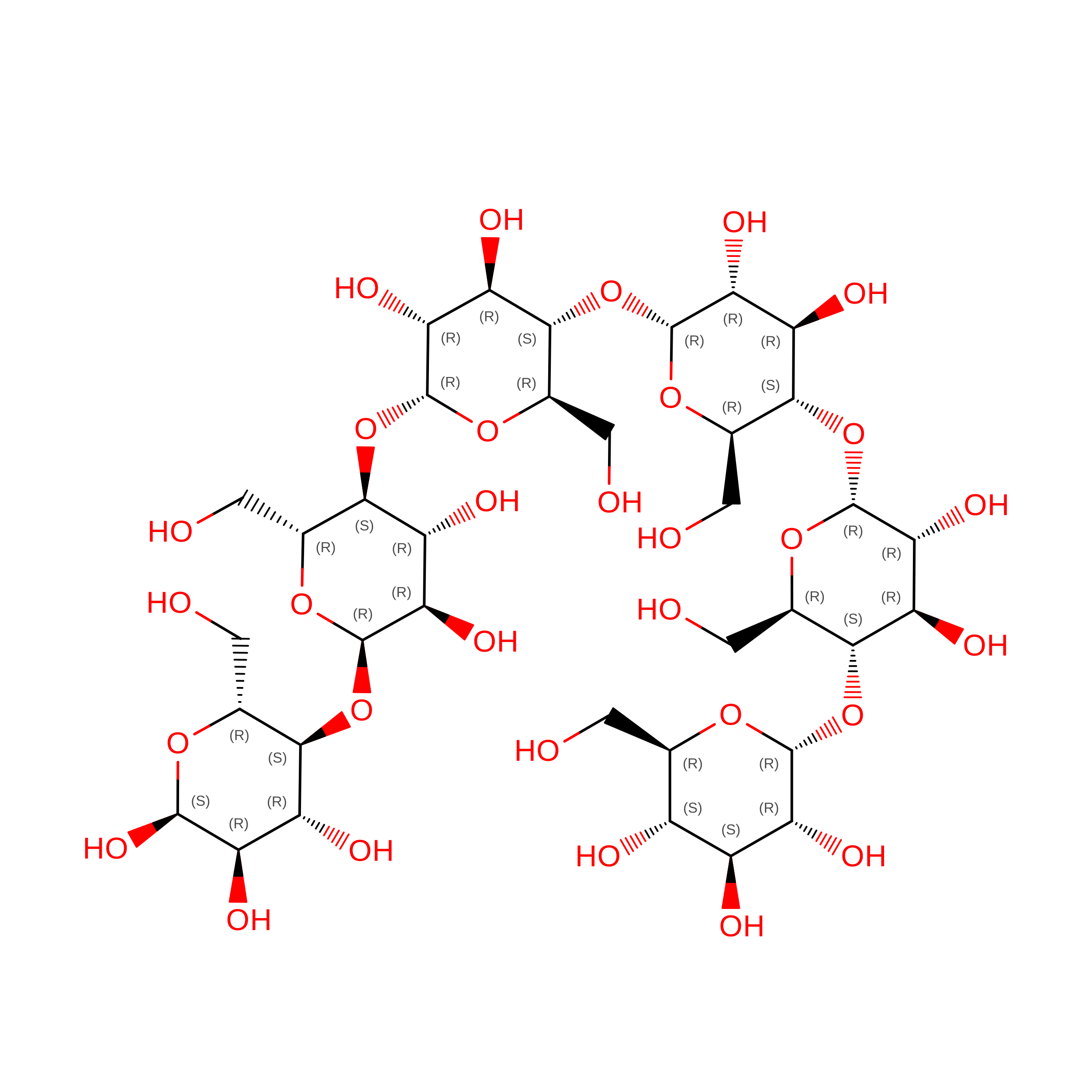
alpha-D-glucopyranose-(1-4)-alpha-D-glucopyranose-(1-4)-alpha-D-glucopyranose-(1-4)-alpha-D-glucopyranose-(1-4)-alpha-D-glucopyranose-(1-4)-alpha-D-glucopyranose
C, D
6N/A
Glycosylation Resources
GlyTouCan: G91368RN
GlyCosmos: G91368RN
GlyGen: G91368RN

Biologically Interesting Molecules (External Reference) 

1 Unique

Experimental Data & Validation

Experimental Data

  • Method: X-RAY DIFFRACTION
  • Resolution: 2.10 Å
  • R-Value Free:  0.217 (Depositor), 0.222 (DCC) 
  • R-Value Work:  0.184 (Depositor), 0.191 (DCC) 
  • R-Value Observed: 0.184 (Depositor) 
Space Group: P 21 21 21
Unit Cell:
Length ( Å )Angle ( ˚ )
a = 113.69α = 90
b = 118.71β = 90
c = 112.38γ = 90
Software Package:
Software NamePurpose
CNSrefinement
HKL-2000data reduction
SCALEPACKdata scaling
CNSphasing

Structure Validation

View Full Validation Report


Entry History 

Deposition Data

Revision History  (Full details and data files)

  • Version 1.0: 2006-08-29
    Type: Initial release
  • Version 1.1: 2008-04-30
    Changes: Version format compliance
  • Version 1.2: 2011-07-13
    Changes: Version format compliance
  • Version 2.0: 2020-07-29
    Type: Remediation
    Reason: Carbohydrate remediation
    Changes: Advisory, Atomic model, Data collection, Derived calculations, Structure summary
  • Version 2.1: 2021-11-10
    Changes: Database references, Structure summary
  • Version 2.2: 2024-05-29
    Changes: Data collection