2D0G | pdb_00002d0g

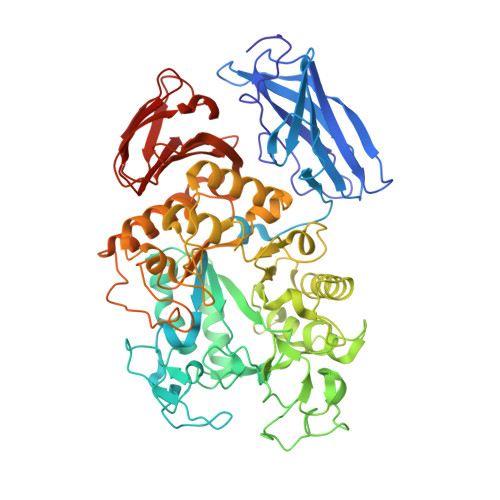
Crystal Structure of Thermoactinomyces vulgaris R-47 Alpha-Amylase 1 (TVAI) Mutant D356N/E396Q complexed with P5, a pullulan model oligosaccharide


Experimental Data Snapshot

  • Method: X-RAY DIFFRACTION
  • Resolution: 2.60 Å
  • R-Value Free: 
    0.190 (Depositor), 0.186 (DCC) 
  • R-Value Work: 
    0.150 (Depositor), 0.145 (DCC) 
  • R-Value Observed: 
    0.154 (Depositor) 

wwPDB Validation 3D Report Full Report

Validation slider image for 2D0G

Ligand Structure Quality Assessment 


This is version 2.2 of the entry. See complete history

Literature

Complexes of Thermoactinomyces vulgaris R-47 alpha-amylase 1 and pullulan model oligossacharides provide new insight into the mechanism for recognizing substrates with alpha-(1,6) glycosidic linkages

Abe, A.Yoshida, H.Tonozuka, T.Sakano, Y.Kamitori, S.

(2005) FEBS J 272: 6145-6153

  • DOI: https://doi.org/10.1111/j.1742-4658.2005.05013.x
  • Primary Citation Related Structures: 
    2D0F, 2D0G, 2D0H

  • PubMed Abstract: 

    Thermoactinomyces vulgaris R-47 alpha-amylase 1 (TVAI) has unique hydrolyzing activities for pullulan with sequence repeats of alpha-(1,4), alpha-(1,4), and alpha-(1,6) glycosidic linkages, as well as for starch. TVAI mainly hydrolyzes alpha-(1,4) glycosidic linkages to produce a panose, but it also hydrolyzes alpha-(1,6) glycosidic linkages with a lesser efficiency. X-ray structures of three complexes comprising an inactive mutant TVAI (D356N or D356N/E396Q) and a pullulan model oligosaccharide (P2; [Glc-alpha-(1,6)-Glc-alpha-(1,4)-Glc-alpha-(1,4)]2 or P5; [Glc-alpha-(1,6)-Glc-alpha-(1,4)-Glc-alpha-(1,4)]5) were determined. The complex D356N/P2 is a mimic of the enzyme/product complex in the main catalytic reaction of TVAI, and a structural comparison with Aspergillus oryzaealpha-amylase showed that the (-) subsites of TVAI are responsible for recognizing both starch and pullulan. D356N/E396Q/P2 and D356N/E396Q/P5 provided models of the enzyme/substrate complex recognizing the alpha-(1,6) glycosidic linkage at the hydrolyzing site. They showed that only subsites -1 and -2 at the nonreducing end of TVAI are effective in the hydrolysis of alpha-(1,6) glycosidic linkages, leading to weak interactions between substrates and the enzyme. Domain N of TVAI is a starch-binding domain acting as an anchor in the catalytic reaction of the enzyme. In this study, additional substrates were also found to bind to domain N, suggesting that domain N also functions as a pullulan-binding domain.


  • Organizational Affiliation
    • Graduate School of Medicine, Kagawa University, Japan.

Macromolecule Content 

  • Total Structure Weight: 74.52 kDa 
  • Atom Count: 5,737 
  • Modeled Residue Count: 637 
  • Deposited Residue Count: 637 
  • Unique protein chains: 1

Macromolecules

Find similar proteins by:|  3D Structure
Entity ID: 1
MoleculeChains  Sequence LengthOrganismDetailsImage
alpha-amylase I637Thermoactinomyces vulgarisMutation(s): 2 
EC: 3.2.1.1 (PDB Primary Data), 3.2.1.135 (UniProt)
UniProt
Find proteins for Q60053 (Thermoactinomyces vulgaris)
Explore Q60053 
Go to UniProtKB:  Q60053
Entity Groups
Sequence Clusters30% Identity50% Identity70% Identity90% Identity95% Identity100% Identity
UniProt GroupQ60053
Sequence Annotations
Expand
Reference Sequence

Oligosaccharides

Help  
Entity ID: 2
MoleculeChains Length2D Diagram GlycosylationD Interactions
beta-D-glucopyranose-(1-4)-alpha-D-glucopyranose-(1-6)-beta-D-glucopyranose-(1-4)-beta-D-glucopyranose-(1-4)-alpha-D-glucopyranose-(1-6)-alpha-D-glucopyranose-(1-4)-alpha-D-glucopyranose-(1-4)-alpha-D-glucopyranose-(1-6)-alpha-D-glucopyranose-(1-4)-alpha-D-glucopyranose
B
10N/A
Glycosylation Resources
GlyTouCan: G39844GI
GlyCosmos: G39844GI
Entity ID: 3
MoleculeChains Length2D Diagram GlycosylationD Interactions
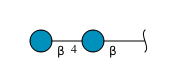
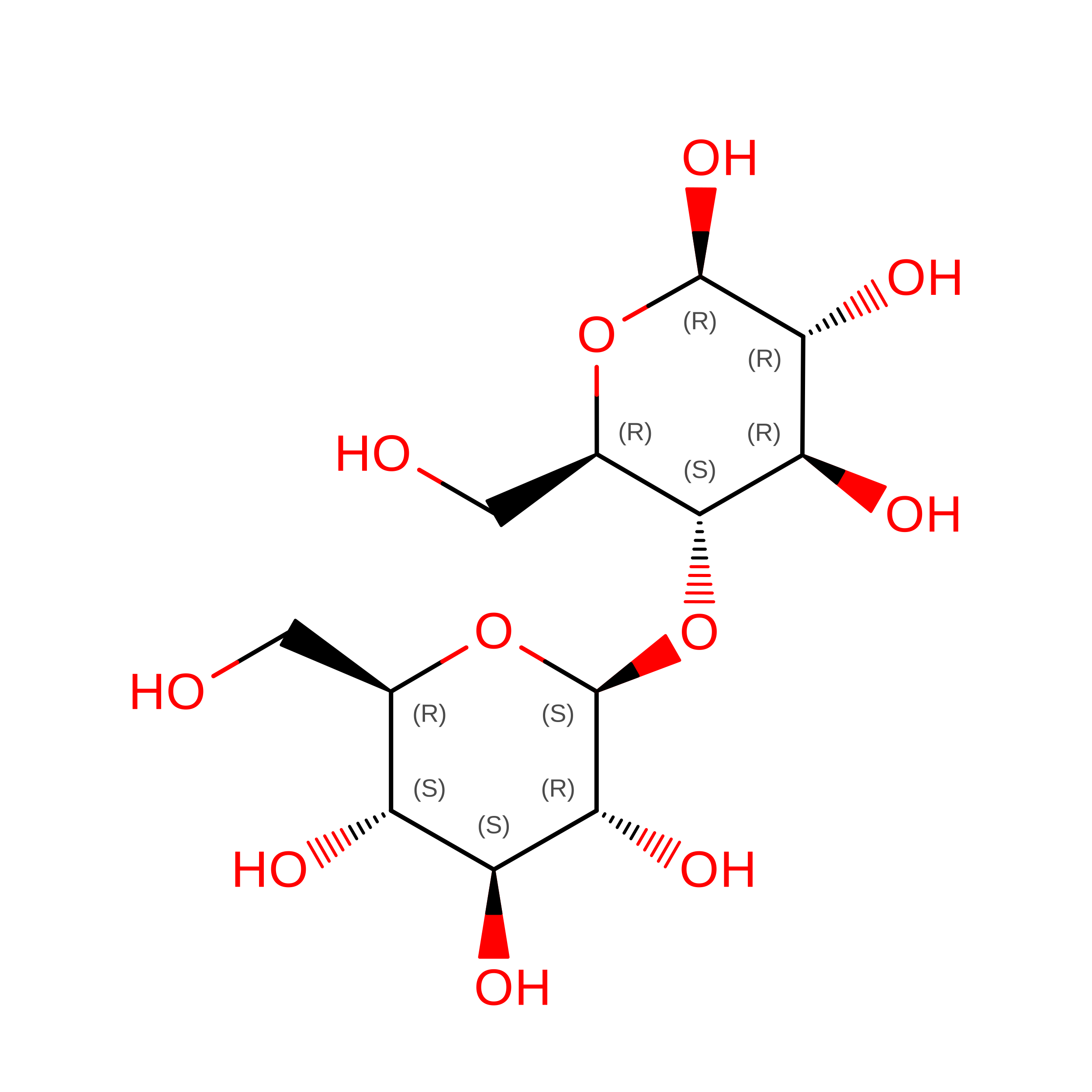
beta-D-glucopyranose-(1-4)-beta-D-glucopyranose
C
2N/A
Glycosylation Resources
GlyTouCan: G84824ZO
GlyCosmos: G84824ZO
Entity ID: 4
MoleculeChains Length2D Diagram GlycosylationD Interactions
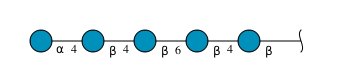
alpha-D-glucopyranose-(1-4)-beta-D-glucopyranose-(1-4)-beta-D-glucopyranose-(1-6)-beta-D-glucopyranose-(1-4)-beta-D-glucopyranose
D
5N/A
Glycosylation Resources
GlyTouCan: G95107LS
GlyCosmos: G95107LS

Small Molecules

Ligands 4 Unique
IDChains Name / Formula / InChI Key2D Diagram3D Interactions
BGC

Query on BGC


Download:Ideal Coordinates CCD File
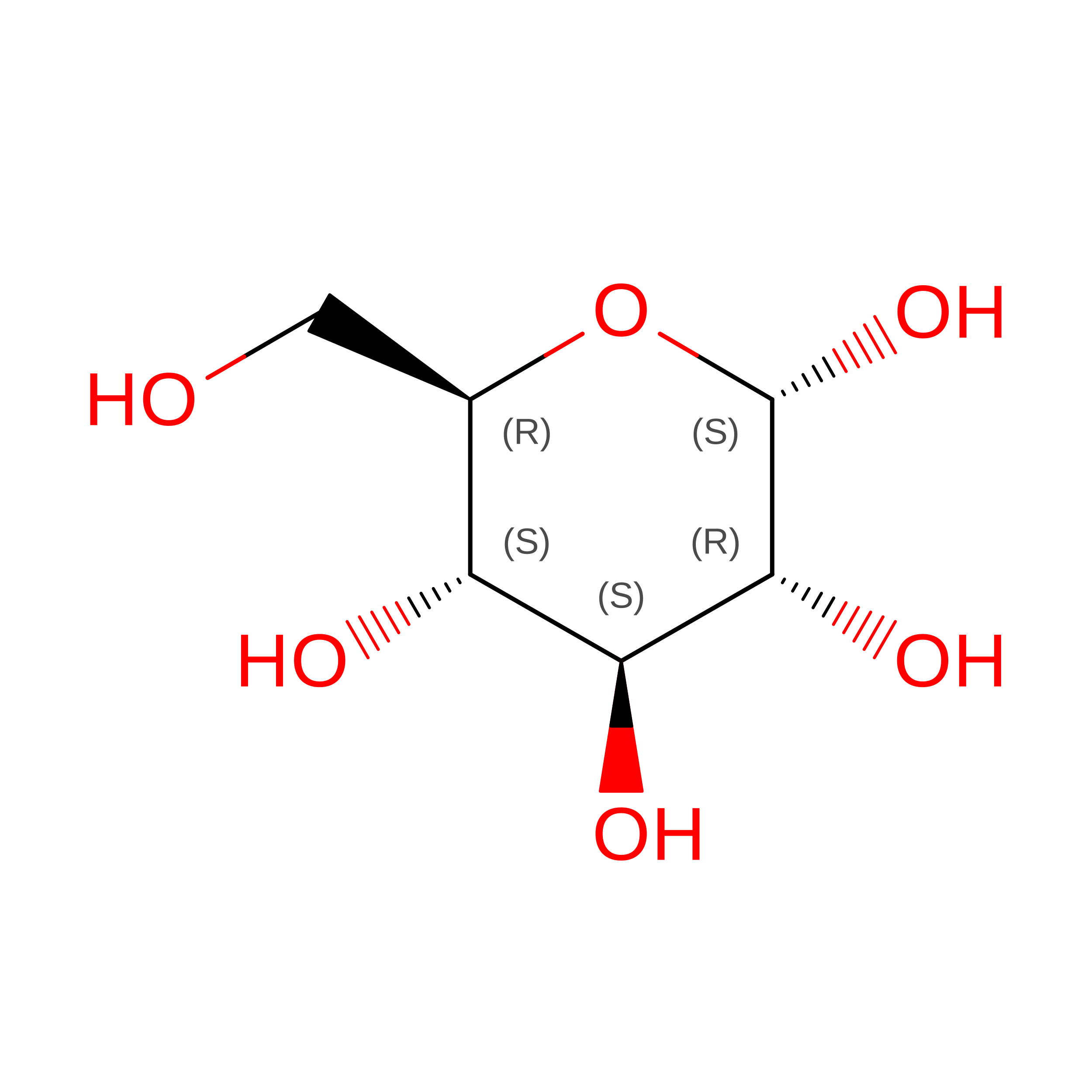
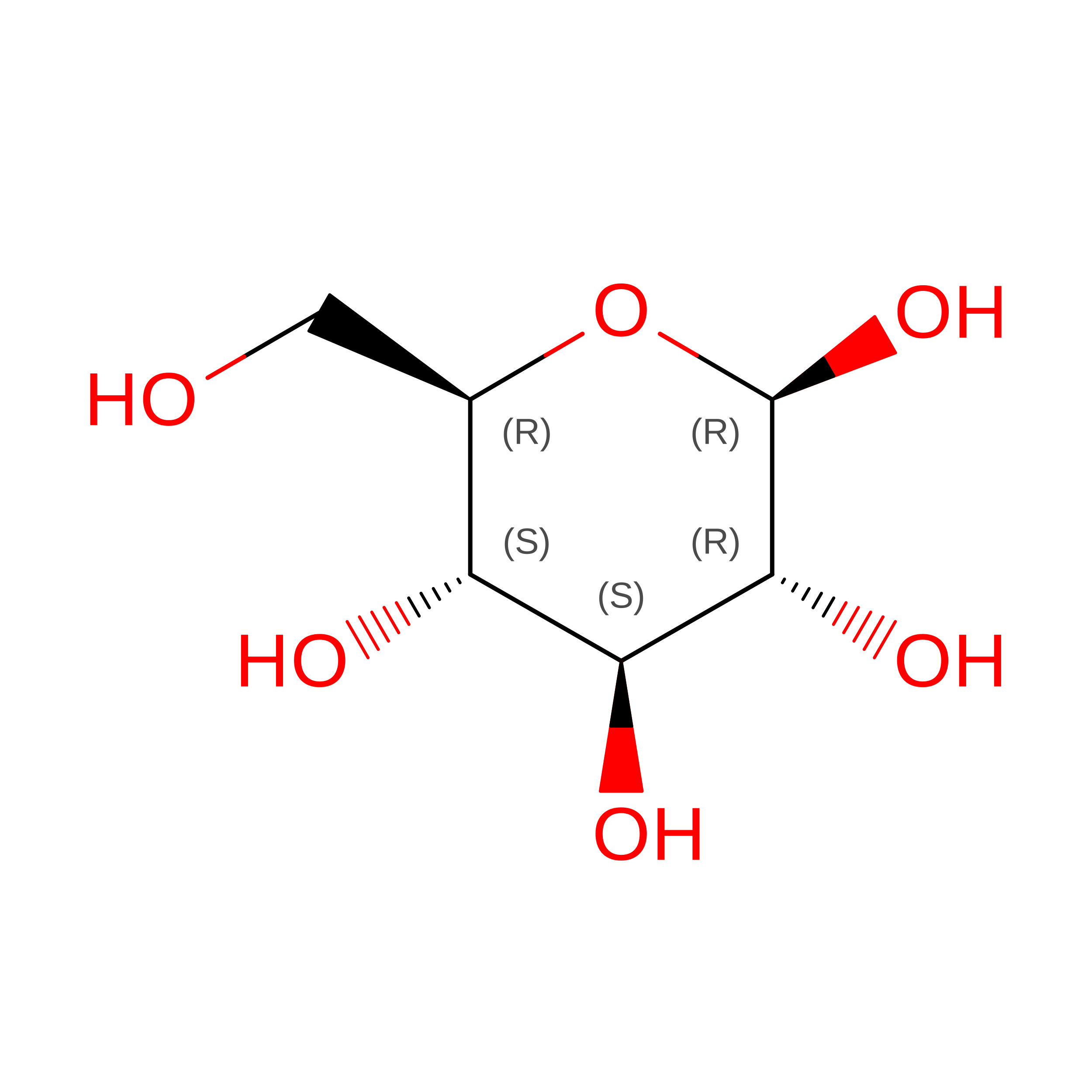
F [auth A]beta-D-glucopyranose
C6 H12 O6
WQZGKKKJIJFFOK-VFUOTHLCSA-N
GLC

Query on GLC


Download:Ideal Coordinates CCD File
E [auth A]alpha-D-glucopyranose
C6 H12 O6
WQZGKKKJIJFFOK-DVKNGEFBSA-N
MPD

Query on MPD


Download:Ideal Coordinates CCD File
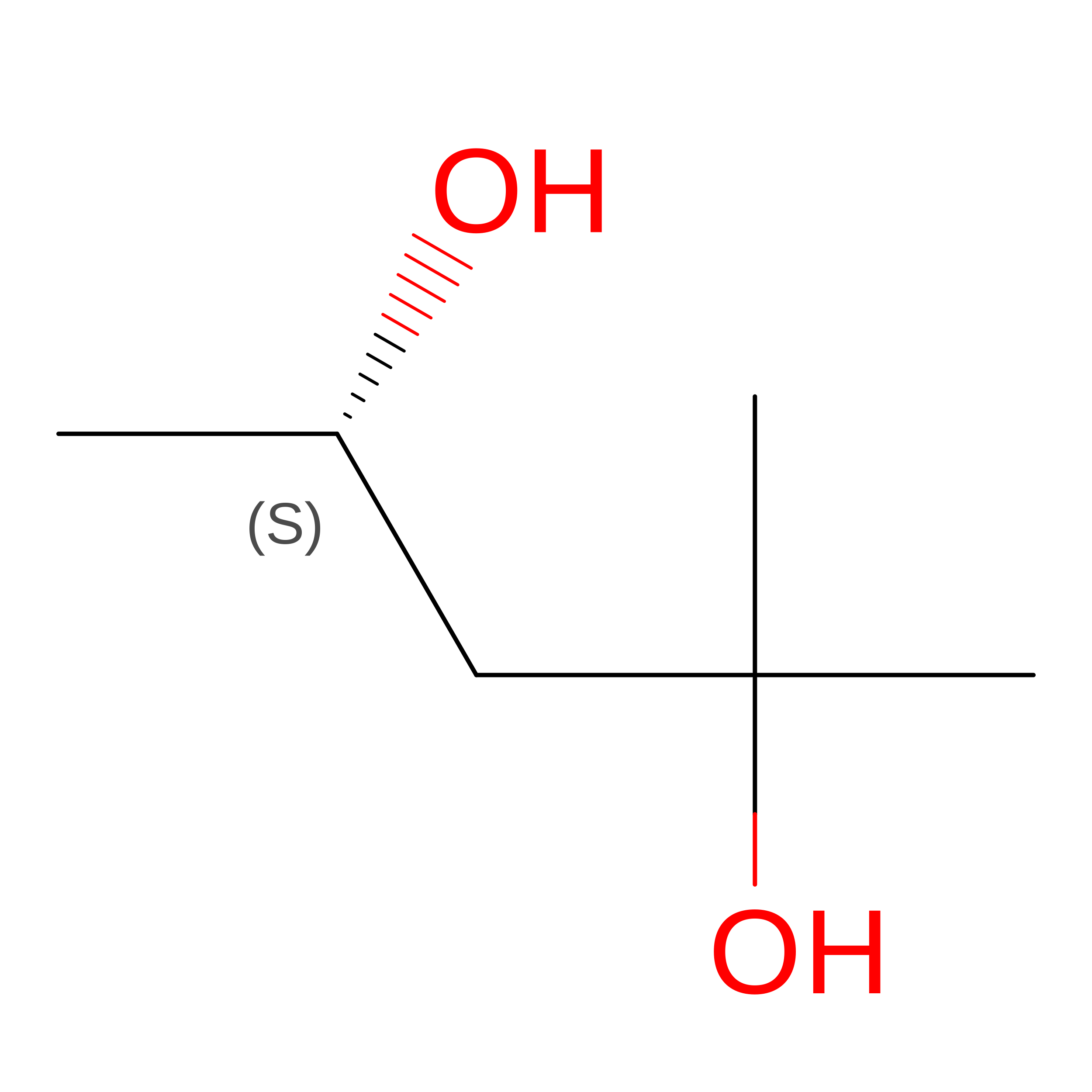
J [auth A](4S)-2-METHYL-2,4-PENTANEDIOL
C6 H14 O2
SVTBMSDMJJWYQN-YFKPBYRVSA-N
CA

Query on CA


Download:Ideal Coordinates CCD File
G [auth A],
H [auth A],
I [auth A]
CALCIUM ION
Ca
BHPQYMZQTOCNFJ-UHFFFAOYSA-N

Biologically Interesting Molecules (External Reference) 

1 Unique

Experimental Data & Validation

Experimental Data

  • Method: X-RAY DIFFRACTION
  • Resolution: 2.60 Å
  • R-Value Free:  0.190 (Depositor), 0.186 (DCC) 
  • R-Value Work:  0.150 (Depositor), 0.145 (DCC) 
  • R-Value Observed: 0.154 (Depositor) 
Space Group: C 1 2 1
Unit Cell:
Length ( Å )Angle ( ˚ )
a = 120.885α = 90
b = 50.698β = 103.43
c = 108.007γ = 90
Software Package:
Software NamePurpose
MOSFLMdata reduction
SCALAdata scaling
CNSrefinement
CCP4data scaling
CNSphasing

Structure Validation

View Full Validation Report


Ligand Structure Quality Assessment 


Entry History 

Deposition Data

Revision History  (Full details and data files)

  • Version 1.0: 2006-07-11
    Type: Initial release
  • Version 1.1: 2008-04-30
    Changes: Version format compliance
  • Version 1.2: 2011-07-13
    Changes: Version format compliance
  • Version 2.0: 2020-07-29
    Type: Remediation
    Reason: Carbohydrate remediation
    Changes: Atomic model, Data collection, Derived calculations, Structure summary
  • Version 2.1: 2021-11-10
    Changes: Database references, Structure summary
  • Version 2.2: 2024-05-29
    Changes: Data collection