2COL | pdb_00002col

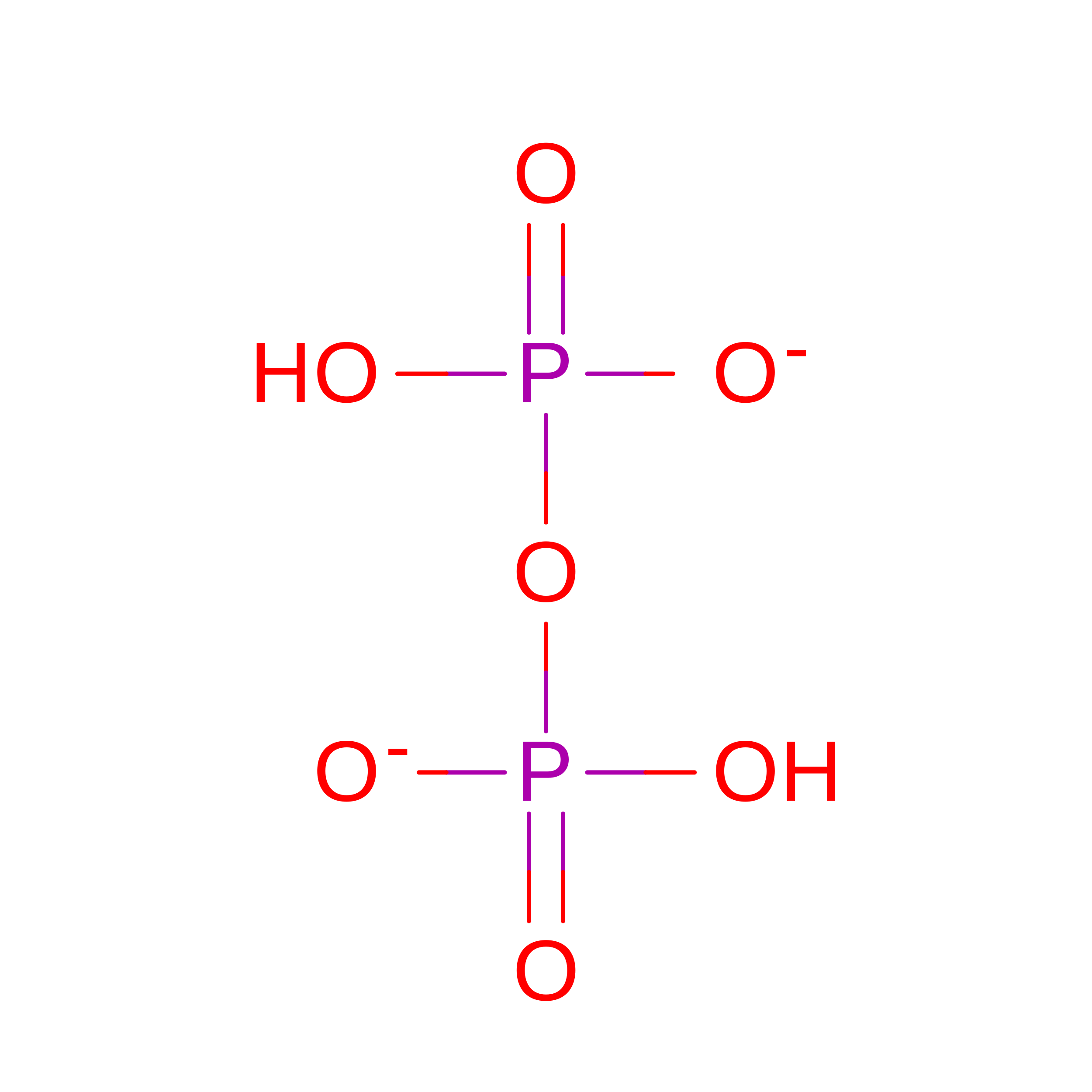
Crystal structure analysis of CyaA/C-Cam with Pyrophosphate


Experimental Data Snapshot

  • Method: X-RAY DIFFRACTION
  • Resolution: 2.20 Å
  • R-Value Free: 
    0.293 (Depositor), 0.293 (DCC) 
  • R-Value Work: 
    0.240 (Depositor), 0.296 (DCC) 
  • R-Value Observed: 
    0.247 (Depositor) 

wwPDB Validation 3D Report Full Report

Validation slider image for 2COL

This is version 1.3 of the entry. See complete history

Literature

Structural basis for the interaction of Bordetella pertussis adenylyl cyclase toxin with calmodulin

Guo, Q.Shen, Y.Lee, Y.S.Gibbs, C.S.Mrksich, M.Tang, W.J.

(2005) EMBO J 24: 3190-3201

  • DOI: https://doi.org/10.1038/sj.emboj.7600800
  • Primary Citation Related Structures: 
    1YRT, 1YRU, 1ZOT, 2COL

  • PubMed Abstract: 

    CyaA is crucial for colonization by Bordetella pertussis, the etiologic agent of whooping cough. Here we report crystal structures of the adenylyl cyclase domain (ACD) of CyaA with the C-terminal domain of calmodulin. Four discrete regions of CyaA bind calcium-loaded calmodulin with a large buried contact surface. Of those, a tryptophan residue (W242) at an alpha-helix of CyaA makes extensive contacts with the calcium-induced, hydrophobic pocket of calmodulin. Mutagenic analyses show that all four regions of CyaA contribute to calmodulin binding and the calmodulin-induced conformational change of CyaA is crucial for catalytic activation. A crystal structure of CyaA-calmodulin with adefovir diphosphate, the metabolite of an approved antiviral drug, reveals the location of catalytic site of CyaA and how adefovir diphosphate tightly binds CyaA. The ACD of CyaA shares a similar structure and mechanism of activation with anthrax edema factor (EF). However, the interactions of CyaA with calmodulin completely diverge from those of EF. This provides molecular details of how two structurally homologous bacterial toxins evolved divergently to bind calmodulin, an evolutionarily conserved calcium sensor.


  • Organizational Affiliation
    • Ben-May Institute for Cancer Research, The University of Chicago, Chicago, IL 60637, USA.

Macromolecule Content 

  • Total Structure Weight: 46.61 kDa 
  • Atom Count: 3,345 
  • Modeled Residue Count: 416 
  • Deposited Residue Count: 423 
  • Unique protein chains: 2

Macromolecules

Find similar proteins by:|  3D Structure
Entity ID: 1
MoleculeChains  Sequence LengthOrganismDetailsImage
Bifunctional hemolysin-adenylate cyclase356Bordetella pertussisMutation(s): 0 
EC: 4.6.1.1
UniProt
Find proteins for P0DKX7 (Bordetella pertussis (strain Tohama I / ATCC BAA-589 / NCTC 13251))
Explore P0DKX7 
Go to UniProtKB:  P0DKX7
Entity Groups
Sequence Clusters30% Identity50% Identity70% Identity90% Identity95% Identity100% Identity
UniProt GroupP0DKX7
Sequence Annotations
Expand
Reference Sequence
Find similar proteins by:|  3D Structure
Entity ID: 2
MoleculeChains  Sequence LengthOrganismDetailsImage
Calmodulin67Xenopus laevisMutation(s): 0 
UniProt
Find proteins for P0DP33 (Xenopus laevis)
Explore P0DP33 
Go to UniProtKB:  P0DP33
Entity Groups
Sequence Clusters30% Identity50% Identity70% Identity90% Identity95% Identity100% Identity
UniProt GroupP0DP33
Sequence Annotations
Expand
Reference Sequence

Experimental Data & Validation

Experimental Data

  • Method: X-RAY DIFFRACTION
  • Resolution: 2.20 Å
  • R-Value Free:  0.293 (Depositor), 0.293 (DCC) 
  • R-Value Work:  0.240 (Depositor), 0.296 (DCC) 
  • R-Value Observed: 0.247 (Depositor) 
Space Group: P 41 21 2
Unit Cell:
Length ( Å )Angle ( ˚ )
a = 79.613α = 90
b = 79.613β = 90
c = 139.465γ = 90
Software Package:
Software NamePurpose
HKL-2000data collection
SCALEPACKdata scaling
CNSrefinement
HKL-2000data reduction
CNSphasing

Structure Validation

View Full Validation Report


Entry History 

Deposition Data

Revision History  (Full details and data files)

  • Version 1.0: 2006-01-24
    Type: Initial release
  • Version 1.1: 2008-04-30
    Changes: Version format compliance
  • Version 1.2: 2011-07-13
    Changes: Version format compliance
  • Version 1.3: 2024-03-13
    Changes: Data collection, Database references, Derived calculations