2CF9 | pdb_00002cf9

Complex of recombinant human thrombin with an inhibitor


Experimental Data Snapshot

  • Method: X-RAY DIFFRACTION
  • Resolution: 1.79 Å
  • R-Value Free: 
    0.198 (Depositor), 0.198 (DCC) 
  • R-Value Work: 
    0.160 (Depositor), 0.160 (DCC) 
  • R-Value Observed: 
    0.162 (Depositor) 

Starting Model: experimental
View more details

wwPDB Validation 3D Report Full Report

Validation slider image for 2CF9

Ligand Structure Quality Assessment 


This is version 1.7 of the entry. See complete history

Literature

Multipolar Interactions in the D Pocket of Thrombin: Large Differences between Tricyclic Imide and Lactam Inhibitors.

Schweizer, E.Hoffmann-Roeder, A.Olsen, J.A.Seiler, P.Obst-Sander, U.Wagner, B.Kansy, M.Banner, D.W.Diederich, F.

(2006) Org Biomol Chem 4: 2364

  • DOI: https://doi.org/10.1039/b602585d
  • Primary Citation Related Structures: 
    2CF8, 2CF9

  • PubMed Abstract: 

    Two series of tricyclic inhibitors of the serine protease thrombin, imides (+/-)-1-(+/-)-8 and lactams (+/-)-9-(+/-)-13, were analysed to evaluate contributions of orthogonal multipolar interactions with the backbone C=O moiety of Asn98 to the free enthalpy of protein-ligand complexation. The lactam derivatives are much more potent and more selective inhibitors (K(i) values between 0.065 and 0.005 microM, selectivity for thrombin over trypsin between 361- and 1609-fold) than the imide compounds (Ki values between 0.057 and 23.7 microM, selectivity for thrombin over trypsin between 3- and 67-fold). The increase in potency and selectivity is explained by the favorable occupancy of the P-pocket of thrombin by the additional isopropyl substituent in the lactam derivatives. The nature of the substituent on the benzyl ring filling the D pocket strongly influences binding potency in the imide series, with Ki values increasing in the sequence: F < OCH2O < Cl < H < OMe < OH < N(pyr)<< Br. This sequence can be explained by both steric fit and the occurrence of orthogonal multipolar interactions with the backbone C[double bond, length as m-dash]O moiety of Asn98. In contrast, the substituent on the benzyl ring hardly affects the ligand potency in the lactam series. This discrepancy was clarified by the comparison of X-ray structures solved for co-crystals of thrombin with imide and lactam ligands. Whereas the benzyl substituents in the imide inhibitors are sufficiently close (< or =3.5 Angstroms) to the C=O group of Asn98 to allow for attractive orthogonal multipolar interactions, the distances in the lactam series are too large (> or =4 Angstroms) for attractive dipolar contacts to be effective.


  • Organizational Affiliation
    • Laboratorium für Organische Chemie, ETH-Zürich, Hönggerberg HCI, Switzerland.

Macromolecule Content 

  • Total Structure Weight: 34.8 kDa 
  • Atom Count: 2,830 
  • Modeled Residue Count: 284 
  • Deposited Residue Count: 296 
  • Unique protein chains: 3

Macromolecules

Find similar proteins by:|  3D Structure
Entity ID: 1
MoleculeChains  Sequence LengthOrganismDetailsImage
THROMBIN HEAVY CHAINA [auth H]257Homo sapiensMutation(s): 0 
EC: 3.4.21.5
UniProt & NIH Common Fund Data Resources
Find proteins for P00734 (Homo sapiens)
Explore P00734 
Go to UniProtKB:  P00734
PHAROS:  P00734
GTEx:  ENSG00000180210 
Entity Groups
Sequence Clusters30% Identity50% Identity70% Identity90% Identity95% Identity100% Identity
UniProt GroupP00734
Sequence Annotations
Expand
Reference Sequence
Find similar proteins by:  Sequence   |   3D Structure  
Entity ID: 2
MoleculeChains  Sequence LengthOrganismDetailsImage
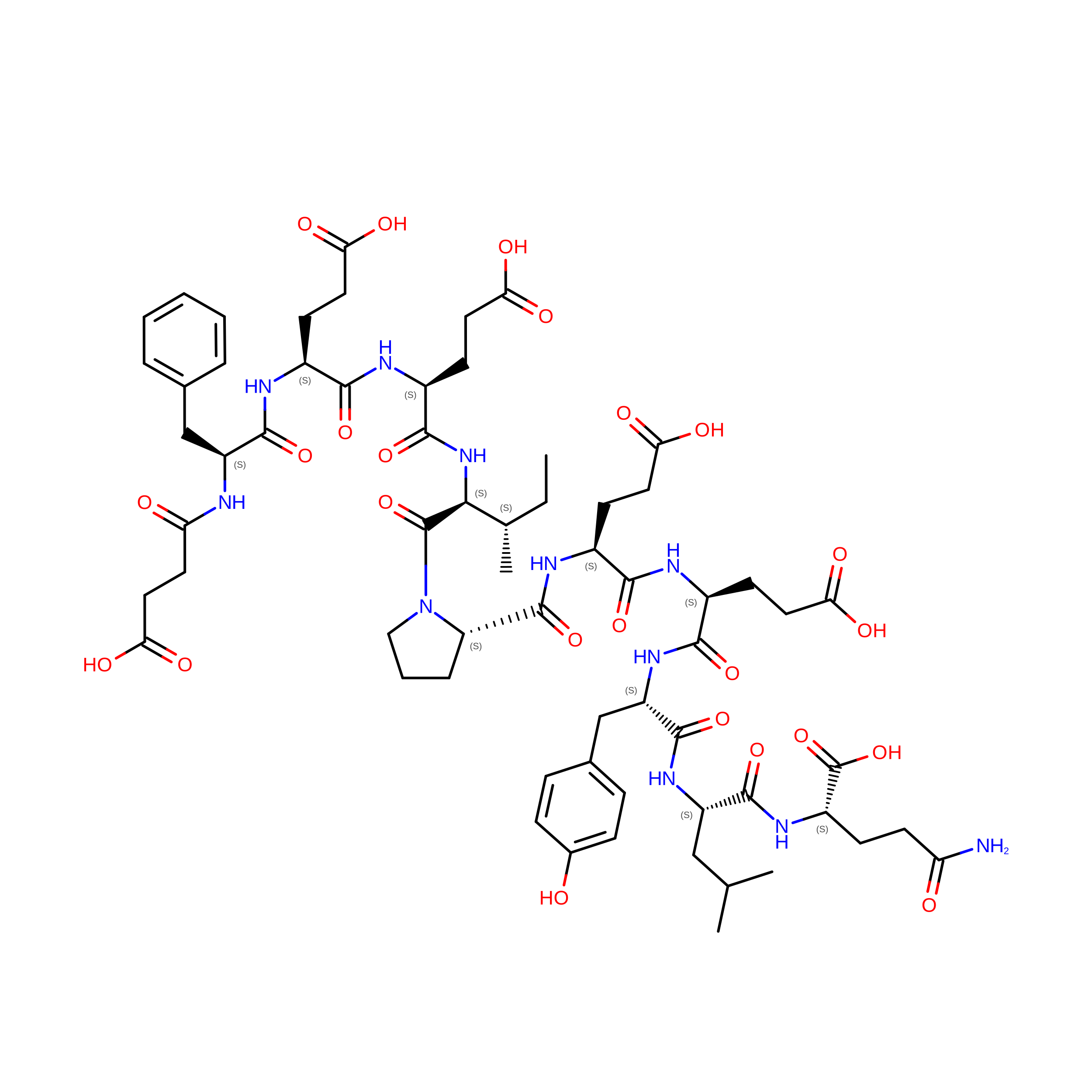
HIRUDIN IIIAB [auth I]11Hirudo medicinalisMutation(s): 0 
UniProt
Find proteins for P28508 (Hirudo medicinalis)
Explore P28508 
Go to UniProtKB:  P28508
Entity Groups
Sequence Clusters30% Identity50% Identity70% Identity90% Identity95% Identity100% Identity
UniProt GroupP28508
Sequence Annotations
Expand
Reference Sequence
Find similar proteins by:|  3D Structure
Entity ID: 3
MoleculeChains  Sequence LengthOrganismDetailsImage
THROMBIN LIGHT CHAINC [auth L]28Homo sapiensMutation(s): 0 
EC: 3.4.21.5
UniProt & NIH Common Fund Data Resources
Find proteins for P00734 (Homo sapiens)
Explore P00734 
Go to UniProtKB:  P00734
PHAROS:  P00734
GTEx:  ENSG00000180210 
Entity Groups
Sequence Clusters30% Identity50% Identity70% Identity90% Identity95% Identity100% Identity
UniProt GroupP00734
Sequence Annotations
Expand
Reference Sequence

Small Molecules

Ligands 3 Unique
IDChains Name / Formula / InChI Key2D Diagram3D Interactions
348

Query on 348


Download:Ideal Coordinates CCD File
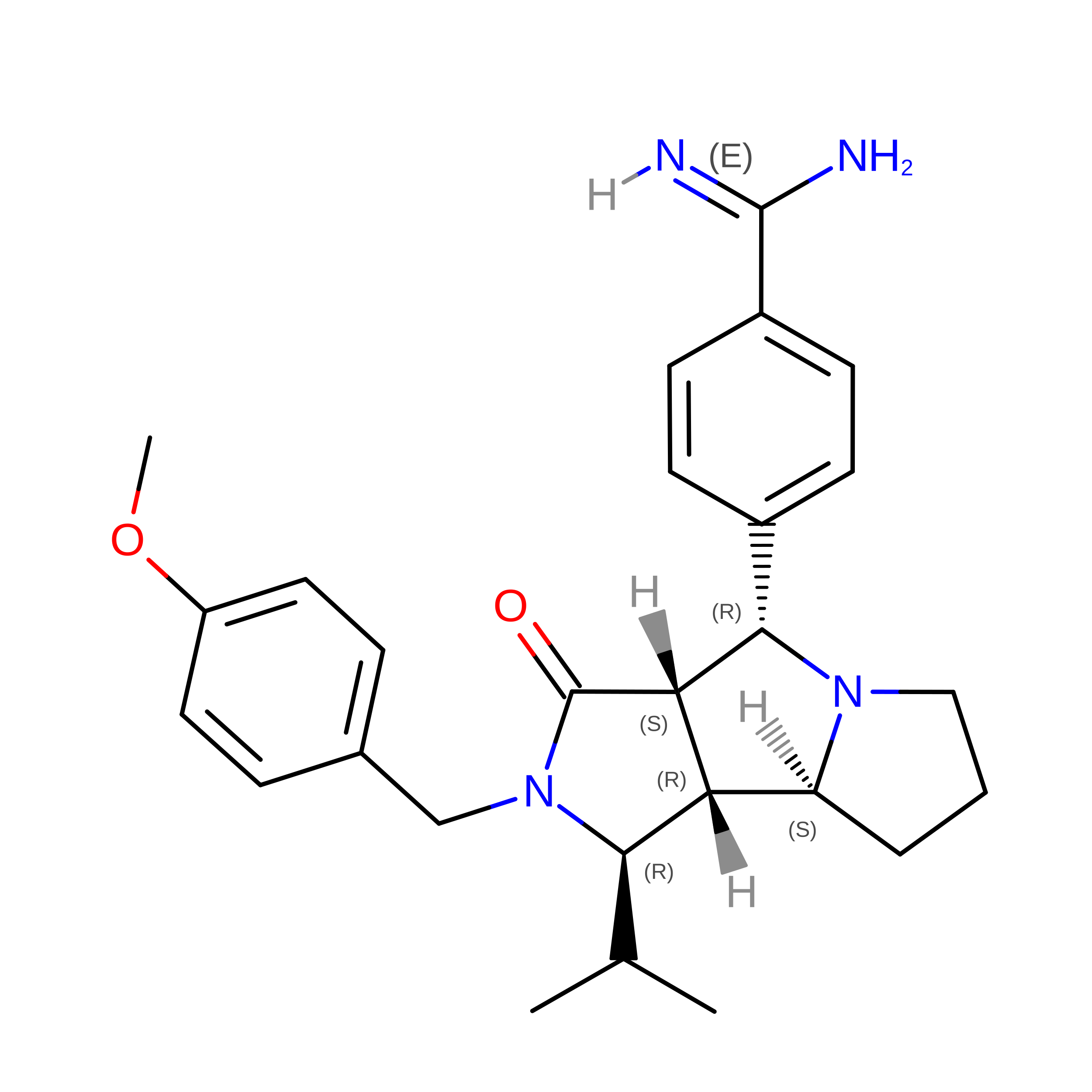
D [auth H]4-[(1R,3AS,4R,8AS,8BR)-1-ISOPROPYL-2-(4-METHOXYBENZYL)-3-OXODECAHYDROPYRROLO[3,4-A]PYRROLIZIN-4-YL]BENZENECARBOXIMIDAMIDE
C27 H34 N4 O2
XETNTDPUFDNJKX-BDUWWWMKSA-N
CA

Query on CA


Download:Ideal Coordinates CCD File
F [auth H]CALCIUM ION
Ca
BHPQYMZQTOCNFJ-UHFFFAOYSA-N
NA

Query on NA


Download:Ideal Coordinates CCD File
E [auth H]SODIUM ION
Na
FKNQFGJONOIPTF-UHFFFAOYSA-N

Biologically Interesting Molecules (External Reference) 

1 Unique

Experimental Data & Validation

Experimental Data

  • Method: X-RAY DIFFRACTION
  • Resolution: 1.79 Å
  • R-Value Free:  0.198 (Depositor), 0.198 (DCC) 
  • R-Value Work:  0.160 (Depositor), 0.160 (DCC) 
  • R-Value Observed: 0.162 (Depositor) 
Space Group: C 1 2 1
Unit Cell:
Length ( Å )Angle ( ˚ )
a = 71.29α = 90
b = 71.84β = 100.56
c = 73.06γ = 90
Software Package:
Software NamePurpose
REFMACrefinement
XDSdata reduction
XDSdata scaling

Structure Validation

View Full Validation Report


Ligand Structure Quality Assessment 


Entry History 

Deposition Data

Revision History  (Full details and data files)

  • Version 1.0: 2006-06-14
    Type: Initial release
  • Version 1.1: 2011-07-13
    Changes: Advisory, Atomic model, Database references, Derived calculations, Non-polymer description, Structure summary, Version format compliance
  • Version 1.2: 2012-11-30
    Changes: Other
  • Version 1.3: 2013-08-07
    Changes: Derived calculations, Other
  • Version 1.4: 2013-10-23
    Changes: Other
  • Version 1.5: 2017-03-29
    Changes: Structure summary
  • Version 1.6: 2017-07-05
    Changes: Data collection
  • Version 1.7: 2023-12-13
    Changes: Data collection, Database references, Derived calculations, Other, Refinement description