2CE0 | pdb_00002ce0

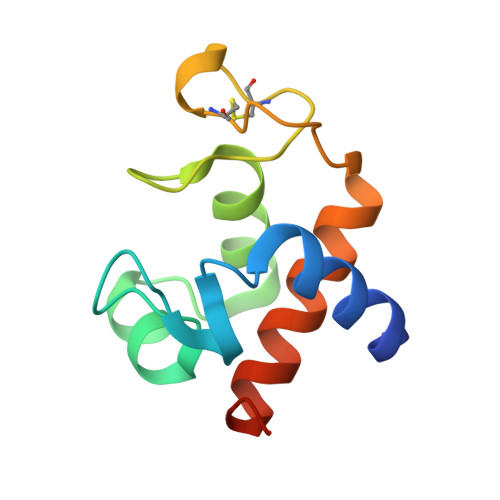
Structure of oxidized Arabidopsis thaliana cytochrome 6A


Experimental Data Snapshot

  • Method: X-RAY DIFFRACTION
  • Resolution: 1.24 Å
  • R-Value Free: 
    0.212 (Depositor), 0.210 (DCC) 
  • R-Value Work: 
    0.182 (Depositor), 0.182 (DCC) 
  • R-Value Observed: 
    0.184 (Depositor) 

Starting Model: experimental
View more details

wwPDB Validation 3D Report Full Report

Validation slider image for 2CE0

Ligand Structure Quality Assessment 


This is version 1.4 of the entry. See complete history

Literature

Structure of Cytochrome C(6A), a Novel Dithio-Cytochrome of Arabidopsis Thaliana, and its Reactivity with Plastocyanin: Implications for Function.

Marcaida, M.J.Schlarb-Ridley, B.G.Worrall, J.A.R.Wastl, J.Evans, T.J.Bendall, D.S.Luisi, B.F.Howe, C.J.

(2006) J Mol Biology 360: 968

  • DOI: https://doi.org/10.1016/j.jmb.2006.05.065
  • Primary Citation Related Structures: 
    2CE0, 2CE1

  • PubMed Abstract: 

    Cytochrome c6A is a unique dithio-cytochrome present in land plants and some green algae. Its sequence and occurrence in the thylakoid lumen suggest that it is derived from cytochrome c6, which functions in photosynthetic electron transfer between the cytochrome b6f complex and photosystem I. Its known properties, however, and a strong indication that the disulfide group is not purely structural, indicate that it has a different, unidentified function. To help in the elucidation of this function the crystal structure of cytochrome c6A from Arabidopsis thaliana has been determined in the two redox states of the heme group, at resolutions of 1.2 A (ferric) and 1.4 A (ferrous). These two structures were virtually identical, leading to the functionally important conclusion that the heme and disulfide groups do not communicate by conformational change. They also show, however, that electron transfer between the reduced disulfide and the heme is feasible. We therefore suggest that the role of cytochrome c6A is to use its disulfide group to oxidize dithiol/disulfide groups of other proteins of the thylakoid lumen, followed by internal electron transfer from the dithiol to the heme, and re-oxidation of the heme by another thylakoid oxidant. Consistent with this model, we found a rapid electron transfer between ferro-cytochrome c6A and plastocyanin, with a second-order rate constant, k2=1.2 x 10(7) M(-1) s(-1).


  • Organizational Affiliation
    • Department of Biochemistry, University of Cambridge, Tennis Court Road, Cambridge CB2 1QW, UK.

Macromolecule Content 

  • Total Structure Weight: 12.31 kDa 
  • Atom Count: 1,002 
  • Modeled Residue Count: 99 
  • Deposited Residue Count: 105 
  • Unique protein chains: 1

Macromolecules

Find similar proteins by:|  3D Structure
Entity ID: 1
MoleculeChains  Sequence LengthOrganismDetailsImage
CYTOCHROME C6105Arabidopsis thalianaMutation(s): 2 
UniProt
Find proteins for Q93VA3 (Arabidopsis thaliana)
Explore Q93VA3 
Go to UniProtKB:  Q93VA3
Entity Groups
Sequence Clusters30% Identity50% Identity70% Identity90% Identity95% Identity100% Identity
UniProt GroupQ93VA3
Sequence Annotations
Expand
Reference Sequence

Small Molecules

Ligands 1 Unique
IDChains Name / Formula / InChI Key2D Diagram3D Interactions
HEC

Query on HEC


Download:Ideal Coordinates CCD File
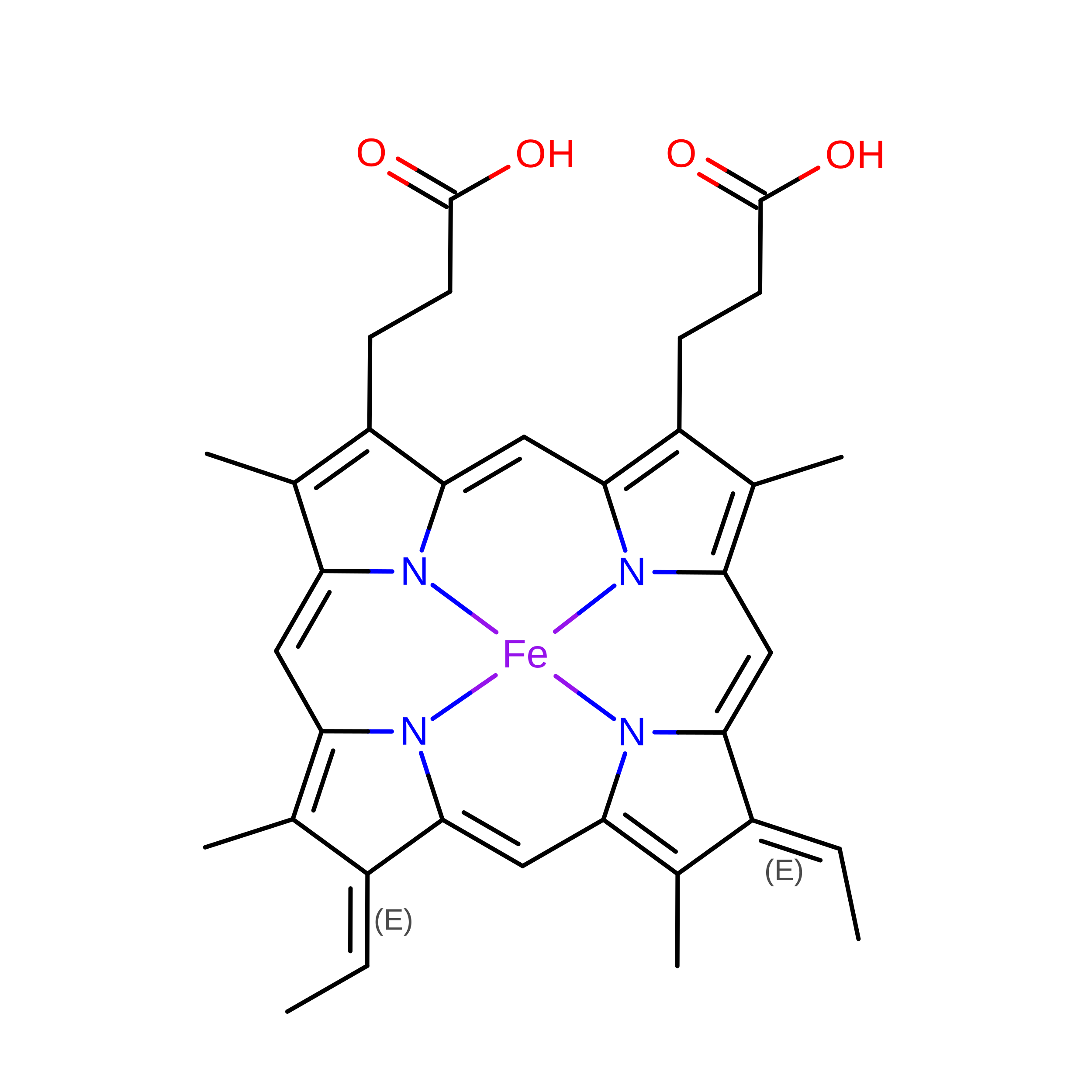
B [auth A]HEME C
C34 H34 Fe N4 O4
HXQIYSLZKNYNMH-LJNAALQVSA-N

Experimental Data & Validation

Experimental Data

  • Method: X-RAY DIFFRACTION
  • Resolution: 1.24 Å
  • R-Value Free:  0.212 (Depositor), 0.210 (DCC) 
  • R-Value Work:  0.182 (Depositor), 0.182 (DCC) 
  • R-Value Observed: 0.184 (Depositor) 
Space Group: P 32 2 1
Unit Cell:
Length ( Å )Angle ( ˚ )
a = 58.209α = 90
b = 58.209β = 90
c = 64.761γ = 120
Software Package:
Software NamePurpose
REFMACrefinement
DENZOdata reduction
SCALEPACKdata scaling
PHASERphasing

Structure Validation

View Full Validation Report


Ligand Structure Quality Assessment 


Entry History 

Deposition Data

Revision History  (Full details and data files)

  • Version 1.0: 2006-07-05
    Type: Initial release
  • Version 1.1: 2011-05-08
    Changes: Version format compliance
  • Version 1.2: 2011-07-13
    Changes: Version format compliance
  • Version 1.3: 2023-12-13
    Changes: Data collection, Database references, Derived calculations, Other, Refinement description
  • Version 1.4: 2024-11-06
    Changes: Structure summary