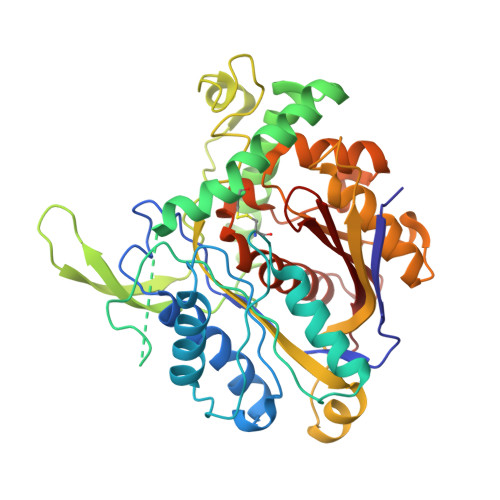
2C7Z | pdb_00002c7z

Plant enzyme crystal form II


Experimental Data Snapshot

  • Method: X-RAY DIFFRACTION
  • Resolution: 2.37 Å
  • R-Value Free: 
    0.276 (Depositor), 0.278 (DCC) 
  • R-Value Work: 
    0.198 (Depositor), 0.198 (DCC) 
  • R-Value Observed: 
    0.202 (Depositor) 

Starting Model: experimental
View more details

wwPDB Validation 3D Report Full Report

Validation slider image for 2C7Z

This is version 1.3 of the entry. See complete history

Literature

The Crystal Structure of a Plant 3-Ketoacyl-Coa Thiolase Reveals the Potential for Redox Control of Peroxisomal Fatty Acid Beta-Oxidation.

Sundaramoorthy, R.Micossi, E.Alphey, M.S.Germain, V.Bryce, J.H.Smith, S.M.Leonard, G.A.Hunter, W.N.

(2006) J Mol Biology 359: 347

  • DOI: https://doi.org/10.1016/j.jmb.2006.03.032
  • Primary Citation Related Structures: 
    2C7Y, 2C7Z

  • PubMed Abstract: 

    Crystal structures of peroxisomal Arabidopsis thaliana 3-ketoacyl-CoA thiolase (AtKAT), an enzyme of fatty acid beta-oxidation, are reported. The subunit, a typical thiolase, is a combination of two similar alpha/beta domains capped with a loop domain. The comparison of AtKAT with the Saccharomyces cerevisiae homologue (ScKAT) structure reveals a different placement of subunits within the functional dimers and that a polypeptide segment forming an extended loop around the open catalytic pocket of ScKAT converts to alpha-helix in AtKAT, and occludes the active site. A disulfide is formed between Cys192, on this helix, and Cys138, a catalytic residue. Access to Cys138 is determined by the structure of this polypeptide segment. AtKAT represents an oxidized, previously unknown inactive form, whilst ScKAT is the reduced and active enzyme. A high level of sequence conservation is observed, including Cys192, in eukaryotic peroxisomal, but not mitochondrial or prokaryotic KAT sequences, for this labile loop/helix segment. This indicates that KAT activity in peroxisomes is influenced by a disulfide/dithiol change linking fatty acid beta-oxidation with redox regulation.


  • Organizational Affiliation
    • Division of Biological Chemistry and Molecular Microbiology, School of Life Sciences, University of Dundee, Dundee DD1 5EH, UK.

Macromolecule Content 

  • Total Structure Weight: 42.27 kDa 
  • Atom Count: 3,002 
  • Modeled Residue Count: 396 
  • Deposited Residue Count: 404 
  • Unique protein chains: 1

Macromolecules

Find similar proteins by:|  3D Structure
Entity ID: 1
MoleculeChains  Sequence LengthOrganismDetailsImage
3-KETOACYL-COA THIOLASE 2404Arabidopsis thalianaMutation(s): 0 
EC: 2.3.1.16
UniProt
Find proteins for Q56WD9 (Arabidopsis thaliana)
Explore Q56WD9 
Go to UniProtKB:  Q56WD9
Entity Groups
Sequence Clusters30% Identity50% Identity70% Identity90% Identity95% Identity100% Identity
UniProt GroupQ56WD9
Sequence Annotations
Expand
Reference Sequence

Experimental Data & Validation

Experimental Data

  • Method: X-RAY DIFFRACTION
  • Resolution: 2.37 Å
  • R-Value Free:  0.276 (Depositor), 0.278 (DCC) 
  • R-Value Work:  0.198 (Depositor), 0.198 (DCC) 
  • R-Value Observed: 0.202 (Depositor) 
Space Group: P 21 21 2
Unit Cell:
Length ( Å )Angle ( ˚ )
a = 73.395α = 90
b = 95.821β = 90
c = 56.125γ = 90
Software Package:
Software NamePurpose
REFMACrefinement
DENZOdata reduction
SCALEPACKdata scaling
AMoREphasing

Structure Validation

View Full Validation Report


Entry History 

Deposition Data

Revision History  (Full details and data files)

  • Version 1.0: 2006-05-17
    Type: Initial release
  • Version 1.1: 2011-07-13
    Changes: Advisory, Version format compliance
  • Version 1.2: 2023-12-13
    Changes: Data collection, Database references, Other, Refinement description
  • Version 1.3: 2024-11-06
    Changes: Structure summary