2BQY | pdb_00002bqy

Inorganic Pyrophosphatase from the Pathogenic Bacterium Helicobacter pylori-Kinetic and Structural Properties


Experimental Data Snapshot

  • Method: X-RAY DIFFRACTION
  • Resolution: 2.30 Å
  • R-Value Free: 
    0.288 (Depositor), 0.290 (DCC) 
  • R-Value Work: 
    0.250 (Depositor), 0.251 (DCC) 
  • R-Value Observed: 
    0.250 (Depositor) 

wwPDB Validation 3D Report Full Report

Validation slider image for 2BQY

This is version 1.3 of the entry. See complete history

Literature

Kinetic and Structural Properties of Inorganic Pyrophosphatase from the Pathogenic Bacterium Helicobacter Pylori.

Chao, T.-C.Huang, H.Tsai, J.Y.Huang, C.Y.Sun, Y.-J.

(2006) Proteins 65: 670

  • DOI: https://doi.org/10.1002/prot.21093
  • Primary Citation Related Structures: 
    2BQX, 2BQY

  • PubMed Abstract: 

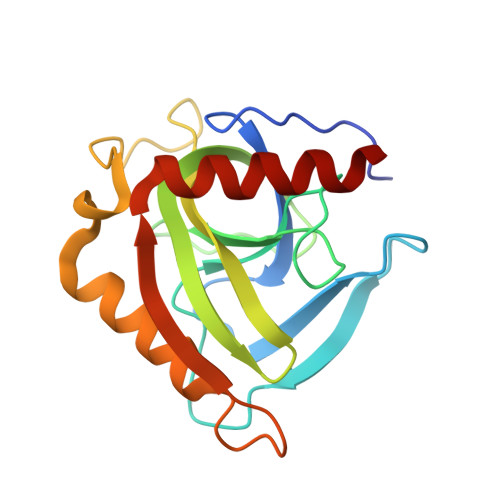
    Inorganic pyrophosphatase (PPase) catalyzes the hydrolysis of pyrophosphate (PPi) to orthophosphate (Pi) and controls the level of PPi in cells. PPase plays an essential role in energy conservation and provides the energy for many biosynthetic pathways. The Helicobacter pylori pyrophosphatase (HpPPase) gene was cloned, expressed, purified, and found to have a molecular weight of 20 kDa. The K(m) and V (max) of HpPPase were determined as 214.4 microM and 594 micromol Pi min(-1) mg(-1), respectively. PPi binds Mg(2+) to form a true substrate that activates the enzyme. However, free PPi could be a potent inhibitor for HpPPase. The effects of the inhibitors NaF, ATP, iminodiphosphate, and N-ethylmaleimide on HpPPase activity were evaluated. NaF showed the highest inhibition of the enzyme. Crystal structures of HpPPase and the PPi-HpPPase complex were determined. HpPPase comprises three alpha-helices and nine beta-strands and folds as a barrel structure. HpPPase forms a hexamer in both the solution and crystal states, and each monomer has its own PPi-binding site. The PPi binding does not cause a significant conformational change in the PPi-HpPPase complex, which might represent an inhibition state for HpPPase in the absence of a divalent metal ion.


  • Organizational Affiliation
    • Institute of Bioinformatics and Structural Biology, National Tsing Hua University, Hsinchu 300, Taiwan, Republic of China.

Macromolecule Content 

  • Total Structure Weight: 19.47 kDa 
  • Atom Count: 1,432 
  • Modeled Residue Count: 170 
  • Deposited Residue Count: 173 
  • Unique protein chains: 1

Macromolecules

Find similar proteins by:|  3D Structure
Entity ID: 1
MoleculeChains  Sequence LengthOrganismDetailsImage
INORGANIC PYROPHOSPHATASE173Helicobacter pylori 26695Mutation(s): 0 
EC: 3.6.1.1
UniProt
Find proteins for P56153 (Helicobacter pylori (strain ATCC 700392 / 26695))
Explore P56153 
Go to UniProtKB:  P56153
Entity Groups
Sequence Clusters30% Identity50% Identity70% Identity90% Identity95% Identity100% Identity
UniProt GroupP56153
Sequence Annotations
Expand
Reference Sequence

Small Molecules

Ligands 1 Unique
IDChains Name / Formula / InChI Key2D Diagram3D Interactions
POP

Query on POP


Download:Ideal Coordinates CCD File
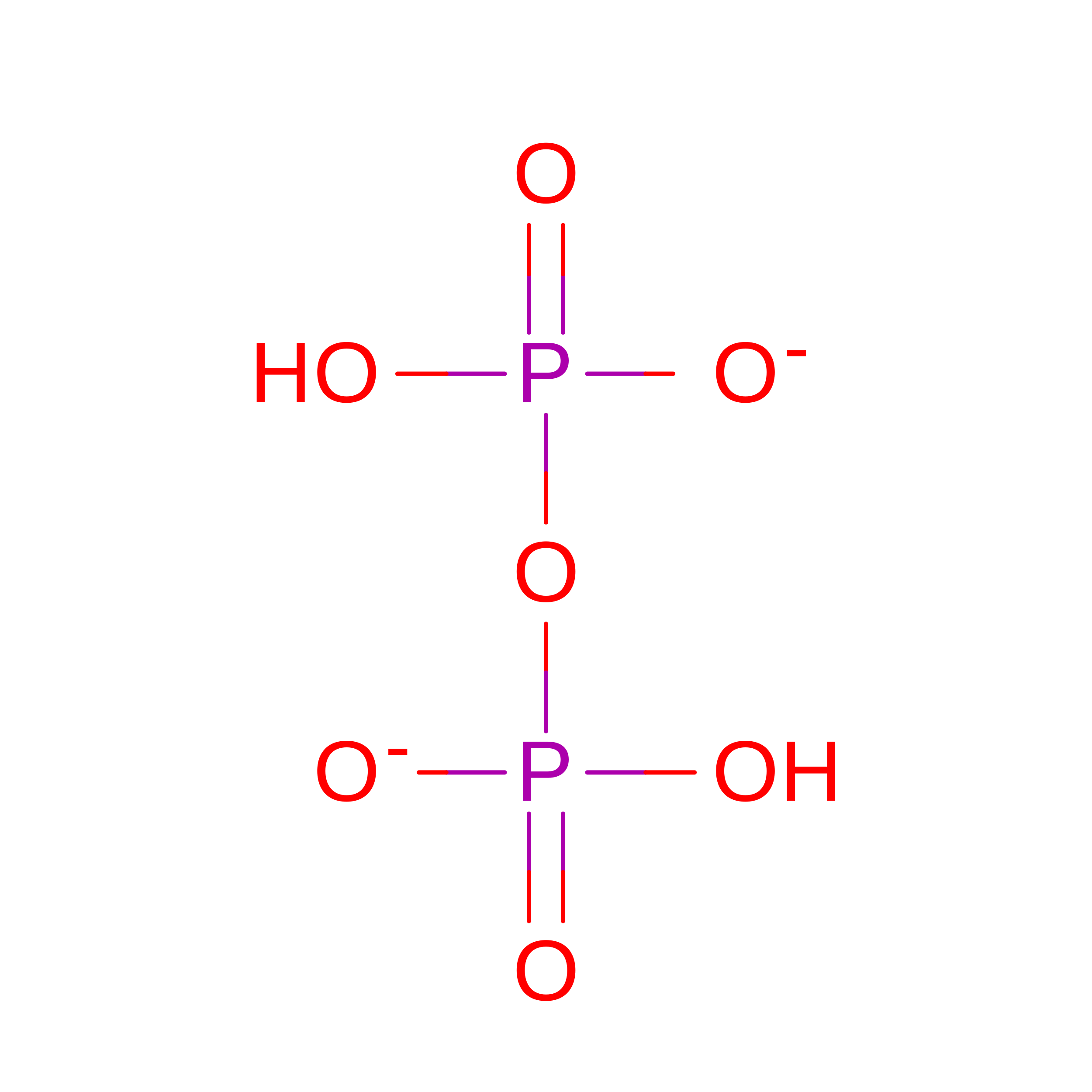
B [auth A]PYROPHOSPHATE 2-
H2 O7 P2
XPPKVPWEQAFLFU-UHFFFAOYSA-L

Experimental Data & Validation

Experimental Data

  • Method: X-RAY DIFFRACTION
  • Resolution: 2.30 Å
  • R-Value Free:  0.288 (Depositor), 0.290 (DCC) 
  • R-Value Work:  0.250 (Depositor), 0.251 (DCC) 
  • R-Value Observed: 0.250 (Depositor) 
Space Group: P 63 2 2
Unit Cell:
Length ( Å )Angle ( ˚ )
a = 101.5α = 90
b = 101.5β = 90
c = 93.95γ = 120
Software Package:
Software NamePurpose
CNSrefinement
HKL-2000data reduction
SCALEPACKdata scaling
AMoREphasing

Structure Validation

View Full Validation Report


Entry History 

Deposition Data

Revision History  (Full details and data files)

  • Version 1.0: 2006-10-18
    Type: Initial release
  • Version 1.1: 2011-05-08
    Changes: Version format compliance
  • Version 1.2: 2011-07-13
    Changes: Version format compliance
  • Version 1.3: 2024-05-08
    Changes: Data collection, Database references, Other