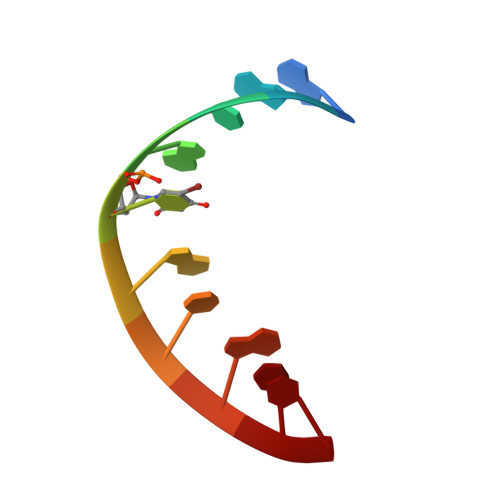
2AO5 | pdb_00002ao5

Crystal structure of an RNA duplex r(GGCGBrUGCGCU)2 with terminal and internal tandem G-U base pairs


Experimental Data Snapshot

  • Method: X-RAY DIFFRACTION
  • Resolution: 2.10 Å
  • R-Value Free: 
    0.250 (Depositor), 0.194 (DCC) 
  • R-Value Work: 
    0.207 (Depositor), 0.150 (DCC) 
  • R-Value Observed: 
    0.222 (Depositor) 

wwPDB Validation 3D Report Full Report

Validation slider image for 2AO5

This is version 1.3 of the entry. See complete history

Literature

Structure of an RNA duplex r(GGCGBrUGCGCU)2 with terminal and internal tandem G.U base pairs.

Utsunomiya, R.Suto, K.Balasundaresan, D.Fukamizu, A.Kumar, P.K.Mizuno, H.

(2006) Acta Crystallogr D Biol Crystallogr 62: 331-338

  • DOI: https://doi.org/10.1107/S0907444905043210
  • Primary Citation Related Structures: 
    2AO5

  • PubMed Abstract: 

    The crystal structure of a self-complementary RNA duplex r(GGCG(Br)UGCGCU)(2) with terminal G.U and internal tandem G.U base pairs has been determined at 2.1 Angstroms resolution. The crystals belong to the tetragonal space group P4(3), with unit-cell parameters a = b = 37.69, c = 96.28 Angstroms and two duplexes in the asymmetric unit. The two strands of each duplex are related by a pseudodyad axis. The structure was refined to final R(work) and R(free) values of 20.9 and 25.3%, respectively. The duplexes stack in an end-to-end manner, forming infinite columns along the c axis. This is the first structural study of an RNA duplex containing G.U pairs at the termini. The stacking overlaps of the terminal G.U base pairs with their adjacent Watson-Crick base pairs are larger than those of Watson-Crick base pairs of the 5'-YR-3'/3'-RY-5' type. The terminal G.U base pairs of neighbouring duplexes are also stacked with each other. An alternating underwound-overwound pattern of the twist angles is seen at each step along the duplex. This observation is typical for internal tandem G.U pairs, while the terminal G.U base pairs exhibit high twist angles with the adjacent Watson-Crick pairs. The 3'-side of U of the internal G.U base pair, which is unstacked, appears to be stabilized by pi-cation interaction with an Mg(2+) ion.


  • Organizational Affiliation
    • Institute of Applied Biochemistry, University of Tsukuba, Ibaraki, Japan.

Macromolecule Content 

  • Total Structure Weight: 13.18 kDa 
  • Atom Count: 1,103 
  • Modeled Residue Count: 40 
  • Deposited Residue Count: 40 
  • Unique nucleic acid chains: 1

Macromolecules

Find similar nucleic acids by:  Sequence
Entity ID: 1
MoleculeChains LengthOrganismImage
5'-R(*GP*GP*CP*GP*(5BU)P*GP*CP*GP*CP*U)-3'
A, B, C, D
10N/A
Sequence Annotations
Expand
Reference Sequence

Small Molecules

Ligands 1 Unique
IDChains Name / Formula / InChI Key2D Diagram3D Interactions
MG

Query on MG


Download:Ideal Coordinates CCD File
E [auth A]MAGNESIUM ION
Mg
JLVVSXFLKOJNIY-UHFFFAOYSA-N

Experimental Data & Validation

Experimental Data

  • Method: X-RAY DIFFRACTION
  • Resolution: 2.10 Å
  • R-Value Free:  0.250 (Depositor), 0.194 (DCC) 
  • R-Value Work:  0.207 (Depositor), 0.150 (DCC) 
  • R-Value Observed: 0.222 (Depositor) 
Space Group: P 43
Unit Cell:
Length ( Å )Angle ( ˚ )
a = 37.693α = 90
b = 37.693β = 90
c = 96.283γ = 90
Software Package:
Software NamePurpose
CNSrefinement
HKL-2000data reduction
SCALEPACKdata scaling
CNSphasing

Structure Validation

View Full Validation Report


Entry History 

Deposition Data

Revision History  (Full details and data files)

  • Version 1.0: 2006-03-28
    Type: Initial release
  • Version 1.1: 2008-04-30
    Changes: Version format compliance
  • Version 1.2: 2011-07-13
    Changes: Version format compliance
  • Version 1.3: 2024-03-13
    Changes: Data collection, Database references, Derived calculations