2AG6 | pdb_00002ag6

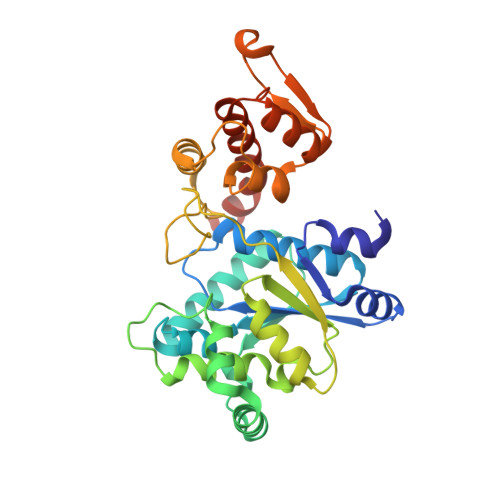
Crystal structure of p-bromo-l-phenylalanine-tRNA sythetase in complex with p-bromo-l-phenylalanine


Experimental Data Snapshot

  • Method: X-RAY DIFFRACTION
  • Resolution: 1.90 Å
  • R-Value Free: 
    0.247 (Depositor), 0.216 (DCC) 
  • R-Value Work: 
    0.209 (Depositor), 0.215 (DCC) 
  • R-Value Observed: 
    0.211 (Depositor) 

Starting Model: experimental
View more details

wwPDB Validation 3D Report Full Report

Validation slider image for 2AG6

Ligand Structure Quality Assessment 


This is version 1.6 of the entry. See complete history

Literature

Structural plasticity of an aminoacyl-tRNA synthetase active site

Turner, J.M.Graziano, J.Spraggon, G.Schultz, P.G.

(2006) Proc Natl Acad Sci U S A 103: 6483-6488

  • DOI: https://doi.org/10.1073/pnas.0601756103
  • Primary Citation Related Structures: 
    1ZH0, 2AG6

  • PubMed Abstract: 

    Recently, tRNA aminoacyl-tRNA synthetase pairs have been evolved that allow one to genetically encode a large array of unnatural amino acids in both prokaryotic and eukaryotic organisms. We have determined the crystal structures of two substrate-bound Methanococcus jannaschii tyrosyl aminoacyl-tRNA synthetases that charge the unnatural amino acids p-bromophenylalanine and 3-(2-naphthyl)alanine (NpAla). A comparison of these structures with the substrate-bound WT synthetase, as well as a mutant synthetase that charges p-acetylphenylalanine, shows that altered specificity is due to both side-chain and backbone rearrangements within the active site that modify hydrogen bonds and packing interactions with substrate, as well as disrupt the alpha8-helix, which spans the WT active site. The high degree of structural plasticity that is observed in these aminoacyl-tRNA synthetases is rarely found in other mutant enzymes with altered specificities and provides an explanation for the surprising adaptability of the genetic code to novel amino acids.


  • Organizational Affiliation
    • Department of Chemistry and The Skaggs Institute for Chemical Biology, The Scripps Research Institute, 10550 North Torrey Pines Road, La Jolla, CA 92037, USA.

Macromolecule Content 

  • Total Structure Weight: 36.32 kDa 
  • Atom Count: 2,617 
  • Modeled Residue Count: 307 
  • Deposited Residue Count: 314 
  • Unique protein chains: 1

Macromolecules

Find similar proteins by:|  3D Structure
Entity ID: 1
MoleculeChains  Sequence LengthOrganismDetailsImage
Tyrosyl-tRNA synthetase314Methanocaldococcus jannaschiiMutation(s): 5 
Gene Names: tyrS
EC: 6.1.1.1
UniProt
Find proteins for Q57834 (Methanocaldococcus jannaschii (strain ATCC 43067 / DSM 2661 / JAL-1 / JCM 10045 / NBRC 100440))
Explore Q57834 
Go to UniProtKB:  Q57834
Entity Groups
Sequence Clusters30% Identity50% Identity70% Identity90% Identity95% Identity100% Identity
UniProt GroupQ57834
Sequence Annotations
Expand
Reference Sequence

Small Molecules

Ligands 1 Unique
IDChains Name / Formula / InChI Key2D Diagram3D Interactions
4BF

Query on 4BF


Download:Ideal Coordinates CCD File
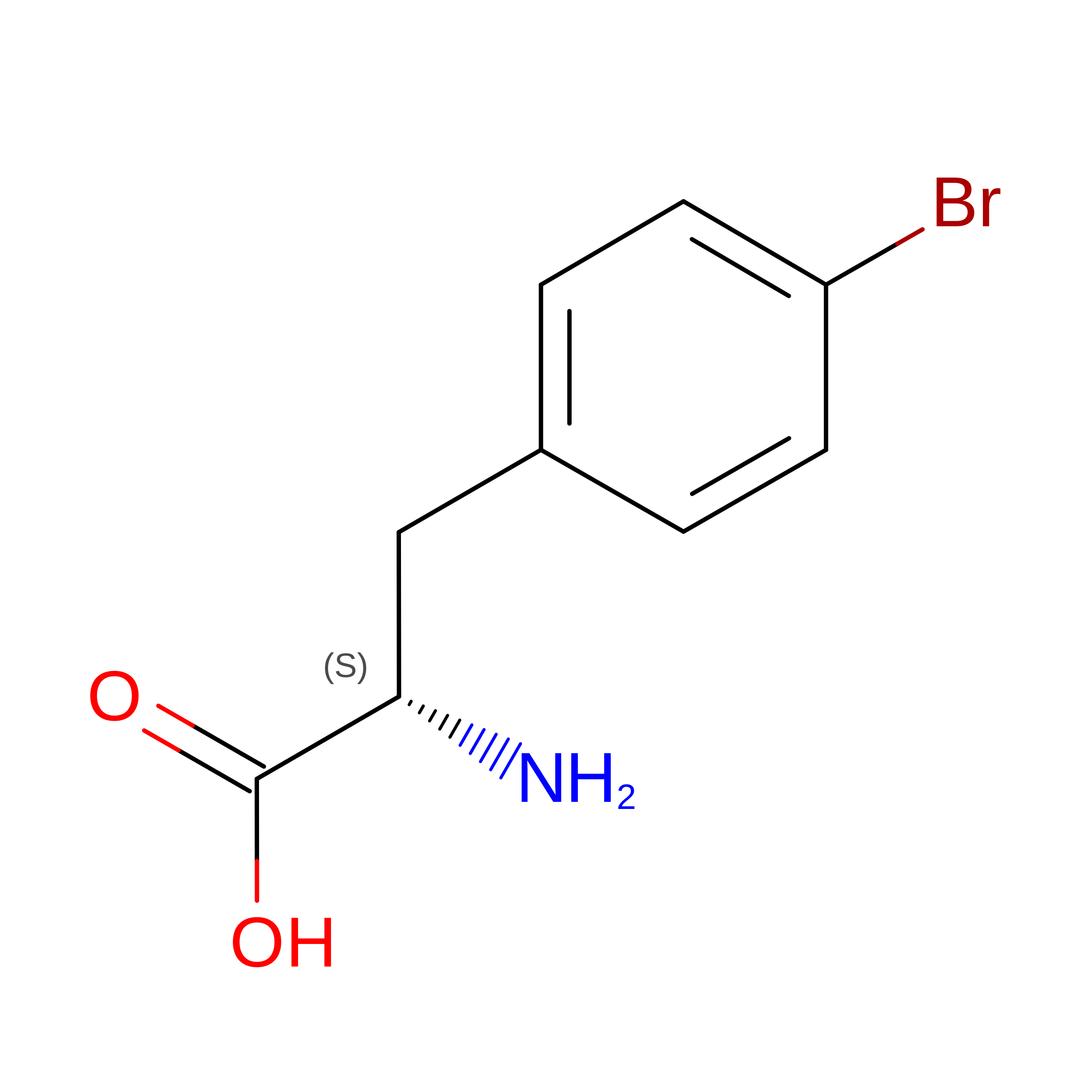
B [auth A]4-BROMO-L-PHENYLALANINE
C9 H10 Br N O2
PEMUHKUIQHFMTH-QMMMGPOBSA-N

Experimental Data & Validation

Experimental Data

  • Method: X-RAY DIFFRACTION
  • Resolution: 1.90 Å
  • R-Value Free:  0.247 (Depositor), 0.216 (DCC) 
  • R-Value Work:  0.209 (Depositor), 0.215 (DCC) 
  • R-Value Observed: 0.211 (Depositor) 
Space Group: P 43 21 2
Unit Cell:
Length ( Å )Angle ( ˚ )
a = 102.719α = 90
b = 102.719β = 90
c = 70.598γ = 90
Software Package:
Software NamePurpose
REFMACrefinement
HKL-2000data reduction
SCALEPACKdata scaling

Structure Validation

View Full Validation Report


Ligand Structure Quality Assessment 


Entry History 

Deposition Data

Revision History  (Full details and data files)

  • Version 1.0: 2006-04-04
    Type: Initial release
  • Version 1.1: 2008-04-02
    Changes: Version format compliance
  • Version 1.2: 2011-07-13
    Changes: Advisory, Derived calculations, Version format compliance
  • Version 1.3: 2017-10-11
    Changes: Refinement description
  • Version 1.4: 2021-10-20
    Changes: Database references, Derived calculations
  • Version 1.5: 2023-08-23
    Changes: Data collection, Refinement description
  • Version 1.6: 2023-11-15
    Changes: Data collection