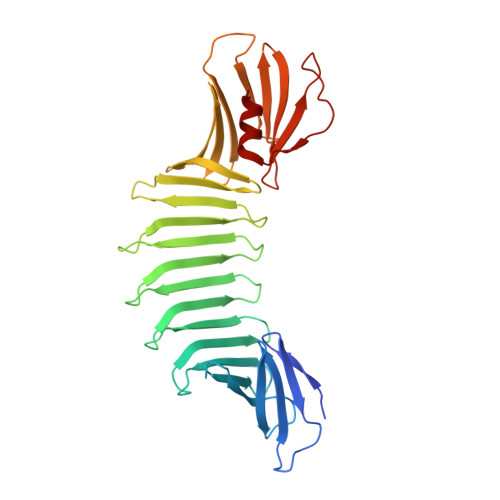
2AF5 | pdb_00002af5

2.5A X-ray Structure of Engineered OspA protein


Experimental Data Snapshot

  • Method: X-RAY DIFFRACTION
  • Resolution: 2.50 Å
  • R-Value Free: 
    0.276 (Depositor), 0.282 (DCC) 
  • R-Value Work: 
    0.242 (Depositor), 0.245 (DCC) 
  • R-Value Observed: 
    0.246 (Depositor) 

Starting Model: experimental
View more details

wwPDB Validation 3D Report Full Report

Validation slider image for 2AF5

This is version 1.4 of the entry. See complete history

Literature

Atomic structures of peptide self-assembly mimics.

Makabe, K.McElheny, D.Tereshko, V.Hilyard, A.Gawlak, G.Yan, S.Koide, A.Koide, S.

(2006) Proc Natl Acad Sci U S A 103: 17753-17758

  • DOI: https://doi.org/10.1073/pnas.0606690103
  • Primary Citation Related Structures: 
    2AF5, 2FKG, 2FKJ, 2HKD

  • PubMed Abstract: 

    Although the beta-rich self-assemblies are a major structural class for polypeptides and the focus of intense research, little is known about their atomic structures and dynamics due to their insoluble and noncrystalline nature. We developed a protein engineering strategy that captures a self-assembly segment in a water-soluble molecule. A predefined number of self-assembling peptide units are linked, and the beta-sheet ends are capped to prevent aggregation, which yields a mono-dispersed soluble protein. We tested this strategy by using Borrelia outer surface protein (OspA) whose single-layer beta-sheet located between two globular domains consists of two beta-hairpin units and thus can be considered as a prototype of self-assembly. We constructed self-assembly mimics of different sizes and determined their atomic structures using x-ray crystallography and NMR spectroscopy. Highly regular beta-sheet geometries were maintained in these structures, and peptide units had a nearly identical conformation, supporting the concept that a peptide in the regular beta-geometry is primed for self-assembly. However, we found small but significant differences in the relative orientation between adjacent peptide units in terms of beta-sheet twist and bend, suggesting their inherent flexibility. Modeling shows how this conformational diversity, when propagated over a large number of peptide units, can lead to a substantial degree of nanoscale polymorphism of self-assemblies.


  • Organizational Affiliation
    • Department of Biochemistry and Molecular Biology, University of Chicago, Chicago, IL 60637, USA.

Macromolecule Content 

  • Total Structure Weight: 32.29 kDa 
  • Atom Count: 2,279 
  • Modeled Residue Count: 292 
  • Deposited Residue Count: 297 
  • Unique protein chains: 1

Macromolecules

Find similar proteins by:|  3D Structure
Entity ID: 1
MoleculeChains  Sequence LengthOrganismDetailsImage
Engineered Outer Surface Protein A (OspA) with the inserted two beta-hairpins297Borreliella burgdorferiMutation(s): 0 
UniProt
Find proteins for P0CL66 (Borreliella burgdorferi (strain ATCC 35210 / DSM 4680 / CIP 102532 / B31))
Explore P0CL66 
Go to UniProtKB:  P0CL66
Entity Groups
Sequence Clusters30% Identity50% Identity70% Identity90% Identity95% Identity100% Identity
UniProt GroupP0CL66
Sequence Annotations
Expand
Reference Sequence

Experimental Data & Validation

Experimental Data

  • Method: X-RAY DIFFRACTION
  • Resolution: 2.50 Å
  • R-Value Free:  0.276 (Depositor), 0.282 (DCC) 
  • R-Value Work:  0.242 (Depositor), 0.245 (DCC) 
  • R-Value Observed: 0.246 (Depositor) 
Space Group: P 1 21 1
Unit Cell:
Length ( Å )Angle ( ˚ )
a = 48.547α = 90
b = 55.33β = 104.08
c = 70.361γ = 90
Software Package:
Software NamePurpose
REFMACrefinement
HKL-2000data reduction
SCALEPACKdata scaling
MOLREPphasing

Structure Validation

View Full Validation Report


Entry History 

Deposition Data

Revision History  (Full details and data files)

  • Version 1.0: 2006-08-01
    Type: Initial release
  • Version 1.1: 2008-04-30
    Changes: Version format compliance
  • Version 1.2: 2011-07-13
    Changes: Advisory, Version format compliance
  • Version 1.3: 2017-08-16
    Changes: Source and taxonomy
  • Version 1.4: 2023-08-23
    Changes: Data collection, Database references, Refinement description