Download Mendeley
Crystal structure of human arginase I at 1.29 A resolution and exploration of inhibition in the immune response.
Di Costanzo, L., Sabio, G., Mora, A., Rodriguez, P.C., Ochoa, A.C., Centeno, F., Christianson, D.W.(2005) Proc Natl Acad Sci U S A 102: 13058-13063
- PubMed: 16141327 Search on PubMedSearch on PubMed Central
- DOI: https://doi.org/10.1073/pnas.0504027102
- Primary Citation Related Structures:
1WVA, 2AEB - PubMed Abstract:
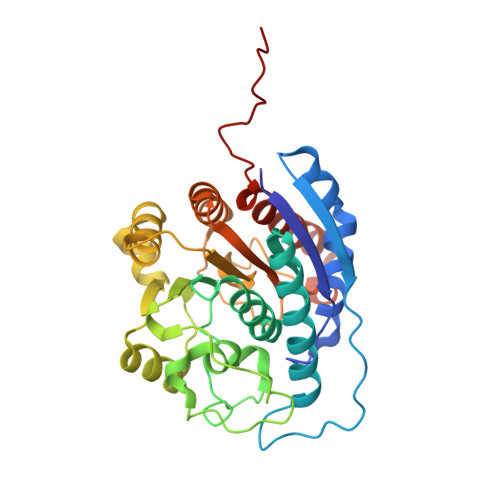
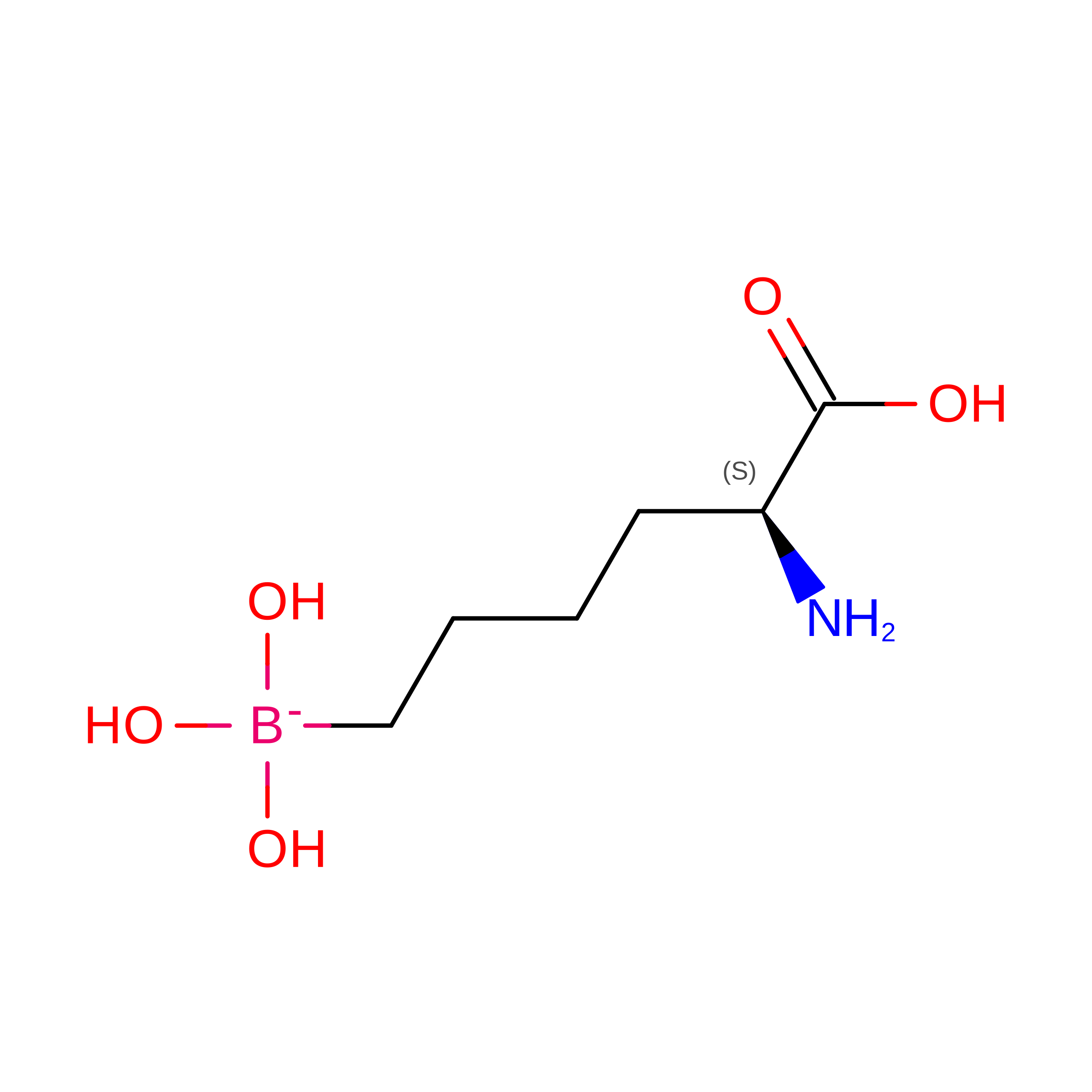
Human arginase I is a potential target for therapeutic intervention in diseases linked to compromised l-arginine homeostasis. Here, we report high-affinity binding of the reaction coordinate analogue inhibitors 2(S)-amino-6-boronohexanoic acid (ABH, Kd = 5 nM) and S-(2-boronoethyl)-l-cysteine (BEC, Kd = 270 nM) to human arginase I, and we report x-ray crystal structures of the respective enzyme-inhibitor complexes at 1.29- and 1.94-A resolution determined from crystals twinned by hemihedry. The ultrahigh-resolution structure of the human arginase I-ABH complex yields an unprecedented view of the binuclear manganese cluster and illuminates the structural basis for nanomolar affinity: bidentate inner-sphere boronate-manganese coordination interactions and fully saturated hydrogen bond networks with inhibitor alpha-amino and alpha-carboxylate groups. These interactions are therefore implicated in the stabilization of the transition state for l-arginine hydrolysis. Electron density maps also reveal that active-site residue H141 is protonated as the imidazolium cation. The location of H141 is such that it could function as a general acid to protonate the leaving amino group of l-ornithine during catalysis, and this is a revised mechanistic proposal for arginase. This work serves as a foundation for studying the structural and chemical biology of arginase I in the immune response, and we demonstrate the inhibition of arginase activity by ABH in human and murine myeloid cells.
- Roy and Diana Vagelos Laboratories, Department of Chemistry, University of Pennsylvania, Philadelphia, PA 19104-6323, USA.
Organizational Affiliation: