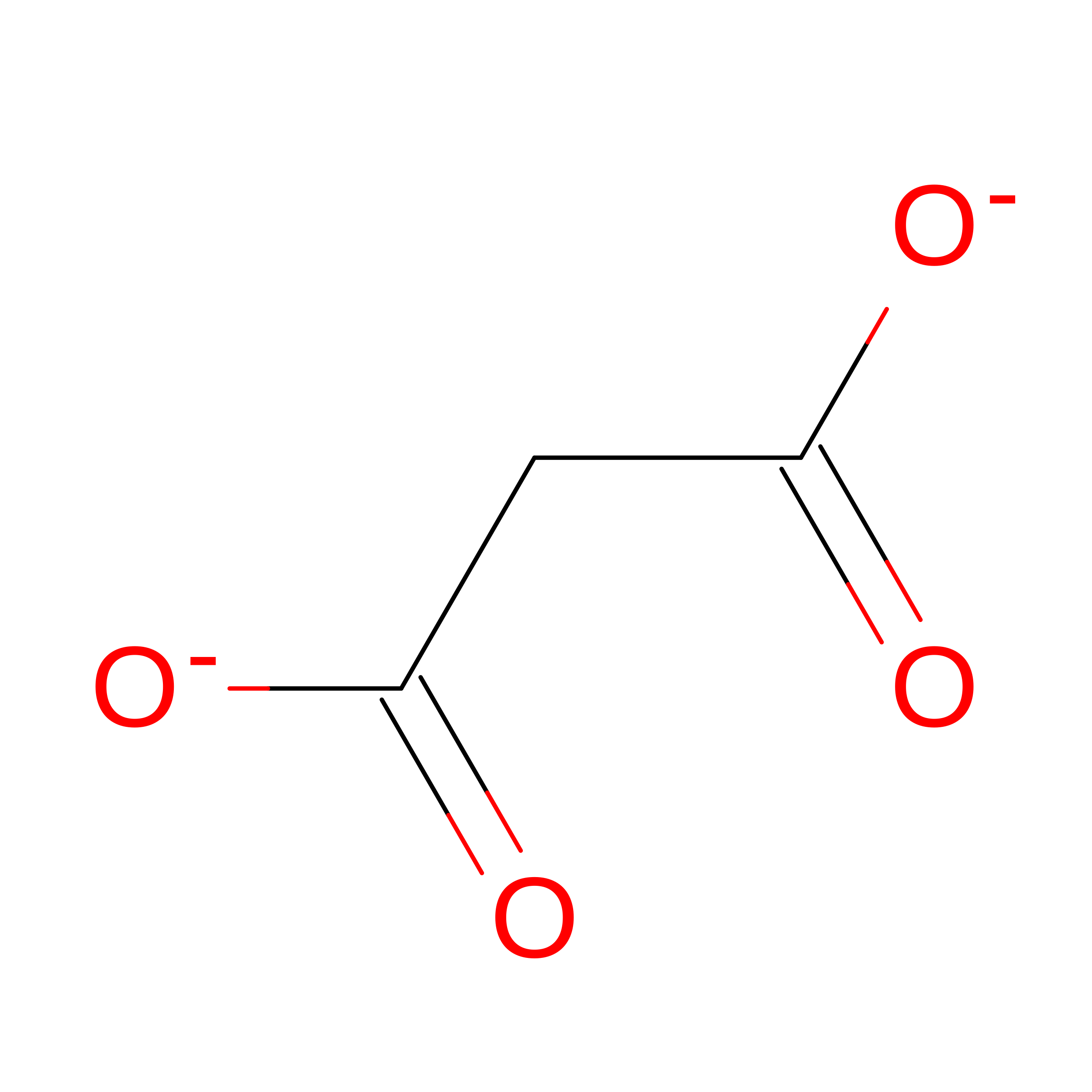
2AAL | pdb_00002aal

Crystal Structures of the Wild-type, Mutant-P1A and Inactivated Malonate Semialdehyde Decarboxylase: A Structural Basis for the Decarboxylase and Hydratase Activities


Experimental Data Snapshot

  • Method: X-RAY DIFFRACTION
  • Resolution: 1.65 Å
  • R-Value Free: 
    0.239 (Depositor), 0.181 (DCC) 
  • R-Value Work: 
    0.184 (Depositor), 0.189 (DCC) 
  • R-Value Observed: 
    0.186 (Depositor) 

Starting Model: experimental
View more details

wwPDB Validation 3D Report Full Report

Validation slider image for 2AAL

This is version 2.1 of the entry. See complete history

Literature

Crystal Structures of the Wild-Type, P1A Mutant, and Inactivated Malonate Semialdehyde Decarboxylase: A Structural Basis for the Decarboxylase and Hydratase Activities

Almrud, J.J.Poelarends, G.J.Johnson Jr., W.H.Serrano, H.Hackert, M.L.Whitman, C.P.

(2005) Biochemistry 44: 14818-14827

  • DOI: https://doi.org/10.1021/bi051383m
  • Primary Citation Related Structures: 
    2AAG, 2AAJ, 2AAL

  • PubMed Abstract: 

    Malonate semialdehyde decarboxylase (MSAD) from Pseudomonas pavonaceae 170 is a tautomerase superfamily member that converts malonate semialdehyde to acetaldehyde by a mechanism utilizing Pro-1 and Arg-75. Pro-1 and Arg-75 have also been implicated in the hydratase activity of MSAD in which 2-oxo-3-pentynoate is processed to acetopyruvate. Crystal structures of MSAD (1.8 A resolution), the P1A mutant of MSAD (2.7 A resolution), and MSAD inactivated by 3-chloropropiolate (1.6 A resolution), a mechanism-based inhibitor activated by the hydratase activity of MSAD, have been determined. A comparison of the P1A-MSAD and MSAD structures reveals little geometric alteration, indicating that Pro-1 plays an important catalytic role but not a critical structural role. The structures of wild-type MSAD and MSAD covalently modified at Pro-1 by 3-oxopropanoate, the adduct resulting from the incubation of MSAD and 3-chloropropiolate, implicate Asp-37 as the residue that activates a water molecule for attack at C-3 of 3-chloropropiolate to initiate a Michael addition of water. The interactions of Arg-73 and Arg-75 with the C-1 carboxylate group of the adduct suggest these residues polarize the alpha,beta-unsaturated acid and facilitate the addition of water. On the basis of these structures, a mechanism for the inactivation of MSAD by 3-chloropropiolate can be formulated along with mechanisms for the decarboxylase and hydratase activities. The results also provide additional evidence supporting the hypothesis that MSAD and trans-3-chloroacrylic acid dehalogenase, a tautomerase superfamily member preceding MSAD in the trans-1,3-dichloropropene degradation pathway, diverged from a common ancestor but retained the key elements for the conjugate addition of water.


  • Organizational Affiliation
    • Division of Medicinal Chemistry, College of Pharmacy, The University of Texas, Austin, Texas 78712-1074, USA.

Macromolecule Content 

  • Total Structure Weight: 85.7 kDa 
  • Atom Count: 7,105 
  • Modeled Residue Count: 775 
  • Deposited Residue Count: 780 
  • Unique protein chains: 1

Macromolecules

Find similar proteins by:|  3D Structure
Entity ID: 1
MoleculeChains  Sequence LengthOrganismDetailsImage
Malonate semialdehyde decarboxylase
A, B, C, D, E
A, B, C, D, E, F
130Pseudomonas pavonaceaeMutation(s): 0 
Gene Names: msaD
UniProt
Find proteins for Q9EV83 (Pseudomonas pavonaceae)
Explore Q9EV83 
Go to UniProtKB:  Q9EV83
Entity Groups
Sequence Clusters30% Identity50% Identity70% Identity90% Identity95% Identity100% Identity
UniProt GroupQ9EV83
Sequence Annotations
Expand
Reference Sequence

Experimental Data & Validation

Experimental Data

  • Method: X-RAY DIFFRACTION
  • Resolution: 1.65 Å
  • R-Value Free:  0.239 (Depositor), 0.181 (DCC) 
  • R-Value Work:  0.184 (Depositor), 0.189 (DCC) 
  • R-Value Observed: 0.186 (Depositor) 
Space Group: P 32
Unit Cell:
Length ( Å )Angle ( ˚ )
a = 51.889α = 90
b = 51.889β = 90
c = 219.083γ = 120
Software Package:
Software NamePurpose
DENZOdata reduction
SCALEPACKdata scaling
MOLREPphasing
REFMACrefinement

Structure Validation

View Full Validation Report


Entry History 

Deposition Data

Revision History  (Full details and data files)

  • Version 1.0: 2005-11-22
    Type: Initial release
  • Version 1.1: 2008-04-30
    Changes: Version format compliance
  • Version 1.2: 2011-07-13
    Changes: Version format compliance
  • Version 1.3: 2011-07-27
    Changes: Atomic model, Refinement description, Version format compliance
  • Version 1.4: 2022-12-21
    Changes: Database references
  • Version 2.0: 2024-03-27
    Changes: Advisory, Atomic model, Data collection, Database references, Derived calculations, Polymer sequence, Refinement description, Source and taxonomy, Structure summary
  • Version 2.1: 2024-04-03
    Changes: Refinement description