Download Mendeley
Fragment-based active-site exploration of urethane hydrolases reveals a diversity of urethane binding modes.
Bicer, D., Kochubei, D., Graham, R., Pena-Diaz, S., Rotilio, L., Villadsen, N.L., Sommerfeldt, A., Johansen, M.B., Sandahl, A., Thirup, S.S., Morth, J.P., Otzen, D.E.(2026) Acta Crystallogr D Struct Biol 82: 1298-1317
- PubMed: 42929454 Search on PubMedSearch on PubMed Central
- DOI: https://doi.org/10.1107/S2059798326010624
- Primary Citation Related Structures:
29JV, 29JY, 29KJ, 29KX, 29NV, 29NW, 29OJ, 29OO, 29PW, 29PZ, 29QA, 29QC, 29QE, 29QS, 29QU, 29QX, 29RS, 29RU, 29RV, 29RW, 29ZK, 30FO, 30GE, 30GV, 30HF, 30HG, 30NQ, 30OB, 30OC, 30OM, 30OP, 30PJ, 30PL, 30QO, 30QP, 30QW, 30QY, 30RG, 30SD, 30TU, 30TV, 30VA, 34FS - PubMed Abstract:
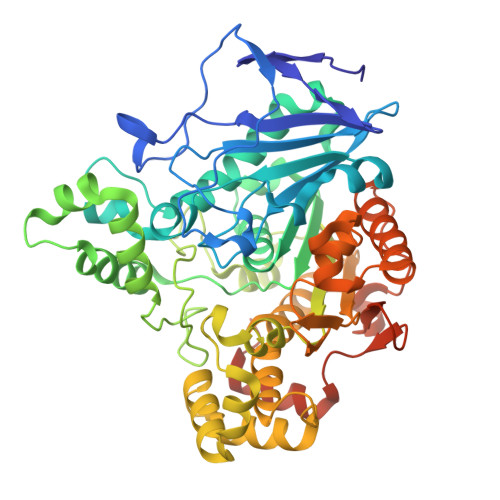
Recent advances in the discovery, characterization and engineering of urethanases provide new opportunities for the sustainable biocatalytic degradation of polyurethane waste. A mechanistic understanding of enzyme-plastic interactions is essential for structure-based engineering to enhance urethanase activity. However, the extremely complex and hydrophobic nature of polyurethane makes it challenging to elucidate the structural basis of enzyme-plastic interactions. Here, we used a fragment-based approach to characterize the active sites of two novel urethanases called amidase U11 and esterase AX PUR5 with different catalytic scaffolds, employing a crystallographic fragment-screening campaign to map subpockets in the active site and validate these subpockets as plastic binding sites by using soluble plastic fragment analogues that mimic the substrate, transition state or product. We resolved 42 high-resolution structures for both esterase AX PUR5 and amidase U11. The fragment-based approach identified new substrate-binding subpockets, while interactions of plastic mimetics in the active site provided a mechanistic understanding of the recognition and binding of polyurethane fragments by these subpockets. These results highlight a diversity of binding modes among urethanases towards different polyurethane fragments.
- Department of Molecular Biology and Genetics, Aarhus University, Universitetsbyen 81, 8000 Aarhus, Denmark.
Organizational Affiliation: