Download Mendeley
Conformational Plasticity of the Human Norovirus GII.3 Capsid Reveals Alternative P Domain Interaction Networks.
Song, C., Miki, M., Takai-Todaka, R., Murakami, K., Katayama, K., Murata, K.(2026) Int J Mol Sci 27
- PubMed: 42589245 Search on PubMedSearch on PubMed Central
- DOI: https://doi.org/10.3390/ijms27156586
- Primary Citation Related Structures:
27ZD - PubMed Abstract:
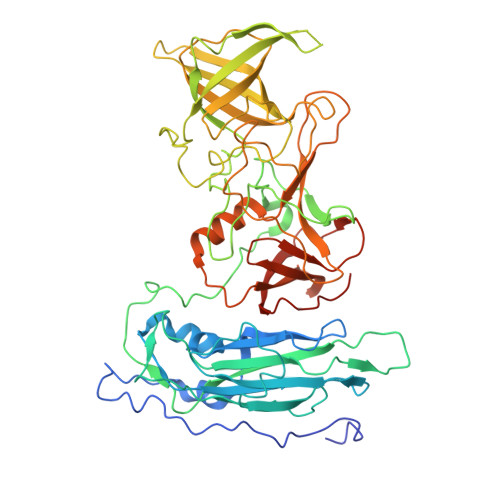
Human noroviruses (HuNoVs) are a leading cause of acute gastroenteritis worldwide, yet no effective antiviral therapeutics are currently available. Although environmentally induced capsid conformational changes associated with infectivity have been reported in murine noroviruses (MNVs), comparable conformational switching has not been demonstrated in HuNoVs. In this study, we generated HuNoV GII.3 virus-like particles (VLPs) using a baculovirus expression system and identified two distinct T = 3 particle populations coexisting within VLP preparations derived from a single strain through cryo-electron microscopy single-particle analysis. Comparative structural analysis revealed that these two T = 3 capsid conformations correspond to the resting and rising states of the protruding (P) domain. Rearrangement of the P domain alters intermolecular interactions between adjacent capsid subunits, resulting in distinct capsid surface architectures. In the resting state, intermolecular contacts were mediated predominantly by the P2 subdomain, with limited contribution from the P1 subdomain. In contrast, the rising state exhibited a shift toward an alternative interaction interface primarily involving the P1 subdomain. The alteration of the capsid surface accompanying this conformational switching can influence biologically relevant intermolecular interactions with viral hosts and antibodies as demonstrated in murine norovirus. These findings demonstrate previously unrecognized structural polymorphism in the HuNoV capsid and provide evidence that conformational switching may occur in HuNoVs. Our results offer new insights into norovirus capsid dynamics and may inform future structure-based vaccine and antiviral drug development.
- Department of Convergence Medicine, School of Medicine, Pusan National University, Yangsan 50612, Republic of Korea.
Organizational Affiliation: