Download Mendeley
Structural basis for LMBD1-dependent trafficking and cobalamin export of ABCD4.
Liu, Q., Li, X., Wu, Y., Zheng, K., Zhou, M., Long, T.(2026) Nat Commun 17
- PubMed: 42303638 Search on PubMedSearch on PubMed Central
- DOI: https://doi.org/10.1038/s41467-026-74552-5
- Primary Citation Related Structures:
24VC, 24VD, 24VE - PubMed Abstract:
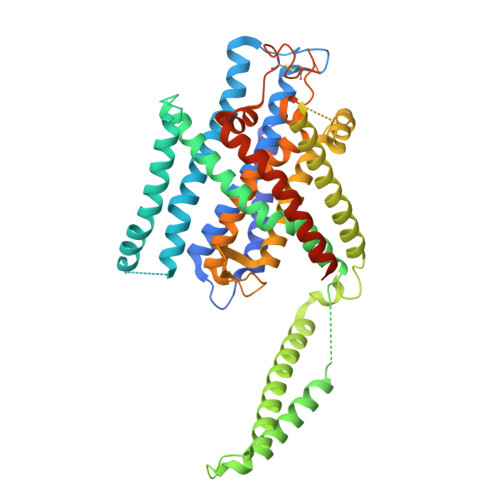
Correct trafficking of lysosomal transporters is essential for intracellular homeostasis. While most lysosomal membrane proteins are directed to the lysosome via sorting motifs, the cobalamin exporter ABCD4 is distinct, instead relying on LMBD1 as a dedicated chaperone for its trafficking. Dysfunction of either protein causes inherited cobalamin metabolism disorders. Despite its physiological significance, the molecular mechanism underlying this chaperone-dependent trafficking remains unclear. Here, we report the cryo-EM structures of ABCD4 complex with LMBD1 in the lumen-open, substrate-bound and cytosol-open states. LMBD1 contains nine transmembrane-helices (TMs) and a cytosolic domain, both of which engage ABCD4. Cell imaging shows that disruption of these interactions impairs the trafficking of ABCD4 to lysosomes. Structural and biochemical analyses provide insights into cobalamin recognition and reveal conformational states associated with the proposed cobalamin transport cycle. These findings provide molecular insights into cobalamin metabolism and illustrate a chaperone-assisted mechanism that supports proper trafficking of a lysosomal transporter.
- State Key Laboratory of Metabolism and Regulation in Complex Organisms, Taikang Medical School (School of Basic Medical Sciences), Taikang Center for Life and Medical Sciences, Wuhan University, Wuhan, China.
Organizational Affiliation: