Download Mendeley
Structure and dynamics of a four-protofilament microtubule from Heimdallarchaeales alpha / beta-tubulin.
Tran, L.T., Ali, S., Matsumoto, T., Yamazaki, Y., Narita, A., Miyazaki, M., Robinson, R.C.(2026) Sci Adv 12: eaeh4305-eaeh4305
- PubMed: 42455893 Search on PubMedSearch on PubMed Central
- DOI: https://doi.org/10.1126/sciadv.aeh4305
- Primary Citation Related Structures:
24RT, 24SV, 24SW - PubMed Abstract:
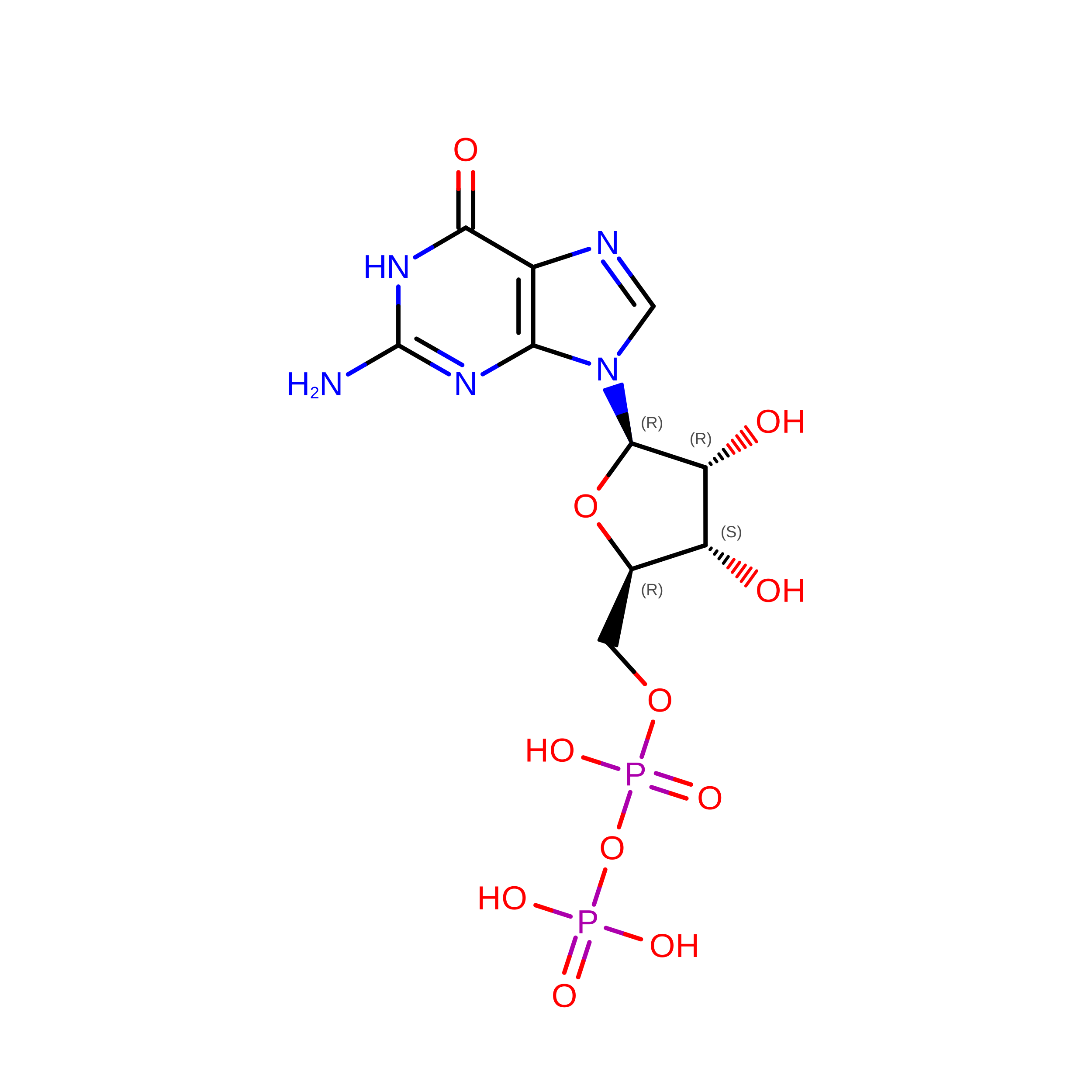
Eukaryotic microtubules are typically 13-protofilament tubes assembled from α/β-tubulin heterodimers that combine mechanical rigidity with dynamic instability. Homologous tubulins have been identified in Asgard archaea, the closest prokaryotic relatives to eukaryotes. Here, we characterize a heterodimeric α/β-tubulin system from Heimdallarchaeales. Biochemical reconstitution shows that Heim- α/β-tubulin forms a heterodimer that undergoes guanosine 5'-triphosphate-dependent polymerization with coupled nucleotide hydrolysis. Cryo-electron microscopy reveals that the polymers are composed of four-protofilament tubules, with microtubule-like lattices formed by conserved longitudinal interfaces and ball-and-socket lateral contacts. Single-filament imaging demonstrates intrinsic kinetic polarity and dynamic instability, while liposome encapsulation shows that microtubule growth generates forces sufficient to deform membranes. Despite their reduced protofilament number, Heim -α/β-microtubules share key structural and dynamic features with eukaryotic microtubules but exhibit lower bending stiffness and polymerization force. Thus, microtubule-like polymers can form from a range of protofilament numbers, with reduced architectures potentially adapted to small cellular dimensions and lower mechanical loads. Together, our results indicate expansion in microtubule protofilament number during eukaryogenesis.
- RIKEN Center for Integrative Medical Sciences, 1-7-22 Suehiro-cho, Tsurumi-ku, Yokohama, Kanagawa 230-0045, Japan.
Organizational Affiliation: