Download Mendeley
Structure of the human P2X3 receptor reveals the basis for subtype-selective inhibition by sivopixant.
Zhao, Z., Wang, D.P., Zhang, X., Gao, Y., Xu, H., Teng, X., Shen, C., Chen, J., Zhang, J., Guo, C.R., Hattori, M.(2026) PLoS Biol 24: e3003777-e3003777
- PubMed: 42018567 Search on PubMedSearch on PubMed Central
- DOI: https://doi.org/10.1371/journal.pbio.3003777
- Primary Citation Related Structures:
21DX, 21FG - PubMed Abstract:
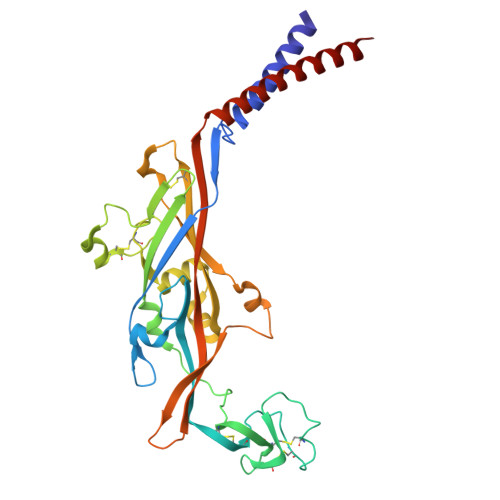
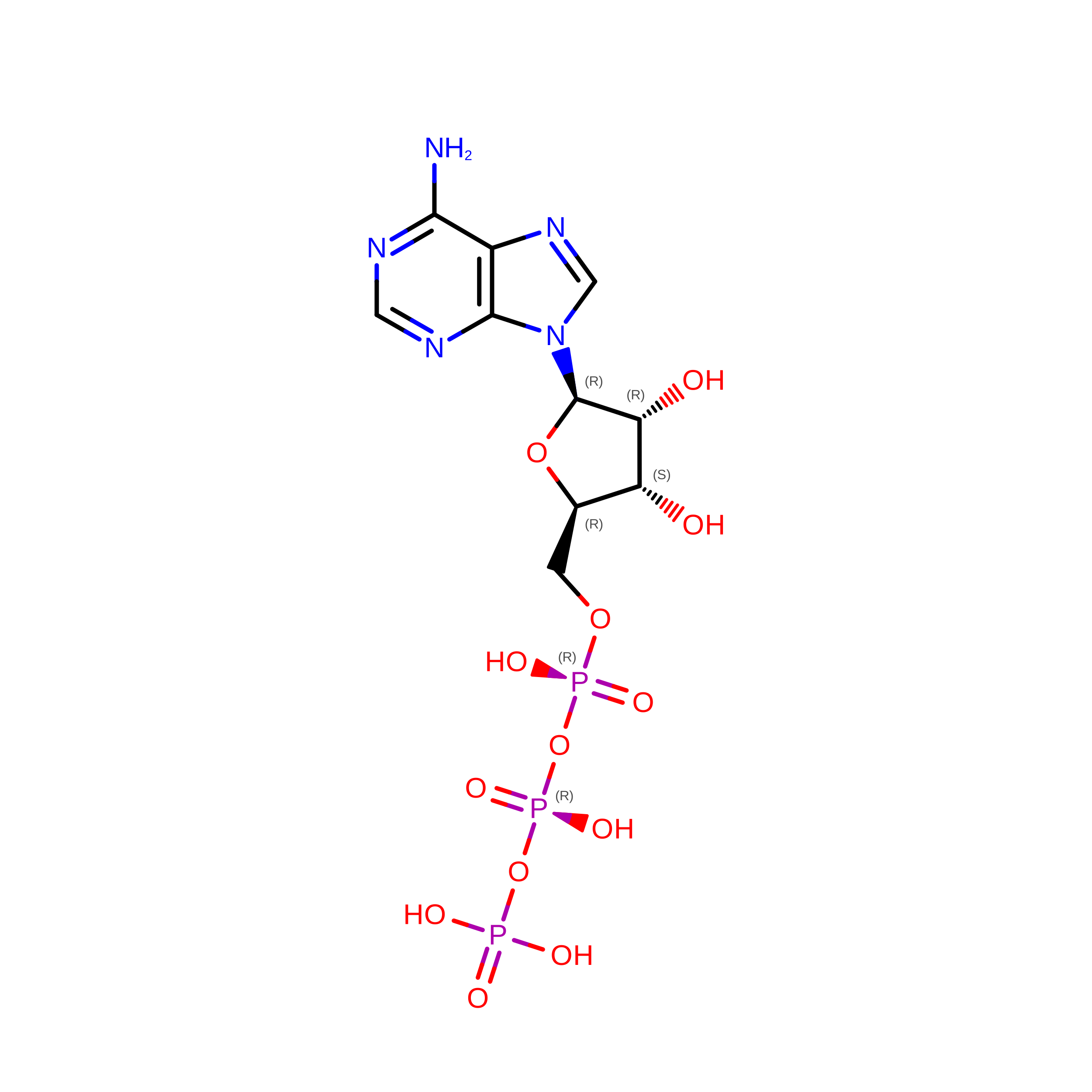
P2X receptors are ATP-gated cation channels, and the P2X3 subtype plays crucial roles in peripheral sensory neurons, including in chronic pain and chronic cough. Accordingly, P2X3 receptors have attracted substantial interest as a therapeutic target. Gefapixant, a negative allosteric modulator (NAM) of P2X3 receptors, has been approved in some countries for the treatment of chronic cough; however, its limited selectivity for P2X3 homomers over P2X2/P2X3 heteromers is associated with taste disturbance as a prominent adverse effect. These limitations have motivated the development of next-generation NAMs with improved subtype selectivity, but their subtype-specific allosteric inhibition mechanisms are unclear. Here, we report the cryo-EM structure of the human P2X3 receptor in complex with ATP and the P2X3-selective next-generation NAM sivopixant, an investigational drug. Sivopixant binds to an allosteric site at the portal of the central pocket in the extracellular domain, and structure-based mutational analysis by electrophysiology identifies key residues required for sivopixant-dependent inhibition of human P2X3 receptors. Structural comparisons across P2X subtypes, together with patch-clamp analyses of gain-of-function mutants that confer sensitivity to two investigational drugs, sivopixant and camlipixant, provided a broadly applicable structural framework for subtype selectivity. Furthermore, structural comparisons with apo and ATP-bound open states of P2X3 receptors, together with molecular dynamics simulations, revealed that sivopixant expands the upper-body domain to suppress the lower-body movements required for channel activation, thereby preventing channel opening even in the presence of ATP.
- State Key Laboratory of Genetics and Development of Complex Phenotypes, Collaborative Innovation Center of Genetics and Development, Department of Physiology and Neurobiology, School of Life Sciences, Fudan University, Shanghai, China.
Organizational Affiliation: