Download Mendeley
Natural Asp-tRNA Synthetase Fragment Targets Myofibroblasts to Abrogate Tissue Fibrosis.
Adams, R.A., Wang, Y.T., Barber, A.G., Hamel, K., Imfeld, A., Burman, L., Rauch, K., Chong, Y.E., Villanueva, A., Guy, L., Liu, W., Manzo, C., Klopp-Savino, S., Polizzi, C., Stamps, J., Pastenes, M., Tian, H., Fung, C.P., Zhang, Y., Hugo Ho, K.W., Sangiorgi, B., Dillingham, B., Brust, T.F., Chiang, K.P., Wu, Z., Xu, Z., Burkart, C., Nangle, L.A.(2026) J Biol Chem : 113586-113586
- PubMed: 42815638 Search on PubMed
- DOI: https://doi.org/10.1016/j.jbc.2026.113586
- Primary Citation Related Structures:
21AA - PubMed Abstract:
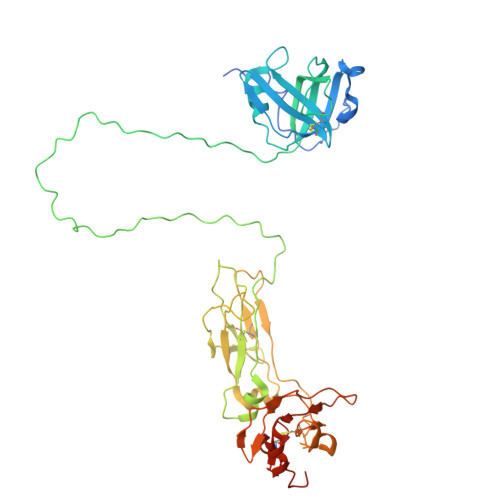
Fibrosis remains a major global health challenge with limited therapies that only slow disease progression. While the aminoacyl-tRNA synthetase (aaRS) family is known to utilize evolutionarily appended domains as extracellular signaling molecules, their role in regulating the homeostasis of the fibrotic process is poorly defined. We identify a natural proteolytic fragment of aspartyl-tRNA synthetase (DARS), termed DARS-N1, that selectively triggers apoptosis in myofibroblasts by targeting latent-transforming growth factor beta binding protein 1 (LTBP-1) on the extracellular matrix (ECM). This active N-terminal fragment of DARS reduces focal adhesion kinase (FAK) activation in undifferentiated fibroblasts and myofibroblasts, while only myofibroblasts exhibit inadequate cell-matrix attachment leading to loss of anchorage-dependent survival and promotion of apoptosis. We utilized ATYR0101, a therapeutic form of DARS-N1 engineered for extended serum exposure, to demonstrate anti-fibrotic activity in lung (bleomycin). Spatial transcriptomics analysis showed that ATYR0101 activates a restorative program promoting the return to a healthy state. These findings highlight ATYR0101's potential as a transformative therapy for disrupting the process of chronic tissue fibrosis.
- aTyr Pharma, San Diego, CA, USA.
Organizational Affiliation: