Download Mendeley
Solvation and the hidden thermodynamics of a zinc finger probed by nonstandard repair of a protein crevice
Lachenmann, M.J., Ladbury, J.E., Qian, X., Huang, K., Singh, R., Weiss, M.A.(2004) Protein Sci 13: 3115-3126
- PubMed: 15557258 Search on PubMedSearch on PubMed Central
- DOI: https://doi.org/10.1110/ps.04866404
- Primary Citation Related Structures:
1XRZ - PubMed Abstract:
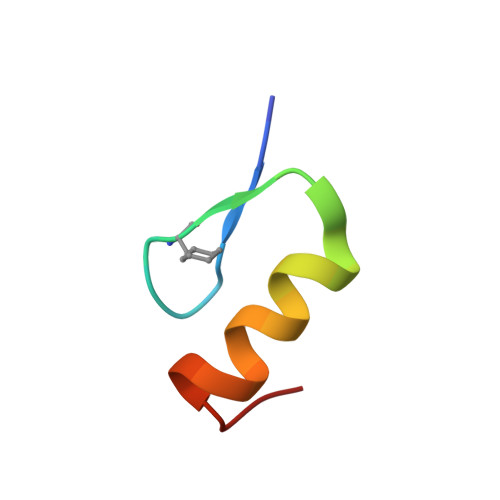
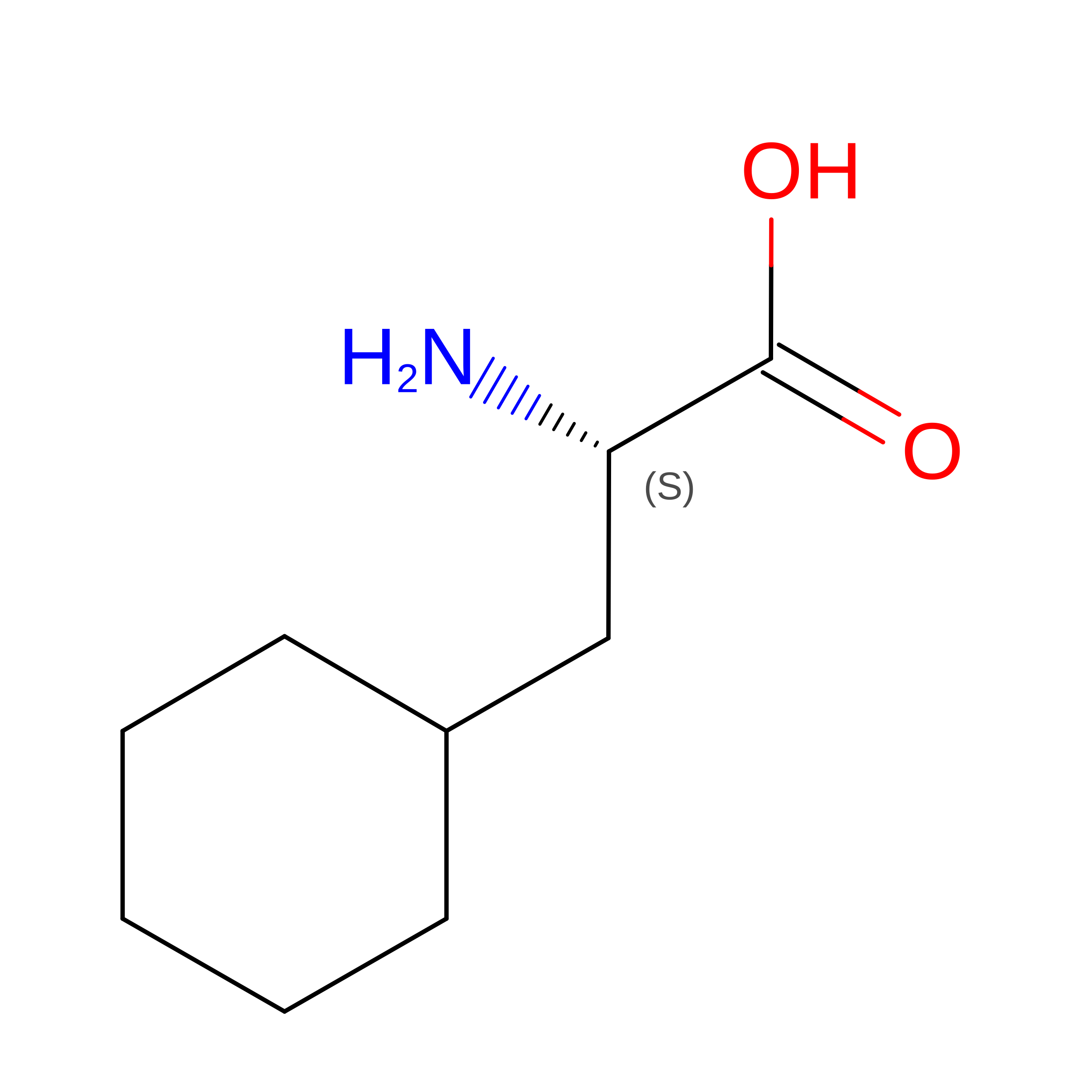
The classical Zn finger contains a phenylalanine at the crux of its three architectural elements: a beta-hairpin, an alpha-helix, and a Zn(2+)-binding site. Surprisingly, phenylalanine is not required for high-affinity Zn2+ binding, but instead contributes to the specification of a precise DNA-binding surface. Substitution of phenylalanine by leucine leads to a floppy but native-like structure whose Zn affinity is maintained by marked entropy-enthalpy compensation (DeltaDeltaH -8.3 kcal/mol and -TDeltaDeltaS 7.7 kcal/mol). Phenylalanine and leucine differ in shape, size, and aromaticity. To distinguish which features correlate with dynamic stability, we have investigated a nonstandard finger containing cyclohexanylalanine at this site. The structure of the nonstandard finger is similar to that of the native domain. The cyclohexanyl ring assumes a chair conformation, and conformational fluctuations characteristic of the leucine variant are damped. Although the nonstandard finger exhibits a lower affinity for Zn2+ than does the native domain (DeltaDeltaG -1.2 kcal/mol), leucine-associated perturbations in enthalpy and entropy are almost completely attenuated (DeltaDeltaH -0.7 kcal/mol and -TDeltaDeltaS -0.5 kcal/mol). Strikingly, global changes in entropy (as inferred from calorimetry) are in each case opposite in sign from changes in configurational entropy (as inferred from NMR). This seeming paradox suggests that enthalpy-entropy compensation is dominated by solvent reorganization rather than nominal molecular properties. Together, these results demonstrate that dynamic and thermodynamic perturbations correlate with formation or repair of a solvated packing defect rather than type of physical interaction (aromatic or aliphatic) within the core.
- Department of Biochemistry, Case Western Reserve University, Cleveland, Ohio 44106-4935, USA.
Organizational Affiliation: