1WQ9 | pdb_00001wq9

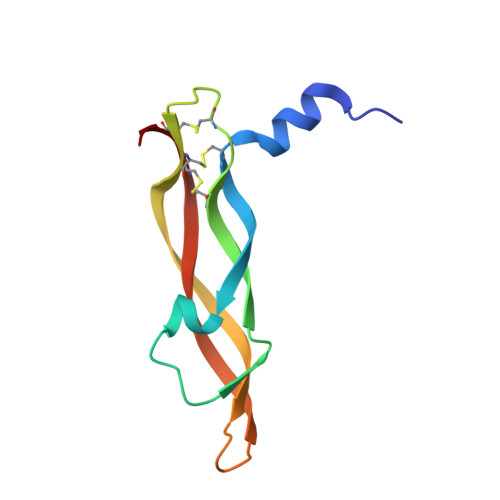
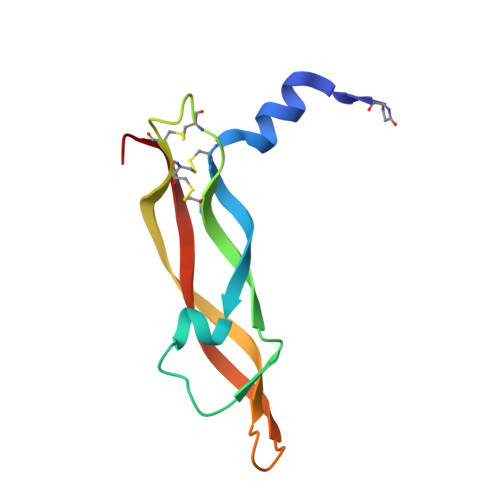
Crystal structure of VR-1, a VEGF-F from a snake venom


Experimental Data Snapshot

  • Method: X-RAY DIFFRACTION
  • Resolution: 2.00 Å
  • R-Value Free: 
    0.252 (Depositor), 0.249 (DCC) 
  • R-Value Work: 
    0.206 (Depositor), 0.205 (DCC) 
  • R-Value Observed: 
    0.206 (Depositor) 

wwPDB Validation 3D Report Full Report

Validation slider image for 1WQ9

This is version 2.1 of the entry. See complete history

Literature

Crystal structures of novel vascular endothelial growth factors (VEGF) from snake venoms: insight into selective VEGF binding to kinase insert domain-containing receptor but not to fms-like tyrosine kinase-1.

Suto, K.Yamazaki, Y.Morita, T.Mizuno, H.

(2005) J Biological Chem 280: 2126-2131

  • DOI: https://doi.org/10.1074/jbc.M411395200
  • Primary Citation Related Structures: 
    1WQ8, 1WQ9

  • PubMed Abstract: 

    Vascular endothelial growth factor-A (VEGF-A(165)) exerts multiple effects upon binding to the fms-like tyrosine kinase-1 (Flt-1) and the kinase insert domain-containing receptor (KDR). We recently identified two novel snake venom VEGFs (vammin and VR-1) having unique properties. These VEGFs, designated VEGF-Fs, are highly specific ligands for the kinase insert domain-containing receptor and exhibit potent biological activity both in vitro and in vivo when compared with VEGF-A(165). Here, we solved the crystal structures of vammin and VR-1 at 1.9 and 2.0 A resolutions, respectively. Both structures are very similar to each other, and these structures exhibit similar but significantly different features from the known structures of other VEGFs. These differences include a conformational difference in receptor-binding loop 3 caused by an amino acid residue insertion and a difference in surface potential on the possible binding surface for domain 3 of the receptor. These structural differences may be related to the highly selective ligand properties of VEGF-F.


  • Organizational Affiliation
    • Department of Biochemistry, National Institute of Agrobiological Sciences, 2-1-2, Kannondai, Tsukuba, Ibaraki 305-8602, Japan.

Macromolecule Content 

  • Total Structure Weight: 21.91 kDa 
  • Atom Count: 1,652 
  • Modeled Residue Count: 192 
  • Deposited Residue Count: 192 
  • Unique protein chains: 2

Macromolecules

Find similar proteins by:|  3D Structure
Entity ID: 1
MoleculeChains  Sequence LengthOrganismDetailsImage
Vascular endothelial growth factor96Daboia russelii russeliiMutation(s): 0 
UniProt
Find proteins for P67861 (Daboia russelii)
Explore P67861 
Go to UniProtKB:  P67861
Entity Groups
Sequence Clusters30% Identity50% Identity70% Identity90% Identity95% Identity100% Identity
UniProt GroupP67861
Sequence Annotations
Expand
Reference Sequence
Find similar proteins by:|  3D Structure
Entity ID: 2
MoleculeChains  Sequence LengthOrganismDetailsImage
Vascular endothelial growth factor96Daboia russelii russeliiMutation(s): 0 
UniProt
Find proteins for P67861 (Daboia russelii)
Explore P67861 
Go to UniProtKB:  P67861
Entity Groups
Sequence Clusters30% Identity50% Identity70% Identity90% Identity95% Identity100% Identity
UniProt GroupP67861
Sequence Annotations
Expand
Reference Sequence

Small Molecules

Modified Residues  1 Unique
IDChains TypeFormula2D DiagramParent
PCA
Query on PCA
B
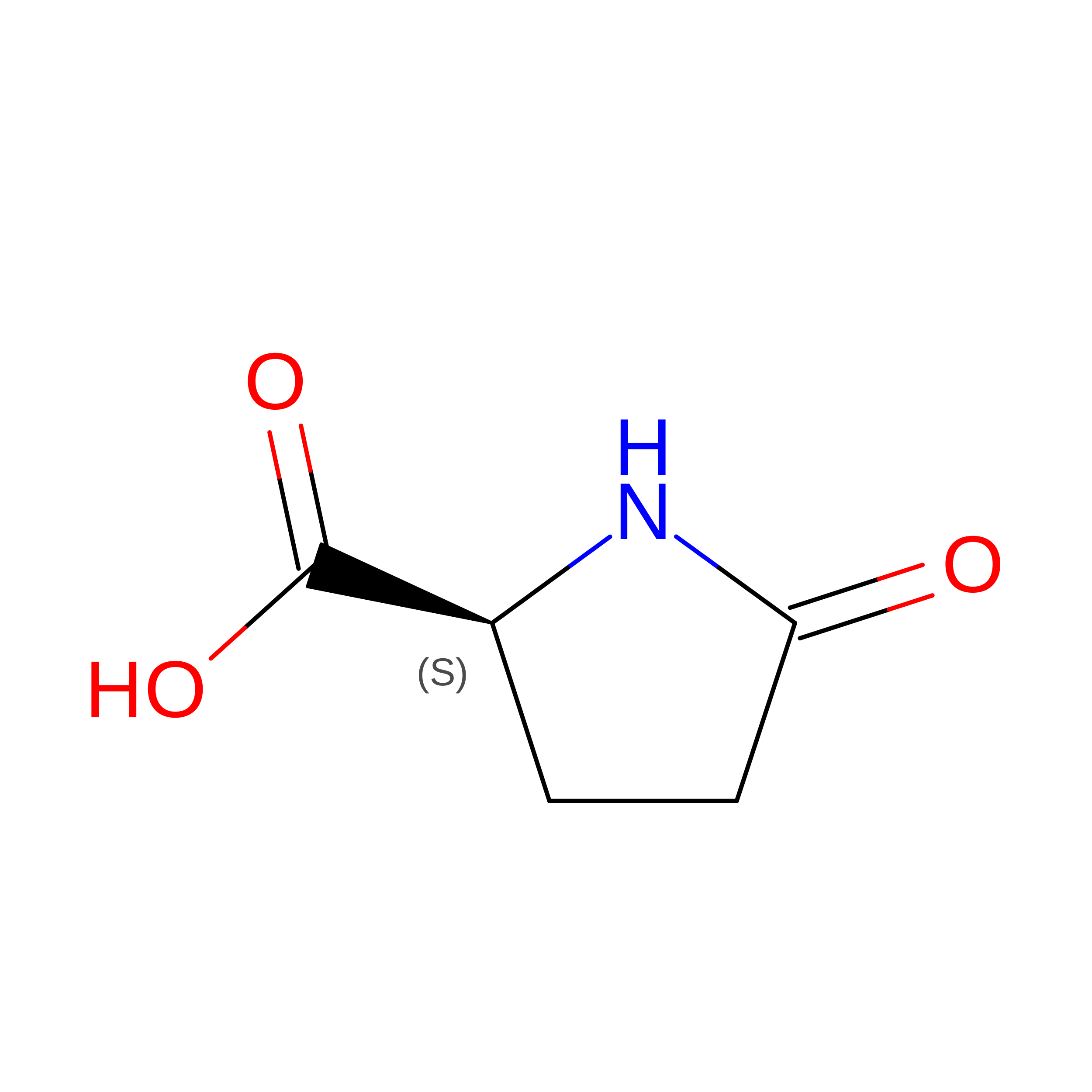
L-PEPTIDE LINKINGC5 H7 N O3GLN

Experimental Data & Validation

Experimental Data

  • Method: X-RAY DIFFRACTION
  • Resolution: 2.00 Å
  • R-Value Free:  0.252 (Depositor), 0.249 (DCC) 
  • R-Value Work:  0.206 (Depositor), 0.205 (DCC) 
  • R-Value Observed: 0.206 (Depositor) 
Space Group: P 21 21 2
Unit Cell:
Length ( Å )Angle ( ˚ )
a = 90.348α = 90
b = 48.961β = 90
c = 54.214γ = 90
Software Package:
Software NamePurpose
CNSrefinement
HKL-2000data reduction
SCALEPACKdata scaling
CNSphasing
SHARPphasing

Structure Validation

View Full Validation Report


Entry History 

Deposition Data

Revision History  (Full details and data files)

  • Version 1.0: 2004-12-07
    Type: Initial release
  • Version 1.1: 2008-04-30
    Changes: Version format compliance
  • Version 1.2: 2011-07-13
    Changes: Version format compliance
  • Version 2.0: 2019-12-25
    Changes: Derived calculations, Polymer sequence
  • Version 2.1: 2024-10-23
    Changes: Data collection, Database references, Structure summary