1O9B | pdb_00001o9b

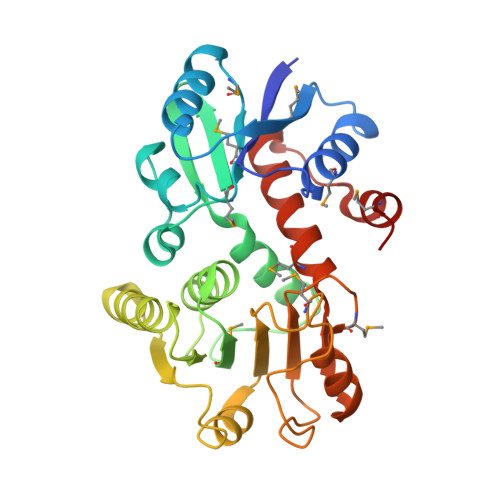
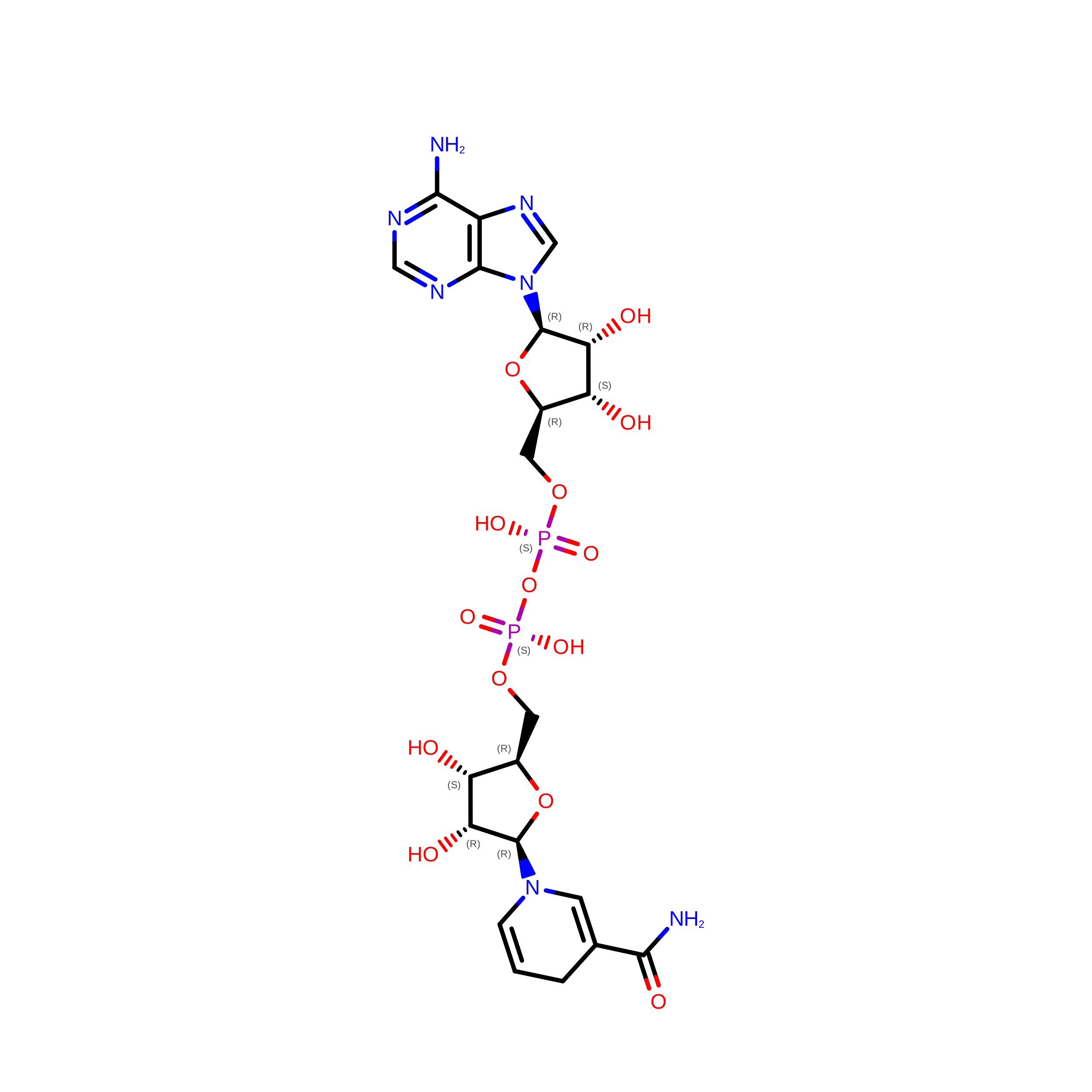
QUINATE/SHIKIMATE DEHYDROGENASE YDIB COMPLEXED WITH NADH


Experimental Data Snapshot

  • Method: X-RAY DIFFRACTION
  • Resolution: 2.50 Å
  • R-Value Free: 
    0.294 (Depositor), 0.291 (DCC) 
  • R-Value Work: 
    0.226 (Depositor), 0.219 (DCC) 
  • R-Value Observed: 
    0.226 (Depositor) 

wwPDB Validation 3D Report Full Report

Validation slider image for 1O9B

Ligand Structure Quality Assessment 


This is version 1.2 of the entry. See complete history

Literature

Structures of Shikimate Dehydrogenase Aroe and its Paralog Ydib: A Common Structural Framework for Different Activities

Michel, G.Roszak, A.W.Sauve, V.Mclean, J.Matte, A.Coggins, J.R.Cygler, M.Lapthorn, A.J.

(2003) J Biological Chem 278: 19463

  • DOI: https://doi.org/10.1074/jbc.M300794200
  • Primary Citation Related Structures: 
    1NYT, 1O9B

  • PubMed Abstract: 

    Shikimate dehydrogenase catalyzes the fourth step of the shikimate pathway, the essential route for the biosynthesis of aromatic compounds in plants and microorganisms. Absent in metazoans, this pathway is an attractive target for nontoxic herbicides and drugs. Escherichia coli expresses two shikimate dehydrogenase paralogs, the NADP-specific AroE and a putative enzyme YdiB. Here we characterize YdiB as a dual specificity quinate/shikimate dehydrogenase that utilizes either NAD or NADP as a cofactor. Structures of AroE and YdiB with bound cofactors were determined at 1.5 and 2.5 A resolution, respectively. Both enzymes display a similar architecture with two alpha/beta domains separated by a wide cleft. Comparison of their dinucleotide-binding domains reveals the molecular basis for cofactor specificity. Independent molecules display conformational flexibility suggesting that a switch between open and closed conformations occurs upon substrate binding. Sequence analysis and structural comparison led us to propose the catalytic machinery and a model for 3-dehydroshikimate recognition. Furthermore, we discuss the evolutionary and metabolic implications of the presence of two shikimate dehydrogenases in E. coli and other organisms.


  • Organizational Affiliation
    • Biotechnology Research Institute, NRC Macromolecular Structure Group, Montreal, Quebec H4P 2R2, Canada.

Macromolecule Content 

  • Total Structure Weight: 65.35 kDa 
  • Atom Count: 4,541 
  • Modeled Residue Count: 562 
  • Deposited Residue Count: 576 
  • Unique protein chains: 1

Macromolecules

Find similar proteins by:|  3D Structure
Entity ID: 1
MoleculeChains  Sequence LengthOrganismDetailsImage
HYPOTHETICAL SHIKIMATE 5-DEHYDROGENASE-LIKE PROTEIN YDIB
A, B
288Escherichia coliMutation(s): 0 
EC: 1.1.1.25 (PDB Primary Data), 1.1.1.282 (UniProt)
UniProt
Find proteins for P0A6D5 (Escherichia coli (strain K12))
Explore P0A6D5 
Go to UniProtKB:  P0A6D5
Entity Groups
Sequence Clusters30% Identity50% Identity70% Identity90% Identity95% Identity100% Identity
UniProt GroupP0A6D5
Sequence Annotations
Expand
Reference Sequence

Small Molecules

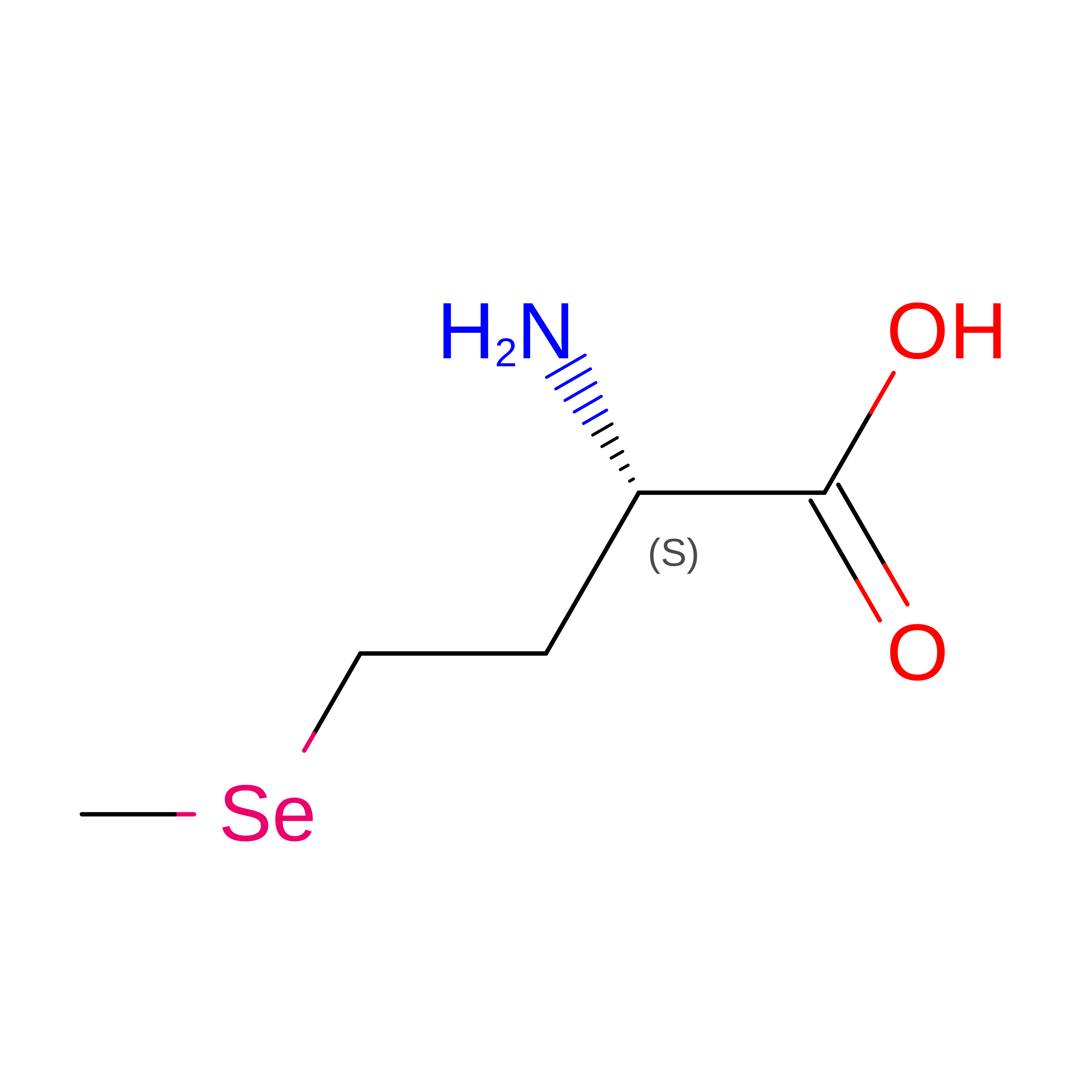
Modified Residues  1 Unique
IDChains TypeFormula2D DiagramParent
MSE
Query on MSE
A, B
L-PEPTIDE LINKINGC5 H11 N O2 SeMET

Experimental Data & Validation

Experimental Data

  • Method: X-RAY DIFFRACTION
  • Resolution: 2.50 Å
  • R-Value Free:  0.294 (Depositor), 0.291 (DCC) 
  • R-Value Work:  0.226 (Depositor), 0.219 (DCC) 
  • R-Value Observed: 0.226 (Depositor) 
Space Group: P 64
Unit Cell:
Length ( Å )Angle ( ˚ )
a = 157.874α = 90
b = 157.874β = 90
c = 40.011γ = 120
Software Package:
Software NamePurpose
CNSrefinement
DENZOdata reduction
SCALEPACKdata scaling
CNSphasing

Structure Validation

View Full Validation Report


Ligand Structure Quality Assessment 


Entry History 

Deposition Data

Revision History  (Full details and data files)

  • Version 1.0: 2003-02-01
    Type: Initial release
  • Version 1.1: 2013-10-30
    Changes: Atomic model, Database references, Derived calculations, Non-polymer description, Other, Source and taxonomy, Structure summary, Version format compliance
  • Version 1.2: 2024-10-23
    Changes: Data collection, Database references, Derived calculations, Other, Structure summary