1KC4 | pdb_00001kc4

NMR Structural Analysis of the Complex Formed Between alpha-Bungarotoxin and the Principal alpha-Neurotoxin Binding Sequence on the alpha7 Subunit of a Neuronal Nicotinic Acetylcholine Receptor


Experimental Data Snapshot

  • Method: SOLUTION NMR
  • Conformers Submitted: 10 
  • Selection Criteria: The submitted conformer models are the 10 with the lowest energy from a pool of over 100 accepted structures that had no restraint violations. 

wwPDB Validation 3D Report Full Report

Validation slider image for 1KC4

This is version 1.3 of the entry. See complete history

Literature

NMR structural analysis of alpha-bungarotoxin and its complex with the principal alpha-neurotoxin-binding sequence on the alpha 7 subunit of a neuronal nicotinic acetylcholine receptor.

Moise, L.Piserchio, A.Basus, V.J.Hawrot, E.

(2002) J Biological Chem 277: 12406-12417

  • DOI: https://doi.org/10.1074/jbc.M110320200
  • Primary Citation Related Structures: 
    1KC4, 1KFH, 1KL8

  • PubMed Abstract: 

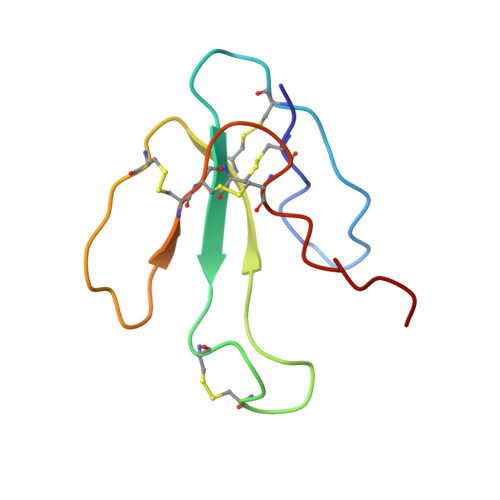
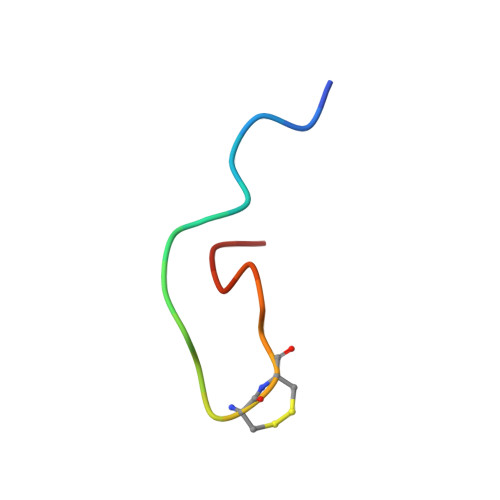
    We report a new, higher resolution NMR structure of alpha-bungarotoxin that defines the structure-determining disulfide core and beta-sheet regions. We further report the NMR structure of the stoichiometric complex formed between alpha-bungarotoxin and a recombinantly expressed 19-mer peptide ((178)IPGKRTESFYECCKEPYPD(196)) derived from the alpha7 subunit of the chick neuronal nicotinic acetylcholine receptor. A comparison of these two structures reveals binding-induced stabilization of the flexible tip of finger II in alpha-bungarotoxin. The conformational rearrangements in the toxin create an extensive binding surface involving both sides of the alpha7 19-mer hairpin-like structure. At the contact zone, Ala(7), Ser(9), and Ile(11) in finger I and Arg(36), Lys(38), Val(39), and Val(40) in finger II of alpha-bungarotoxin interface with Phe(186), Tyr(187), Glu(188), and Tyr(194) in the alpha7 19-mer underscoring the importance of receptor aromatic residues as critical neurotoxin-binding determinants. Superimposing the structure of the complex onto that of the acetylcholine-binding protein (1I9B), a soluble homologue of the extracellular domain of the alpha7 receptor, places alpha-bungarotoxin at the peripheral surface of the inter-subunit interface occluding the agonist-binding site. The disulfide-rich core of alpha-bungarotoxin is suggested to be tilted in the direction of the membrane surface with finger II extending into the proposed ligand-binding cavity.


  • Organizational Affiliation
    • Department of Molecular Pharmacology, Brown University, Providence, Rhode Island 02912, USA.

Macromolecule Content 

  • Total Structure Weight: 10.35 kDa 
  • Atom Count: 708 
  • Modeled Residue Count: 93 
  • Deposited Residue Count: 94 
  • Unique protein chains: 2

Macromolecules

Find similar proteins by:|  3D Structure
Entity ID: 1
MoleculeChains  Sequence LengthOrganismDetailsImage
alpha-bungarotoxin74Bungarus multicinctusMutation(s): 0 
UniProt
Find proteins for P60615 (Bungarus multicinctus)
Explore P60615 
Go to UniProtKB:  P60615
Entity Groups
Sequence Clusters30% Identity50% Identity70% Identity90% Identity95% Identity100% Identity
UniProt GroupP60615
Sequence Annotations
Expand
Reference Sequence
Find similar proteins by:  Sequence   |   3D Structure  
Entity ID: 2
MoleculeChains  Sequence LengthOrganismDetailsImage
neuronal acetylcholine receptor protein, alpha-7 chain20Gallus gallusMutation(s): 1 
UniProt
Find proteins for P22770 (Gallus gallus)
Explore P22770 
Go to UniProtKB:  P22770
Entity Groups
Sequence Clusters30% Identity50% Identity70% Identity90% Identity95% Identity100% Identity
UniProt GroupP22770
Sequence Annotations
Expand
Reference Sequence

Small Molecules

Modified Residues  1 Unique
IDChains TypeFormula2D DiagramParent
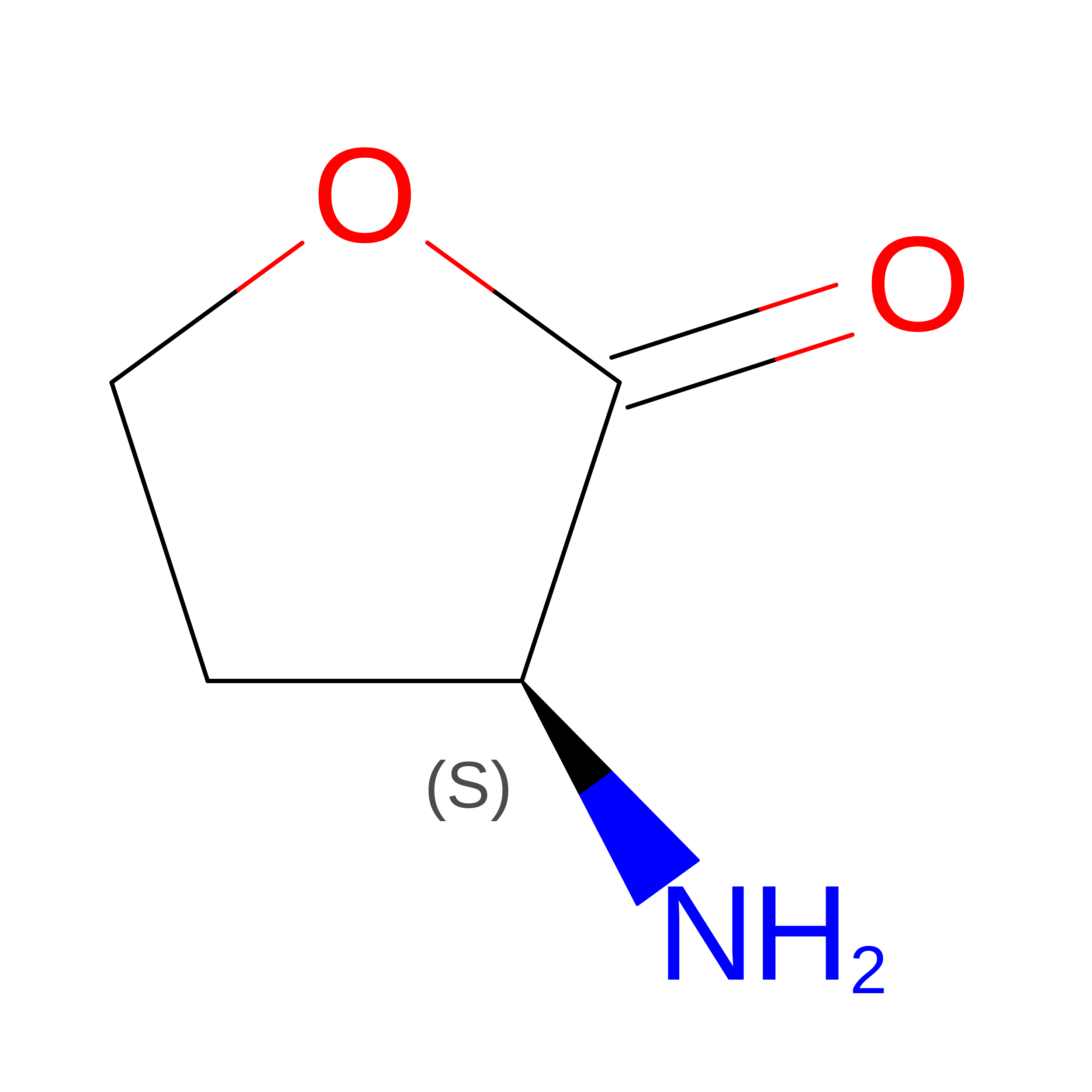
HSL
Query on HSL
B
L-PEPTIDE LINKINGC4 H7 N O2SER

Experimental Data & Validation

Experimental Data

  • Method: SOLUTION NMR
  • Conformers Submitted: 10 
  • Selection Criteria: The submitted conformer models are the 10 with the lowest energy from a pool of over 100 accepted structures that had no restraint violations. 

Structure Validation

View Full Validation Report


Entry History 

Deposition Data

Revision History  (Full details and data files)

  • Version 1.0: 2002-03-13
    Type: Initial release
  • Version 1.1: 2008-04-27
    Changes: Version format compliance
  • Version 1.2: 2011-07-13
    Changes: Version format compliance
  • Version 1.3: 2021-10-27
    Changes: Data collection, Database references, Derived calculations