1KL8 | pdb_00001kl8

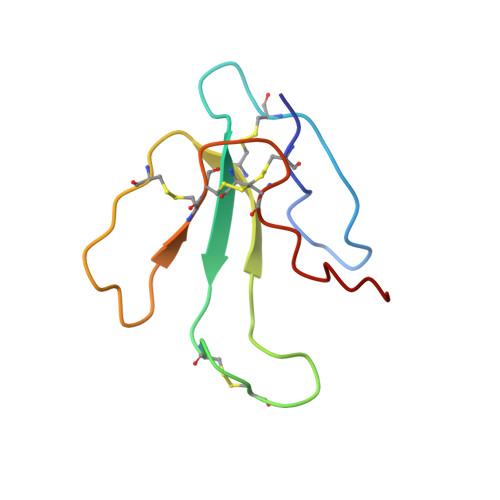
NMR STRUCTURAL ANALYSIS OF THE COMPLEX FORMED BETWEEN ALPHA-BUNGAROTOXIN AND THE PRINCIPAL ALPHA-NEUROTOXIN BINDING SEQUENCE ON THE ALPHA7 SUBUNIT OF A NEURONAL NICOTINIC ACETYLCHOLINE RECEPTOR


Experimental Data Snapshot

  • Method: SOLUTION NMR
  • Conformers Submitted: 

wwPDB Validation 3D Report Full Report

Validation slider image for 1KL8

This is version 1.3 of the entry. See complete history

Literature

NMR structural analysis of alpha-bungarotoxin and its complex with the principal alpha-neurotoxin-binding sequence on the alpha 7 subunit of a neuronal nicotinic acetylcholine receptor.

Moise, L.Piserchio, A.Basus, V.J.Hawrot, E.

(2002) J Biological Chem 277: 12406-12417

  • DOI: https://doi.org/10.1074/jbc.M110320200
  • Primary Citation Related Structures: 
    1KC4, 1KFH, 1KL8

  • PubMed Abstract: 

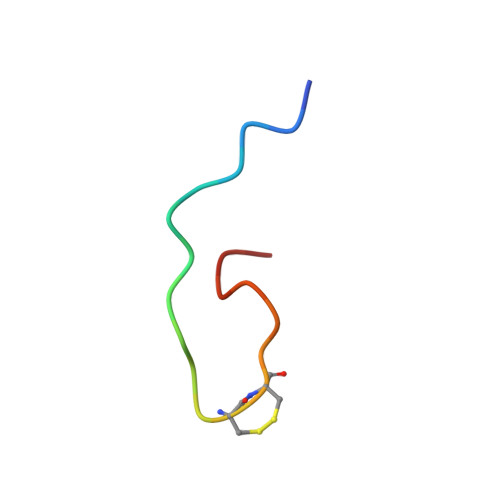
    We report a new, higher resolution NMR structure of alpha-bungarotoxin that defines the structure-determining disulfide core and beta-sheet regions. We further report the NMR structure of the stoichiometric complex formed between alpha-bungarotoxin and a recombinantly expressed 19-mer peptide ((178)IPGKRTESFYECCKEPYPD(196)) derived from the alpha7 subunit of the chick neuronal nicotinic acetylcholine receptor. A comparison of these two structures reveals binding-induced stabilization of the flexible tip of finger II in alpha-bungarotoxin. The conformational rearrangements in the toxin create an extensive binding surface involving both sides of the alpha7 19-mer hairpin-like structure. At the contact zone, Ala(7), Ser(9), and Ile(11) in finger I and Arg(36), Lys(38), Val(39), and Val(40) in finger II of alpha-bungarotoxin interface with Phe(186), Tyr(187), Glu(188), and Tyr(194) in the alpha7 19-mer underscoring the importance of receptor aromatic residues as critical neurotoxin-binding determinants. Superimposing the structure of the complex onto that of the acetylcholine-binding protein (1I9B), a soluble homologue of the extracellular domain of the alpha7 receptor, places alpha-bungarotoxin at the peripheral surface of the inter-subunit interface occluding the agonist-binding site. The disulfide-rich core of alpha-bungarotoxin is suggested to be tilted in the direction of the membrane surface with finger II extending into the proposed ligand-binding cavity.


  • Organizational Affiliation
    • Department of Molecular Pharmacology, Brown University, Providence, Rhode Island 02912, USA.

Macromolecule Content 

  • Total Structure Weight: 10.35 kDa 
  • Atom Count: 708 
  • Modeled Residue Count: 93 
  • Deposited Residue Count: 94 
  • Unique protein chains: 2

Macromolecules

Find similar proteins by:|  3D Structure
Entity ID: 1
MoleculeChains  Sequence LengthOrganismDetailsImage
ALPHA-BUNGAROTOXIN74Bungarus multicinctusMutation(s): 0 
UniProt
Find proteins for P60615 (Bungarus multicinctus)
Explore P60615 
Go to UniProtKB:  P60615
Entity Groups
Sequence Clusters30% Identity50% Identity70% Identity90% Identity95% Identity100% Identity
UniProt GroupP60615
Sequence Annotations
Expand
Reference Sequence
Find similar proteins by:  Sequence   |   3D Structure  
Entity ID: 2
MoleculeChains  Sequence LengthOrganismDetailsImage
NEURONAL ACETYLCHOLINE RECEPTOR PROTEIN, ALPHA-7 CHAIN20Gallus gallusMutation(s): 1 
UniProt
Find proteins for P22770 (Gallus gallus)
Explore P22770 
Go to UniProtKB:  P22770
Entity Groups
Sequence Clusters30% Identity50% Identity70% Identity90% Identity95% Identity100% Identity
UniProt GroupP22770
Sequence Annotations
Expand
Reference Sequence

Small Molecules

Modified Residues  1 Unique
IDChains TypeFormula2D DiagramParent
HSL
Query on HSL
B
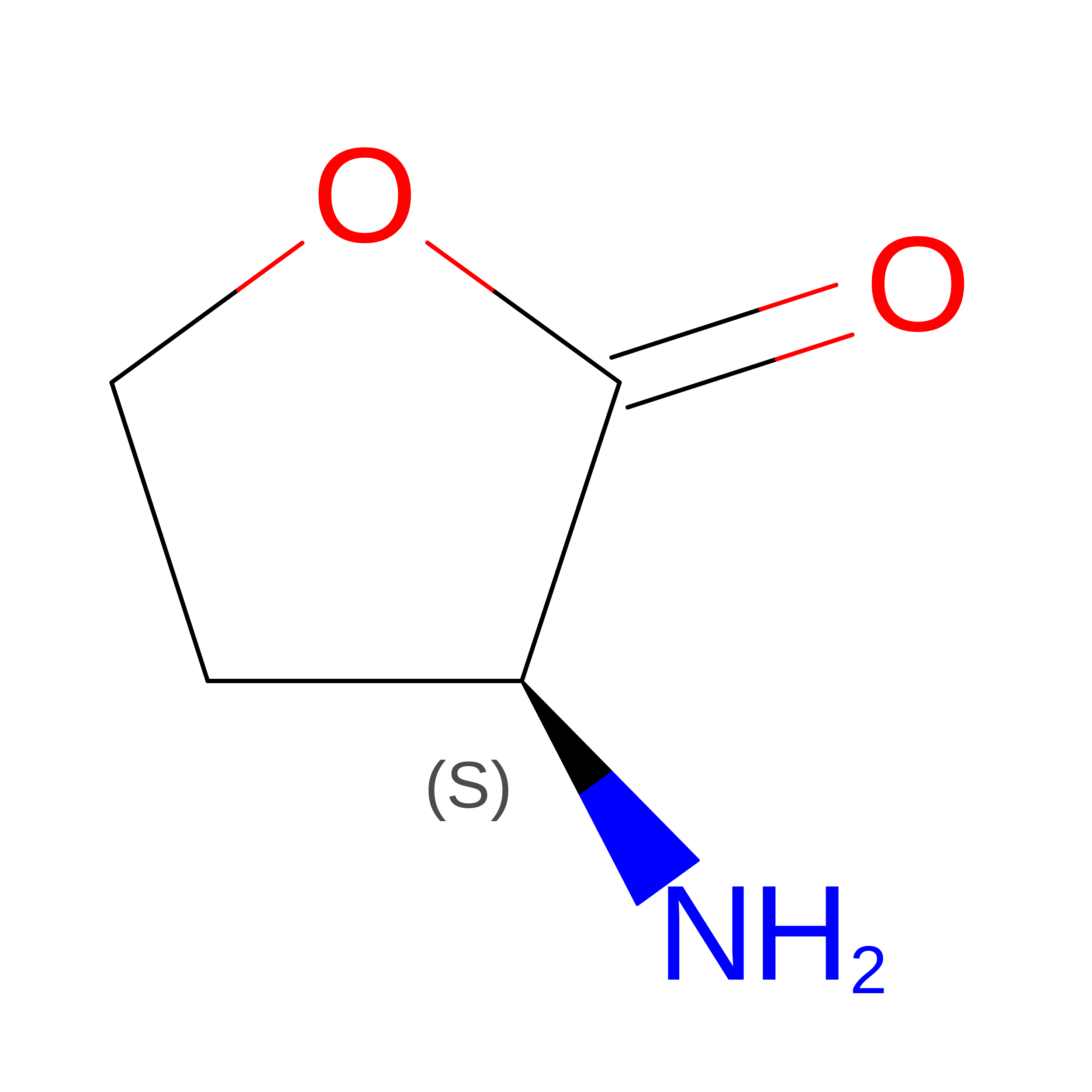
L-PEPTIDE LINKINGC4 H7 N O2SER

Experimental Data & Validation

Experimental Data

  • Method: SOLUTION NMR
  • Conformers Submitted: 

Structure Validation

View Full Validation Report


Entry History 

Deposition Data

Revision History  (Full details and data files)

  • Version 1.0: 2002-03-13
    Type: Initial release
  • Version 1.1: 2008-04-27
    Changes: Version format compliance
  • Version 1.2: 2011-07-13
    Changes: Version format compliance
  • Version 1.3: 2021-10-27
    Changes: Data collection, Database references, Derived calculations