1CO6 | pdb_00001co6

CRYSTAL STRUCTURE OF FERROCYTOCHROME C2 FROM RHODOPSEUDOMONAS VIRIDIS


Experimental Data Snapshot

  • Method: X-RAY DIFFRACTION
  • Resolution: 1.60 Å
  • R-Value Work: 
    0.182 (Depositor), 0.194 (DCC) 

Starting Model: experimental
View more details

wwPDB Validation 3D Report Full Report

Validation slider image for 1CO6

Ligand Structure Quality Assessment 


This is version 2.2 of the entry. See complete history

Literature

Refined crystal structure of ferrocytochrome c2 from Rhodopseudomonas viridis at 1.6 A resolution.

Sogabe, S.Miki, K.

(1995) J Mol Biology 252: 235-246

  • DOI: https://doi.org/10.1006/jmbi.1995.0491
  • Primary Citation Related Structures: 
    1CO6

  • PubMed Abstract: 

    The three-dimensional structure of ferrocytochrome c2 from the purple photosynthetic bacterium Rhodopseudomonas viridis has been refined to a final R-factor of 18.2% for 15,014 unique reflections collected by synchrotron radiation between 6.0 and 1.6 A resolution. The refined model includes 107 amino acid residues, one heme prosthetic group and 125 water molecules. The root-mean-square deviations from the ideal bond lengths and angles were 0.014 A and 3.0 degrees, respectively. The atomic coordinate error was estimated to be less than 0.3 A. A structure comparison of this cytochrome c2 with those of the other c-type cytochromes demonstrated that these cytochromes exhibit a high degree of structural similarity with the exception of the surface loop and the terminal region of the polypeptide chain. The deletion of an intrahelical amino residue distorted the conformation of the alpha-helix and it divided into two pieces. The C-terminal extension of the polypeptide chain caused significant conformational changes of the contact residues compared with the other c-type cytochromes. Of the water molecules conserved in various c-type cytochromes, two are located internally in the vicinity of the heme group. One of these water molecules found in this cytochrome c2 is evolutionarily conserved among eukaryotic cytochromes c. This water molecule is located in the heme proximate environment in a position similar to that of eukaryotic cytochromes c. The position of this water molecule is associated with the oxidation state of the heme iron in electron transfer.


  • Organizational Affiliation
    • Research Laboratory of Resources Utilization, Tokyo Institute of Technology Nagatsuta, Yokohama, Japan.

Macromolecule Content 

  • Total Structure Weight: 12.29 kDa 
  • Atom Count: 1,009 
  • Modeled Residue Count: 107 
  • Deposited Residue Count: 107 
  • Unique protein chains: 1

Macromolecules

Find similar proteins by:|  3D Structure
Entity ID: 1
MoleculeChains  Sequence LengthOrganismDetailsImage
PROTEIN (CYTOCHROME C2)107Blastochloris viridisMutation(s): 0 
Membrane Entity: Yes 
UniProt
Find proteins for P00083 (Blastochloris viridis)
Explore P00083 
Go to UniProtKB:  P00083
Entity Groups
Sequence Clusters30% Identity50% Identity70% Identity90% Identity95% Identity100% Identity
UniProt GroupP00083
Sequence Annotations
Expand
Reference Sequence

Small Molecules

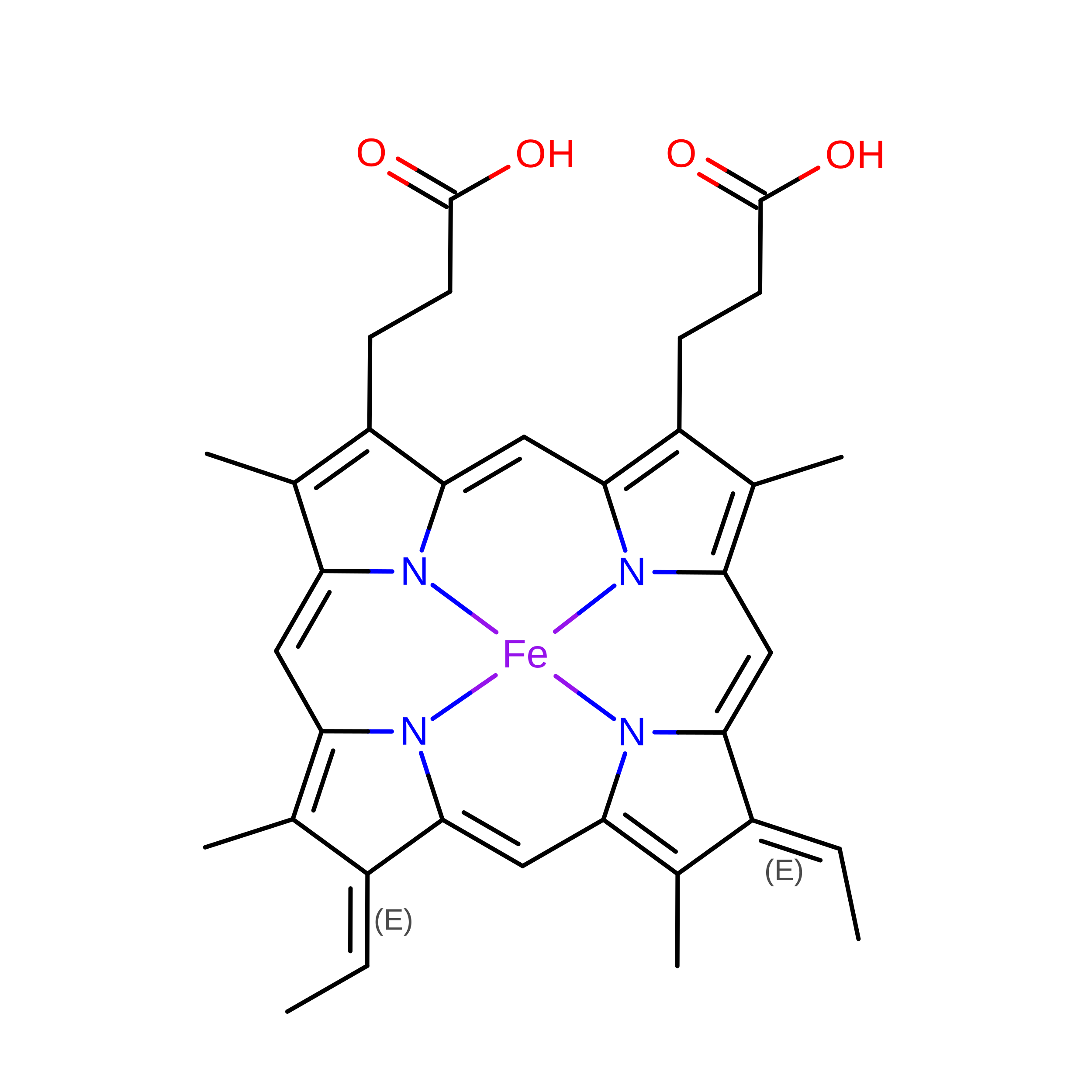
Ligands 1 Unique
IDChains Name / Formula / InChI Key2D Diagram3D Interactions
HEC

Query on HEC


Download:Ideal Coordinates CCD File
B [auth A]HEME C
C34 H34 Fe N4 O4
HXQIYSLZKNYNMH-LJNAALQVSA-N

Experimental Data & Validation

Experimental Data

  • Method: X-RAY DIFFRACTION
  • Resolution: 1.60 Å
  • R-Value Work:  0.182 (Depositor), 0.194 (DCC) 
Space Group: P 32 2 1
Unit Cell:
Length ( Å )Angle ( ˚ )
a = 76.13α = 90
b = 76.13β = 90
c = 40.4γ = 120
Software Package:
Software NamePurpose
PHASERphasing
PROLSQrefinement
WEISdata reduction
PROTEINdata scaling

Structure Validation

View Full Validation Report


Ligand Structure Quality Assessment 


Entry History 

Deposition Data

Revision History  (Full details and data files)

  • Version 1.0: 1999-06-18
    Type: Initial release
  • Version 1.1: 2008-04-26
    Changes: Version format compliance
  • Version 1.2: 2011-07-13
    Changes: Version format compliance
  • Version 1.3: 2017-10-04
    Changes: Refinement description
  • Version 2.0: 2021-03-03
    Changes: Advisory, Atomic model, Data collection, Derived calculations, Non-polymer description, Structure summary
  • Version 2.1: 2023-08-09
    Changes: Data collection, Database references, Refinement description
  • Version 2.2: 2024-11-06
    Changes: Structure summary