1AFC | pdb_00001afc

STRUCTURAL STUDIES OF THE BINDING OF THE ANTI-ULCER DRUG SUCROSE OCTASULFATE TO ACIDIC FIBROBLAST GROWTH FACTOR


Experimental Data Snapshot

  • Method: X-RAY DIFFRACTION
  • Resolution: 2.70 Å
  • R-Value Work: 
    0.204 (Depositor) 
  • R-Value Observed: 
    0.204 (Depositor) 

wwPDB Validation 3D Report Full Report

Validation slider image for 1AFC

This is version 2.1 of the entry. See complete history

Literature

Structural studies of the binding of the anti-ulcer drug sucrose octasulfate to acidic fibroblast growth factor.

Zhu, X.Hsu, B.T.Rees, D.C.

(1993) Structure 1: 27-34

  • DOI: https://doi.org/10.1016/0969-2126(93)90006-3
  • Primary Citation Related Structures: 
    1AFC

  • PubMed Abstract: 

    The anti-ulcer drug sucrose octasulfate (SOS) binds to fibroblast growth factors (FGFs), proteins which stimulate the growth and differentiation of several cell types, including stomach epithelial cells. It is believed that SOS stabilizes FGFs against acid denaturation in the stomach, thus enhancing their ability to stimulate healing of ulcerated tissue. SOS binds to the same site on FGF as heparin and other proteoglycans; in vivo, FGF must bind to cell-surface proteoglycans or to heparin before it can interact with FGF receptors and stimulate growth. The details of this process are not understood. We report the crystal structure of a 1:1 complex between acidic FGF (aFGF) and SOS at 2.7 A resolution. SOS binds to a positively charged region of aFGF, largely composed of residues 112-127, and makes contacts primarily with Lys112, Arg116, Lys118, and Arg122. This region is also important in binding heparin. The overall conformation of aFGF is not changed by binding SOS, although the positions of some side chains in the binding site shift by as much as 6 A. The SOS-FGF crystal structure is consistent with the model that SOS stabilizes FGF by neutralizing several positively charged residues that would destabilize the native structure by electrostatic repulsion. On the basis of this structure, we provide a model for the complex of heparin with an FGF dimer. Such interactions may facilitate FGF receptor dimerization, which may be important in receptor signaling.


  • Organizational Affiliation
    • Division of Chemistry and Chemical Engineering, California Institute of Technology, Pasadena 91125.

Macromolecule Content 

  • Total Structure Weight: 134.83 kDa 
  • Atom Count: 8,304 
  • Modeled Residue Count: 1,016 
  • Deposited Residue Count: 1,120 
  • Unique protein chains: 1

Macromolecules

Find similar proteins by:|  3D Structure
Entity ID: 1
MoleculeChains  Sequence LengthOrganismDetailsImage
ACIDIC FIBROBLAST GROWTH FACTOR
A, B, C, D, E
A, B, C, D, E, F, G, H
140Bos taurusMutation(s): 0 
UniProt
Find proteins for P03968 (Bos taurus)
Explore P03968 
Go to UniProtKB:  P03968
Entity Groups
Sequence Clusters30% Identity50% Identity70% Identity90% Identity95% Identity100% Identity
UniProt GroupP03968
Sequence Annotations
Expand
Reference Sequence

Oligosaccharides

Help  
Entity ID: 2
MoleculeChains Length2D Diagram GlycosylationD Interactions
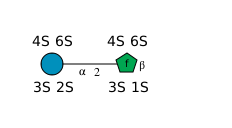
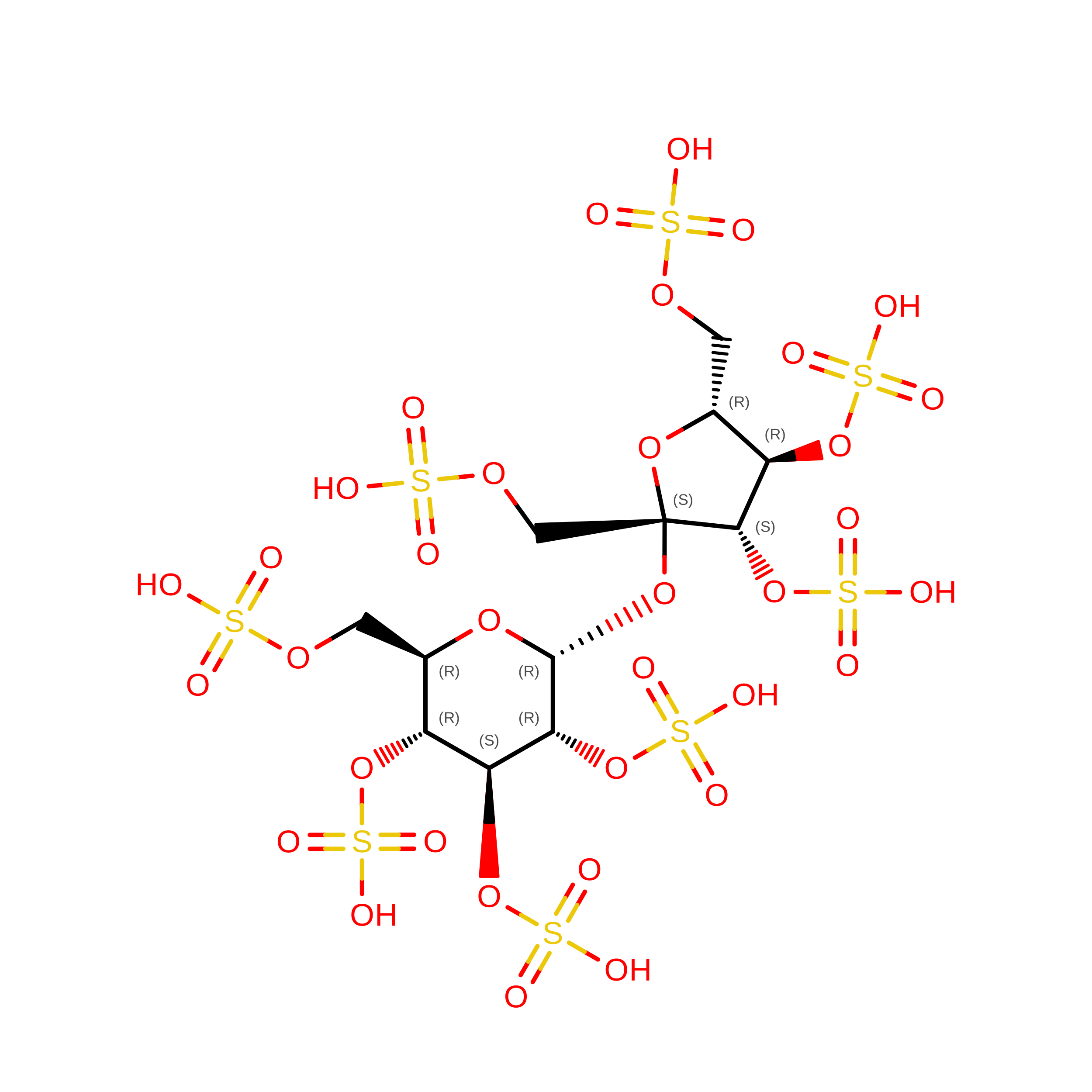
1,3,4,6-tetra-O-sulfo-beta-D-fructofuranose-(2-1)-2,3,4,6-tetra-O-sulfonato-alpha-D-glucopyranose
I, J, K, L, M
I, J, K, L, M, N, O, P
2N/A
Glycosylation Resources
GlyTouCan: G97555GV
GlyCosmos: G97555GV

Biologically Interesting Molecules (External Reference) 

1 Unique

Experimental Data & Validation

Experimental Data

  • Method: X-RAY DIFFRACTION
  • Resolution: 2.70 Å
  • R-Value Work:  0.204 (Depositor) 
  • R-Value Observed: 0.204 (Depositor) 
Space Group: P 32 2 1
Unit Cell:
Length ( Å )Angle ( ˚ )
a = 110.6α = 90
b = 110.6β = 90
c = 172.2γ = 120
Software Package:
Software NamePurpose
X-PLORmodel building
X-PLORrefinement
X-PLORphasing

Structure Validation

View Full Validation Report


Entry History 

Deposition Data

Revision History  (Full details and data files)

  • Version 1.0: 1993-10-31
    Type: Initial release
  • Version 1.1: 2008-03-24
    Changes: Version format compliance
  • Version 1.2: 2011-07-13
    Changes: Version format compliance
  • Version 2.0: 2020-07-29
    Type: Remediation
    Reason: Carbohydrate remediation
    Changes: Advisory, Atomic model, Data collection, Database references, Derived calculations, Non-polymer description, Other, Structure summary
  • Version 2.1: 2024-02-07
    Changes: Data collection, Database references, Structure summary