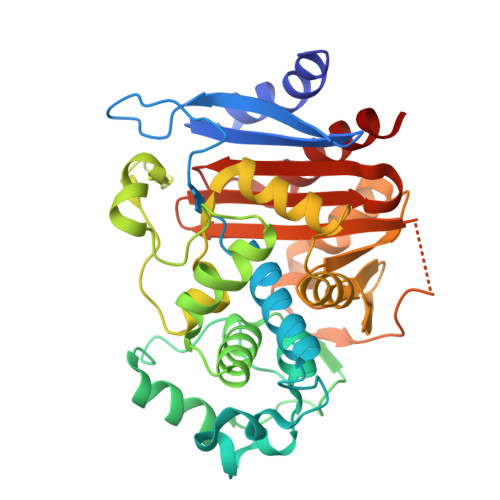
1ZKJ | pdb_00001zkj

Structural Basis for the Extended Substrate Spectrum of CMY-10, a Plasmid-Encoded Class C beta-lactamase


Experimental Data Snapshot

  • Method: X-RAY DIFFRACTION
  • Resolution: 1.55 Å
  • R-Value Free: 
    0.235 (Depositor) 
  • R-Value Work: 
    0.209 (Depositor) 
  • R-Value Observed: 
    0.210 (Depositor) 

wwPDB Validation 3D Report Full Report

Validation slider image for 1ZKJ

This is version 1.3 of the entry. See complete history

Literature

Structural basis for the extended substrate spectrum of CMY-10, a plasmid-encoded class C beta-lactamase.

Kim, J.Y.Jung, H.I.An, Y.J.Lee, J.H.Kim, S.J.Jeong, S.H.Lee, K.J.Suh, P.G.Lee, H.S.Lee, S.H.Cha, S.S.

(2006) Mol Microbiol 60: 907-916

  • DOI: https://doi.org/10.1111/j.1365-2958.2006.05146.x
  • Primary Citation Related Structures: 
    1ZKJ

  • PubMed Abstract: 

    The emergence and dissemination of extended-spectrum (ES) beta-lactamases induce therapeutic failure and a lack of eradication of clinical isolates even by third-generation beta-lactam antibiotics like ceftazidime. CMY-10 is a plasmid-encoded class C beta-lactamase with a wide spectrum of substrates. Unlike the well-studied class C ES beta-lactamase from Enterobacter cloacae GC1, the Omega-loop does not affect the active site conformation and the catalytic activity of CMY-10. Instead, a three-amino-acid deletion in the R2-loop appears to be responsible for the ES activity of CMY-10. According to the crystal structure solved at 1.55 A resolution, the deletion significantly widens the R2 active site, which accommodates the R2 side-chains of beta-lactam antibiotics. This observation led us to demonstrate the hydrolysing activity of CMY-10 towards imipenem with a long R2 substituent. The forced mutational analyses of P99 beta-lactamase reveal that the introduction of deletion mutations into the R2-loop is able to extend the substrate spectrum of class C non-ES beta-lactamases, which is compatible with the isolation of natural class C ES enzymes harbouring deletion mutations in the R2-loop. Consequently, the opening of the R2 active site by the deletion of some residues in the R2-loop can be considered as an operative molecular strategy of class C beta-lactamases to extend their substrate spectrum.


  • Organizational Affiliation
    • School of Biological Sciences, Seoul National University, Seoul 151-742, Republic of Korea.

Macromolecule Content 

  • Total Structure Weight: 39.11 kDa 
  • Atom Count: 3,035 
  • Modeled Residue Count: 350 
  • Deposited Residue Count: 359 
  • Unique protein chains: 1

Macromolecules

Find similar proteins by:|  3D Structure
Entity ID: 1
MoleculeChains  Sequence LengthOrganismDetailsImage
extended-spectrum beta-lactamase359Klebsiella aerogenesMutation(s): 0 
EC: 3.5.2.6
UniProt
Find proteins for Q99QC1 (Klebsiella aerogenes)
Explore Q99QC1 
Go to UniProtKB:  Q99QC1
Entity Groups
Sequence Clusters30% Identity50% Identity70% Identity90% Identity95% Identity100% Identity
UniProt GroupQ99QC1
Sequence Annotations
Expand
Reference Sequence

Small Molecules

Ligands 2 Unique
IDChains Name / Formula / InChI Key2D Diagram3D Interactions
ZN

Query on ZN


Download:Ideal Coordinates CCD File
B [auth A]
C [auth A]
D [auth A]
E [auth A]
F [auth A]
B [auth A],
C [auth A],
D [auth A],
E [auth A],
F [auth A],
G [auth A],
H [auth A],
I [auth A]
ZINC ION
Zn
PTFCDOFLOPIGGS-UHFFFAOYSA-N
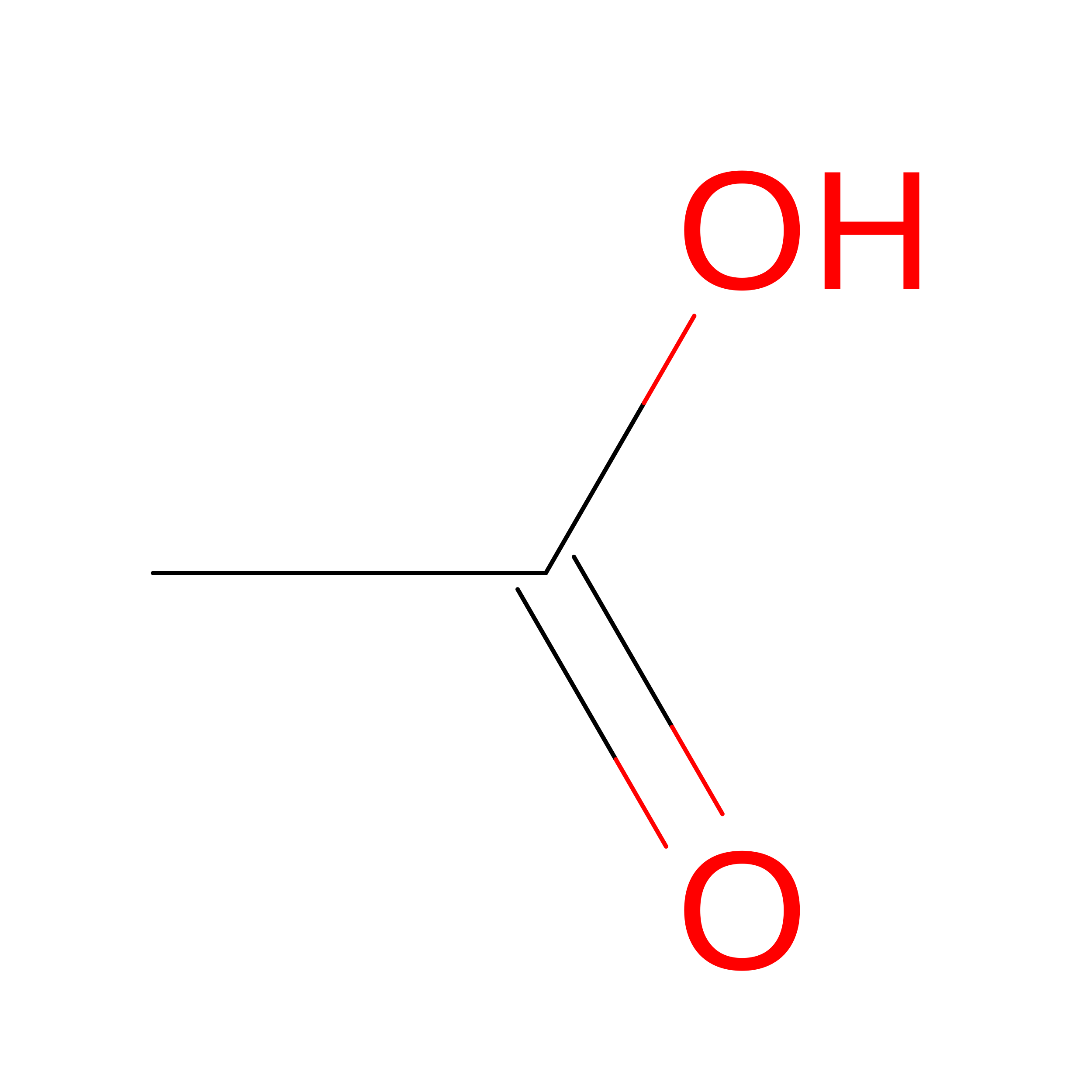
ACY

Query on ACY


Download:Ideal Coordinates CCD File
J [auth A],
K [auth A],
L [auth A],
M [auth A]
ACETIC ACID
C2 H4 O2
QTBSBXVTEAMEQO-UHFFFAOYSA-N

Experimental Data & Validation

Experimental Data

  • Method: X-RAY DIFFRACTION
  • Resolution: 1.55 Å
  • R-Value Free:  0.235 (Depositor) 
  • R-Value Work:  0.209 (Depositor) 
  • R-Value Observed: 0.210 (Depositor) 
Space Group: P 1 21 1
Unit Cell:
Length ( Å )Angle ( ˚ )
a = 49.703α = 90
b = 59.296β = 103.08
c = 63.856γ = 90
Software Package:
Software NamePurpose
CNSrefinement
PROTEUM PLUSdata reduction
SCALEPACKdata scaling
CNSphasing

Structure Validation

View Full Validation Report


Entry History 

Deposition Data

Revision History  (Full details and data files)

  • Version 1.0: 2006-04-18
    Type: Initial release
  • Version 1.1: 2008-04-30
    Changes: Version format compliance
  • Version 1.2: 2011-07-13
    Changes: Version format compliance
  • Version 1.3: 2024-03-13
    Changes: Data collection, Database references, Derived calculations