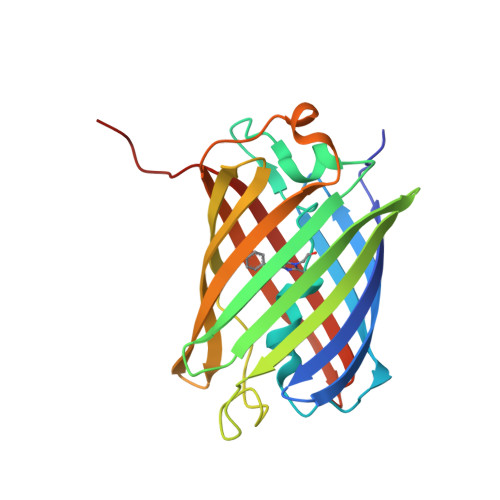
1YZW | pdb_00001yzw

The 2.1A Crystal Structure of the Far-red Fluorescent Protein HcRed: Inherent Conformational Flexibility of the Chromophore


Experimental Data Snapshot

  • Method: X-RAY DIFFRACTION
  • Resolution: 2.10 Å
  • R-Value Free: 
    0.266 (Depositor), 0.279 (DCC) 
  • R-Value Work: 
    0.223 (Depositor), 0.238 (DCC) 
  • R-Value Observed: 
    0.225 (Depositor) 

wwPDB Validation 3D Report Full Report

Validation slider image for 1YZW

This is version 3.0 of the entry. See complete history

Literature

The 2.1A Crystal Structure of the Far-red Fluorescent Protein HcRed: Inherent Conformational Flexibility of the Chromophore

Wilmann, P.G.Petersen, J.Pettikiriarachchi, A.Buckle, A.M.Smith, S.C.Olsen, S.Perugini, M.A.Devenish, R.J.Prescott, M.Rossjohn, J.

(2005) J Mol Biology 349: 223-237

  • DOI: https://doi.org/10.1016/j.jmb.2005.03.020
  • Primary Citation Related Structures: 
    1YZW

  • PubMed Abstract: 

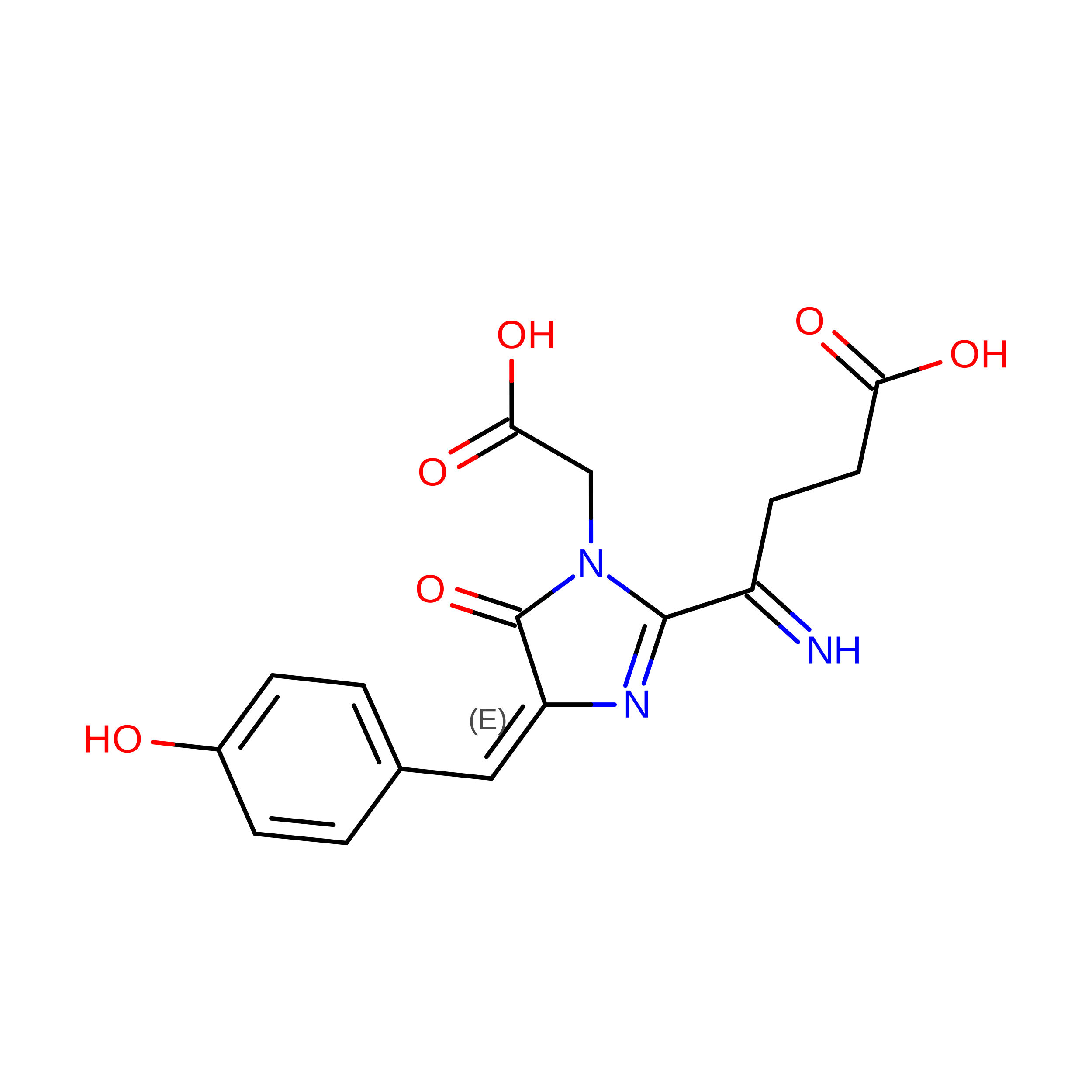
    We have determined the crystal structure of HcRed, a far-red fluorescent protein isolated from Heteractis crispa, to 2.1A resolution. HcRed was observed to form a dimer, in contrast to the monomeric form of green fluorescent protein (GFP) or the tetrameric forms of the GFP-like proteins (eqFP611, Rtms5 and DsRed). Unlike the well-defined chromophore conformation observed in GFP and the GFP-like proteins, the HcRed chromophore was observed to be considerably mobile. Within the HcRed structure, the cyclic tripeptide chromophore, Glu(64)-Tyr(65)-Gly(66), was observed to adopt both a cis coplanar and a trans non-coplanar conformation. As a result of these two conformations, the hydroxyphenyl moiety of the chromophore makes distinct interactions within the interior of the beta-can. These data together with a quantum chemical model of the chromophore, suggest the cis coplanar conformation to be consistent with the fluorescent properties of HcRed, and the trans non-coplanar conformation to be consistent with non-fluorescent properties of hcCP, the chromoprotein parent of HcRed. Moreover, within the GFP-like family, it appears that where conformational freedom is permissible then flexibility in the chromophore conformation is possible.


  • Organizational Affiliation
    • The Protein Crystallography Unit, Monash Centre for Synchrotron Science, School of Biomedical Sciences, Monash University, Clayton, Vic. 3800, Australia.

Macromolecule Content 

  • Total Structure Weight: 102.81 kDa 
  • Atom Count: 7,562 
  • Modeled Residue Count: 884 
  • Deposited Residue Count: 900 
  • Unique protein chains: 1

Macromolecules

Find similar proteins by:|  3D Structure
Entity ID: 1
MoleculeChains  Sequence LengthOrganismDetailsImage
GFP-like non-fluorescent chromoprotein
A, B, C, D
225Radianthus crispaMutation(s): 1 
UniProt
Find proteins for Q95W85 (Radianthus crispa)
Explore Q95W85 
Go to UniProtKB:  Q95W85
Entity Groups
Sequence Clusters30% Identity50% Identity70% Identity90% Identity95% Identity100% Identity
UniProt GroupQ95W85
Sequence Annotations
Expand
Reference Sequence

Small Molecules

Modified Residues  1 Unique
IDChains TypeFormula2D DiagramParent
CRU
Query on CRU
A, B, C, D
L-PEPTIDE LINKINGC16 H15 N3 O6GLU, TYR, GLY

Experimental Data & Validation

Experimental Data

  • Method: X-RAY DIFFRACTION
  • Resolution: 2.10 Å
  • R-Value Free:  0.266 (Depositor), 0.279 (DCC) 
  • R-Value Work:  0.223 (Depositor), 0.238 (DCC) 
  • R-Value Observed: 0.225 (Depositor) 
Space Group: P 21 21 21
Unit Cell:
Length ( Å )Angle ( ˚ )
a = 76.221α = 90
b = 120.733β = 90
c = 118.469γ = 90
Software Package:
Software NamePurpose
REFMACrefinement

Structure Validation

View Full Validation Report


Entry History 

Deposition Data

Revision History  (Full details and data files)

  • Version 1.0: 2005-05-17
    Type: Initial release
  • Version 1.1: 2008-04-30
    Changes: Version format compliance
  • Version 1.2: 2011-07-13
    Changes: Version format compliance
  • Version 2.0: 2023-11-15
    Changes: Atomic model, Data collection, Database references, Derived calculations
  • Version 2.1: 2024-10-30
    Changes: Structure summary
  • Version 3.0: 2026-03-18
    Changes: Polymer sequence