1YWT | pdb_00001ywt

Crystal structure of the human sigma isoform of 14-3-3 in complex with a mode-1 phosphopeptide


Experimental Data Snapshot

  • Method: X-RAY DIFFRACTION
  • Resolution: 2.40 Å
  • R-Value Free: 
    0.283 (Depositor), 0.281 (DCC) 
  • R-Value Work: 
    0.233 (Depositor), 0.233 (DCC) 
  • R-Value Observed: 
    0.233 (Depositor) 

Starting Model: experimental
View more details

wwPDB Validation 3D Report Full Report

Validation slider image for 1YWT

This is version 1.4 of the entry. See complete history

Literature

A structural basis for 14-3-3sigma functional specificity.

Wilker, E.W.Grant, R.A.Artim, S.C.Yaffe, M.B.

(2005) J Biological Chem 280: 18891-18898

  • DOI: https://doi.org/10.1074/jbc.M500982200
  • Primary Citation Related Structures: 
    1YWT

  • PubMed Abstract: 

    The 14-3-3 family of proteins includes seven isotypes in mammalian cells that play numerous diverse roles in intracellular signaling. Most 14-3-3 proteins form homodimers and mixed heterodimers between different isotypes, with overlapping roles in ligand binding. In contrast, one mammalian isoform, 14-3-3sigma, expressed primarily in epithelial cells, appears to play a unique role in the cellular response to DNA damage and in human oncogenesis. The biological and structural basis for these 14-3-3sigma-specific functions is unknown. We demonstrate that endogenous 14-3-3sigma preferentially forms homodimers in cells. We have solved the x-ray crystal structure of 14-3-3sigma bound to an optimal phosphopeptide ligand at 2.4 angstroms resolution. The structure reveals the presence of stabilizing ring-ring and salt bridge interactions unique to the 14-3-3sigma homodimer structure and potentially destabilizing electrostatic interactions between subunits in 14-3-3sigma-containing heterodimers, rationalizing preferential homodimerization of 14-3-3sigma in vivo. The interaction of the phosphopeptide with 14-3-3 reveals a conserved mechanism for phospho-dependent ligand binding, implying that the phosphopeptide binding cleft is not the critical determinant of the unique biological properties of 14-3-3sigma. Instead, the structure suggests a second ligand binding site involved in 14-3-3sigma-specific ligand discrimination. We have confirmed this by site-directed mutagenesis of three sigma-specific residues that uniquely define this site. Mutation of these residues to the alternative sequence that is absolutely conserved in all other 14-3-3 isotypes confers upon 14-3-3sigma the ability to bind to Cdc25C, a ligand that is known to bind to other 14-3-3 proteins but not to sigma.


  • Organizational Affiliation
    • Center for Cancer Research, Department of Biology and Division of Biological Engineering, Massachsuetts Institute of Technology, Cambridge, Massachusetts 02139, USA.

Macromolecule Content 

  • Total Structure Weight: 58.49 kDa 
  • Atom Count: 3,708 
  • Modeled Residue Count: 460 
  • Deposited Residue Count: 520 
  • Unique protein chains: 2

Macromolecules

Find similar proteins by:|  3D Structure
Entity ID: 1
MoleculeChains  Sequence LengthOrganismDetailsImage
14-3-3 protein sigma
A, B
248Homo sapiensMutation(s): 0 
Gene Names: SFNHME1
UniProt & NIH Common Fund Data Resources
Find proteins for P31947 (Homo sapiens)
Explore P31947 
Go to UniProtKB:  P31947
PHAROS:  P31947
GTEx:  ENSG00000175793 
Entity Groups
Sequence Clusters30% Identity50% Identity70% Identity90% Identity95% Identity100% Identity
UniProt GroupP31947
Sequence Annotations
Expand
Reference Sequence
Find similar proteins by:  Sequence   |   3D Structure  
Entity ID: 2
MoleculeChains  Sequence LengthOrganismDetailsImage
synthetic optimal phosphopeptide (mode-1)
C, D
12N/AMutation(s): 0 

Small Molecules

Ligands 1 Unique
IDChains Name / Formula / InChI Key2D Diagram3D Interactions
CA

Query on CA


Download:Ideal Coordinates CCD File
E [auth B]CALCIUM ION
Ca
BHPQYMZQTOCNFJ-UHFFFAOYSA-N
Modified Residues  1 Unique
IDChains TypeFormula2D DiagramParent
SEP
Query on SEP
C, D
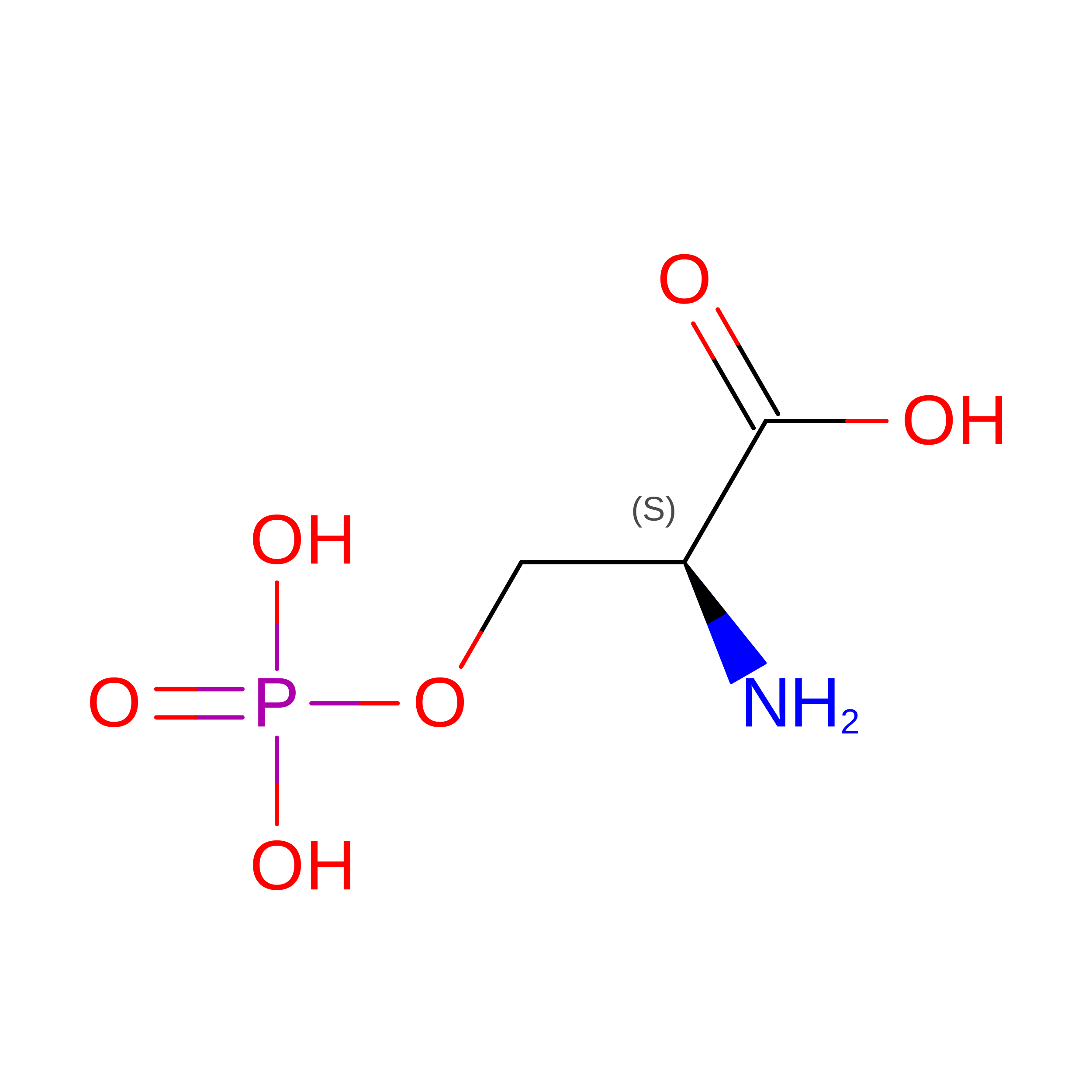
L-PEPTIDE LINKINGC3 H8 N O6 PSER

Experimental Data & Validation

Experimental Data

  • Method: X-RAY DIFFRACTION
  • Resolution: 2.40 Å
  • R-Value Free:  0.283 (Depositor), 0.281 (DCC) 
  • R-Value Work:  0.233 (Depositor), 0.233 (DCC) 
  • R-Value Observed: 0.233 (Depositor) 
Space Group: C 2 2 21
Unit Cell:
Length ( Å )Angle ( ˚ )
a = 56.173α = 90
b = 137.093β = 90
c = 155.313γ = 90
Software Package:
Software NamePurpose
CNSrefinement
HKL-2000data reduction
SCALEPACKdata scaling
AMoREphasing

Structure Validation

View Full Validation Report


Entry History 

Deposition Data

Revision History  (Full details and data files)

  • Version 1.0: 2005-03-01
    Type: Initial release
  • Version 1.1: 2008-04-30
    Changes: Version format compliance
  • Version 1.2: 2011-07-13
    Changes: Version format compliance
  • Version 1.3: 2023-08-23
    Changes: Data collection, Database references, Derived calculations, Refinement description
  • Version 1.4: 2024-10-09
    Changes: Structure summary