1YVD | pdb_00001yvd

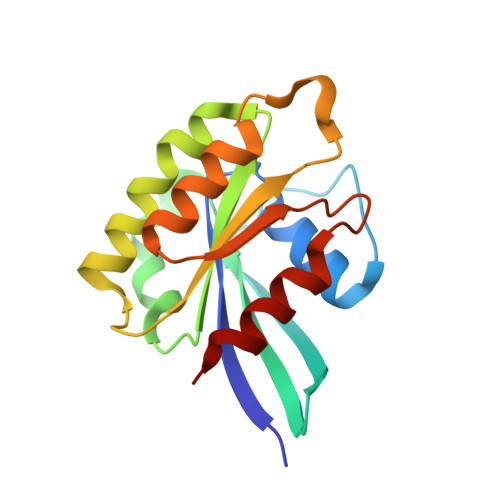
GppNHp-Bound Rab22 GTPase


Experimental Data Snapshot

  • Method: X-RAY DIFFRACTION
  • Resolution: 1.93 Å
  • R-Value Free: 
    0.259 (Depositor), 0.263 (DCC) 
  • R-Value Work: 
    0.190 (Depositor) 
  • R-Value Observed: 
    0.193 (Depositor) 

Starting Model: experimental
View more details

wwPDB Validation 3D Report Full Report

Validation slider image for 1YVD

Ligand Structure Quality Assessment 


This is version 1.4 of the entry. See complete history

Literature

Structural basis of family-wide Rab GTPase recognition by rabenosyn-5.

Eathiraj, S.Pan, X.Ritacco, C.Lambright, D.G.

(2005) Nature 436: 415-419

  • DOI: https://doi.org/10.1038/nature03798
  • Primary Citation Related Structures: 
    1YU9, 1YVD, 1YZK, 1YZL, 1YZM, 1YZN, 1YZQ, 1YZT, 1YZU, 1Z06, 1Z07, 1Z08, 1Z0A, 1Z0D, 1Z0F, 1Z0I, 1Z0J, 1Z0K, 1Z22, 1Z2A

  • PubMed Abstract: 

    Rab GTPases regulate all stages of membrane trafficking, including vesicle budding, cargo sorting, transport, tethering and fusion. In the inactive (GDP-bound) conformation, accessory factors facilitate the targeting of Rab GTPases to intracellular compartments. After nucleotide exchange to the active (GTP-bound) conformation, Rab GTPases interact with functionally diverse effectors including lipid kinases, motor proteins and tethering complexes. How effectors distinguish between homologous Rab GTPases represents an unresolved problem with respect to the specificity of vesicular trafficking. Using a structural proteomic approach, we have determined the specificity and structural basis underlying the interaction of the multivalent effector rabenosyn-5 with the Rab family. The results demonstrate that even the structurally similar effector domains in rabenosyn-5 can achieve highly selective recognition of distinct subsets of Rab GTPases exclusively through interactions with the switch and interswitch regions. The observed specificity is determined at a family-wide level by structural diversity in the active conformation, which governs the spatial disposition of critical conserved recognition determinants, and by a small number of both positive and negative sequence determinants that allow further discrimination between Rab GTPases with similar switch conformations.


  • Organizational Affiliation
    • Program in Molecular Medicine, Department of Biochemistry & Molecular Pharmacology, University of Massachusetts Medical School, Worcester, Massachusetts 01605, USA.

Macromolecule Content 

  • Total Structure Weight: 19.64 kDa 
  • Atom Count: 1,593 
  • Modeled Residue Count: 166 
  • Deposited Residue Count: 169 
  • Unique protein chains: 1

Macromolecules

Find similar proteins by:|  3D Structure
Entity ID: 1
MoleculeChains  Sequence LengthOrganismDetailsImage
Ras-related protein Rab-22A169Mus musculusMutation(s): 0 
Gene Names: Rab22aRab22
EC: 3.6.5.2
UniProt
Find proteins for P35285 (Mus musculus)
Explore P35285 
Go to UniProtKB:  P35285
Entity Groups
Sequence Clusters30% Identity50% Identity70% Identity90% Identity95% Identity100% Identity
UniProt GroupP35285
Sequence Annotations
Expand
Reference Sequence

Small Molecules

Ligands 2 Unique
IDChains Name / Formula / InChI Key2D Diagram3D Interactions
GNP

Query on GNP


Download:Ideal Coordinates CCD File
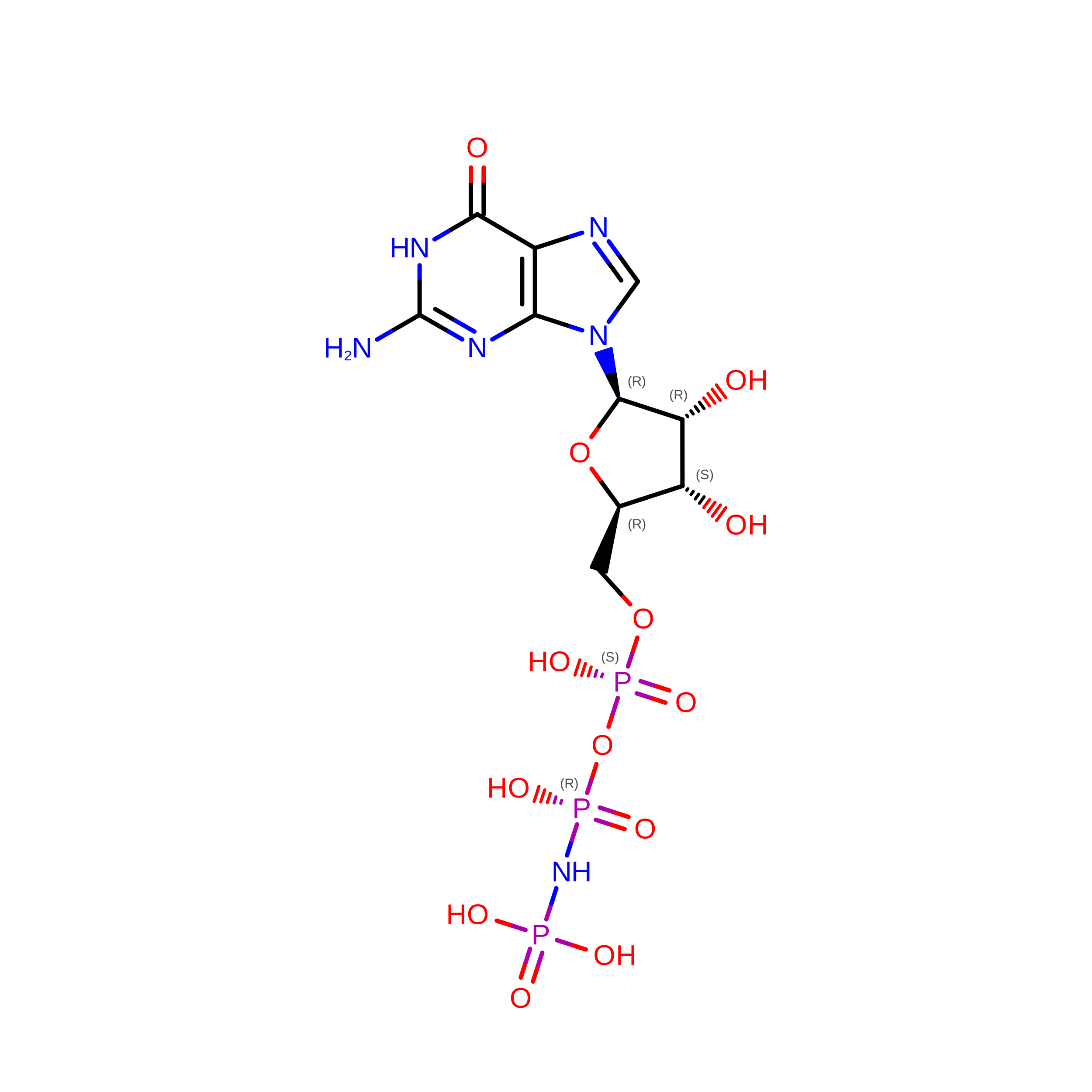
C [auth A]PHOSPHOAMINOPHOSPHONIC ACID-GUANYLATE ESTER
C10 H17 N6 O13 P3
UQABYHGXWYXDTK-UUOKFMHZSA-N
MG

Query on MG


Download:Ideal Coordinates CCD File
B [auth A]MAGNESIUM ION
Mg
JLVVSXFLKOJNIY-UHFFFAOYSA-N

Experimental Data & Validation

Experimental Data

  • Method: X-RAY DIFFRACTION
  • Resolution: 1.93 Å
  • R-Value Free:  0.259 (Depositor), 0.263 (DCC) 
  • R-Value Work:  0.190 (Depositor) 
  • R-Value Observed: 0.193 (Depositor) 
Space Group: P 43 21 2
Unit Cell:
Length ( Å )Angle ( ˚ )
a = 45.536α = 90
b = 45.536β = 90
c = 150.338γ = 90
Software Package:
Software NamePurpose
REFMACrefinement
DENZOdata reduction
SCALEPACKdata scaling
AMoREphasing

Structure Validation

View Full Validation Report


Ligand Structure Quality Assessment 


Entry History 

Deposition Data

Revision History  (Full details and data files)

  • Version 1.0: 2005-07-26
    Type: Initial release
  • Version 1.1: 2008-04-30
    Changes: Version format compliance
  • Version 1.2: 2011-07-13
    Changes: Version format compliance
  • Version 1.3: 2024-02-14
    Changes: Data collection, Database references, Derived calculations
  • Version 1.4: 2024-04-03
    Changes: Refinement description