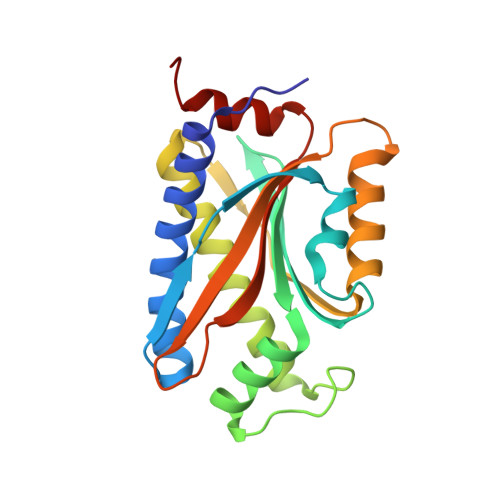
1XKR | pdb_00001xkr

X-ray Structure of Thermotoga maritima CheC


Experimental Data Snapshot

  • Method: X-RAY DIFFRACTION
  • Resolution: 1.75 Å
  • R-Value Free: 
    0.239 (Depositor), 0.252 (DCC) 
  • R-Value Work: 
    0.226 (Depositor), 0.235 (DCC) 
  • R-Value Observed: 
    0.226 (Depositor) 

wwPDB Validation 3D Report Full Report

Validation slider image for 1XKR

This is version 1.3 of the entry. See complete history

Literature

Structure and Function of an Unusual Family of Protein Phosphatases; The Bacterial Chemotaxis Proteins CheC and CheX

Park, S.Y.Chao, X.Gonzalez-Bonet, G.Beel, B.D.Bilwes, A.M.Crane, B.R.

(2004) Mol Cell 16: 563-574

  • DOI: https://doi.org/10.1016/j.molcel.2004.10.018
  • Primary Citation Related Structures: 
    1XKO, 1XKR

  • PubMed Abstract: 

    In bacterial chemotaxis, phosphorylated CheY levels control the sense of flagella rotation and thereby determine swimming behavior. In E. coli, CheY dephosphorylation by CheZ extinguishes the switching signal. But, instead of CheZ, many chemotactic bacteria contain CheC, CheD, and/or CheX. The crystal structures of T. maritima CheC and CheX reveal a common fold unlike that of any other known protein. Unlike CheC, CheX dimerizes via a continuous beta sheet between subunits. T. maritima CheC, as well as CheX, dephosphorylate CheY, although CheC requires binding of CheD to achieve the activity of CheX. Structural analyses identified one conserved active site in CheX and two in CheC; mutations therein reduce CheY-phosphatase activity, but only mutants of two invariant asparagine residues are completely inactive even in the presence of CheD. Our structures indicate that the flagellar switch components FliY and FliM resemble CheC more closely than CheX, but attribute phosphatase activity only to FliY.


  • Organizational Affiliation
    • Department of Chemistry and Chemical Biology, Cornell University, Ithaca, New York 14850, USA.

Macromolecule Content 

  • Total Structure Weight: 22.71 kDa 
  • Atom Count: 1,761 
  • Modeled Residue Count: 205 
  • Deposited Residue Count: 206 
  • Unique protein chains: 1

Macromolecules

Find similar proteins by:|  3D Structure
Entity ID: 1
MoleculeChains  Sequence LengthOrganismDetailsImage
chemotaxis protein CheC206Thermotoga maritimaMutation(s): 0 
EC: 3
UniProt
Find proteins for Q9X006 (Thermotoga maritima (strain ATCC 43589 / DSM 3109 / JCM 10099 / NBRC 100826 / MSB8))
Explore Q9X006 
Go to UniProtKB:  Q9X006
Entity Groups
Sequence Clusters30% Identity50% Identity70% Identity90% Identity95% Identity100% Identity
UniProt GroupQ9X006
Sequence Annotations
Expand
Reference Sequence

Experimental Data & Validation

Experimental Data

  • Method: X-RAY DIFFRACTION
  • Resolution: 1.75 Å
  • R-Value Free:  0.239 (Depositor), 0.252 (DCC) 
  • R-Value Work:  0.226 (Depositor), 0.235 (DCC) 
  • R-Value Observed: 0.226 (Depositor) 
Space Group: P 43 21 2
Unit Cell:
Length ( Å )Angle ( ˚ )
a = 66.3α = 90
b = 66.3β = 90
c = 138.3γ = 90
Software Package:
Software NamePurpose
HKL-2000data collection
SCALEPACKdata scaling
SOLVEphasing
CNSrefinement
HKL-2000data reduction

Structure Validation

View Full Validation Report


Entry History 

Deposition Data

Revision History  (Full details and data files)

  • Version 1.0: 2004-12-07
    Type: Initial release
  • Version 1.1: 2008-04-30
    Changes: Version format compliance
  • Version 1.2: 2011-07-13
    Changes: Version format compliance
  • Version 1.3: 2024-02-14
    Changes: Data collection, Database references