1XK5 | pdb_00001xk5

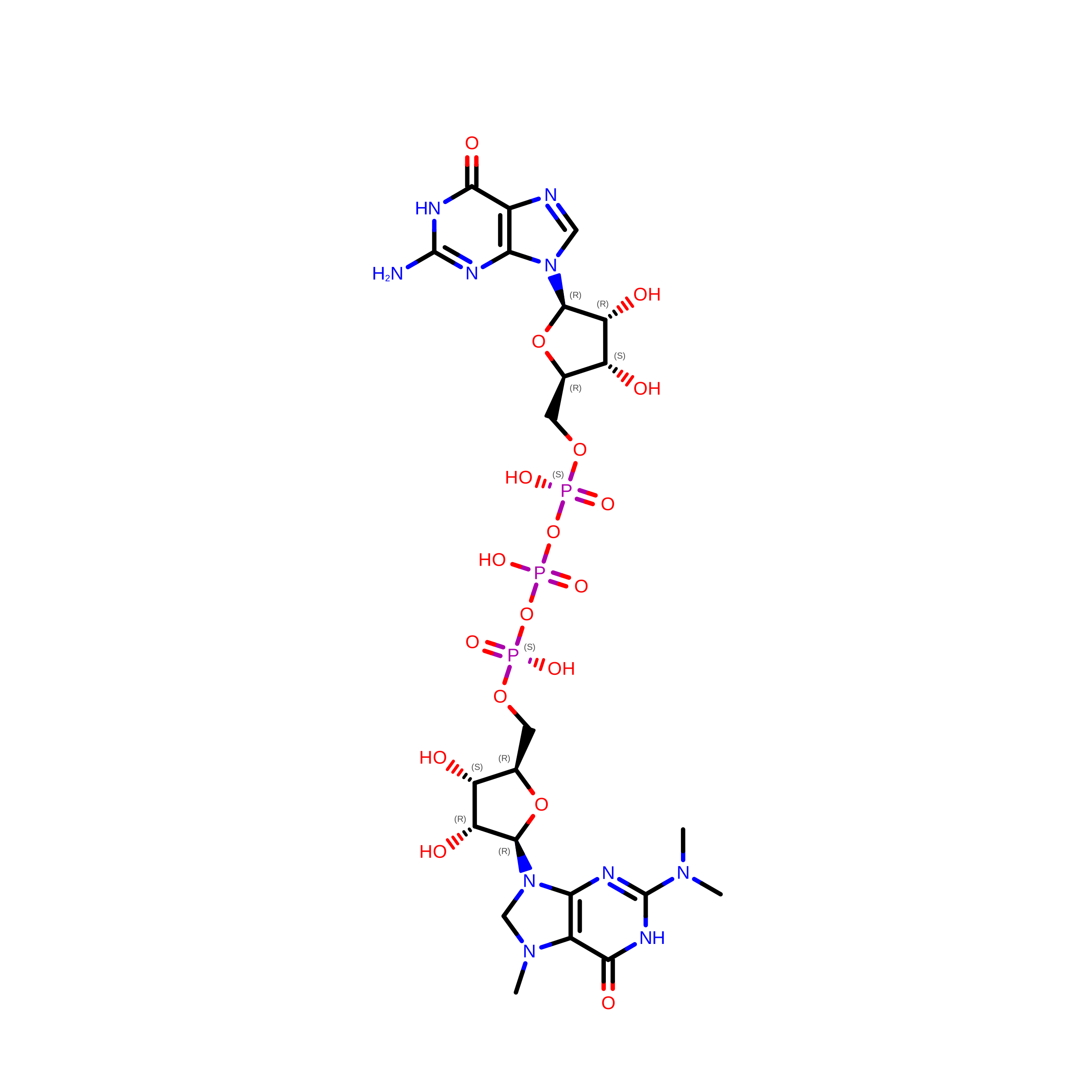
Crystal structure of the m3G-cap-binding domain of snurportin1 in complex with a m3GpppG-cap dinucleotide


Experimental Data Snapshot

  • Method: X-RAY DIFFRACTION
  • Resolution: 2.40 Å
  • R-Value Free: 
    0.276 (Depositor), 0.260 (DCC) 
  • R-Value Work: 
    0.227 (Depositor), 0.226 (DCC) 

wwPDB Validation 3D Report Full Report

Validation slider image for 1XK5

Ligand Structure Quality Assessment 


This is version 1.3 of the entry. See complete history

Literature

Structural basis for m(3)G-cap-mediated nuclear import of spliceosomal UsnRNPs by snurportin1

Strasser, A.Dickmanns, A.Luehrmann, R.Ficner, R.

(2005) EMBO J 24: 2235-2243

  • DOI: https://doi.org/10.1038/sj.emboj.7600701
  • Primary Citation Related Structures: 
    1XK5

  • PubMed Abstract: 

    In higher eukaryotes the biogenesis of spliceosomal UsnRNPs involves a nucleocytoplasmic shuttling cycle. After the m7G-cap-dependent export of the snRNAs U1, U2, U4 and U5 to the cytoplasm, each of these snRNAs associates with seven Sm proteins. Subsequently, the m7G-cap is hypermethylated to the 2,2,7-trimethylguanosine (m3G)-cap. The import adaptor snurportin1 recognises the m3G-cap and facilitates the nuclear import of the UsnRNPs by binding to importin-beta. Here we report the crystal structure of the m3G-cap-binding domain of snurportin1 with bound m3GpppG at 2.4 A resolution, revealing a structural similarity to the mRNA-guanyly-transferase. Snurportin1 binds both the hypermethylated cap and the first nucleotide of the RNA in a stacked conformation. This binding mode differs significantly from that of the m7G-cap-binding proteins Cap-binding protein 20 (CBP20), eukaryotic initiation factor 4E (eIF4E) and viral protein 39 (VP39). The specificity of the m3G-cap recognition by snurportin1 was evaluated by fluorescence spectroscopy, demonstrating the importance of a highly solvent exposed tryptophan for the discrimination of m7G-capped RNAs. The critical role of this tryptophan and as well of a tryptophan continuing the RNA base stack was confirmed by nuclear import assays and cap-binding activity tests using several snurportin1 mutants.


  • Organizational Affiliation
    • Department of Molecular Structural Biology, Institute for Microbiology and Genetics, University Göttingen, Germany.

Macromolecule Content 

  • Total Structure Weight: 23.98 kDa 
  • Atom Count: 1,765 
  • Modeled Residue Count: 204 
  • Deposited Residue Count: 204 
  • Unique protein chains: 1

Macromolecules

Find similar proteins by:|  3D Structure
Entity ID: 1
MoleculeChains  Sequence LengthOrganismDetailsImage
snurportin-1204Homo sapiensMutation(s): 0 
UniProt & NIH Common Fund Data Resources
Find proteins for O95149 (Homo sapiens)
Explore O95149 
Go to UniProtKB:  O95149
GTEx:  ENSG00000169371 
Entity Groups
Sequence Clusters30% Identity50% Identity70% Identity90% Identity95% Identity100% Identity
UniProt GroupO95149
Sequence Annotations
Expand
Reference Sequence

Small Molecules

Ligands 1 Unique
IDChains Name / Formula / InChI Key2D Diagram3D Interactions
TPG

Query on TPG


Download:Ideal Coordinates CCD File
B [auth A]2,2,7-TRIMETHYL-GUANOSINE-5'-TRIPHOSPHATE-5'-GUANOSINE
C23 H35 N10 O18 P3
QBEUSSFUVVPDGT-NAGRZYTCSA-N

Experimental Data & Validation

Experimental Data

  • Method: X-RAY DIFFRACTION
  • Resolution: 2.40 Å
  • R-Value Free:  0.276 (Depositor), 0.260 (DCC) 
  • R-Value Work:  0.227 (Depositor), 0.226 (DCC) 
Space Group: P 41 21 2
Unit Cell:
Length ( Å )Angle ( ˚ )
a = 57.47α = 90
b = 57.47β = 90
c = 130.09γ = 90
Software Package:
Software NamePurpose
DENZOdata reduction
SCALEPACKdata scaling
SHARPphasing
CNSrefinement

Structure Validation

View Full Validation Report


Ligand Structure Quality Assessment 


Entry History 

Deposition Data

Revision History  (Full details and data files)

  • Version 1.0: 2005-06-07
    Type: Initial release
  • Version 1.1: 2008-04-30
    Changes: Version format compliance
  • Version 1.2: 2011-07-13
    Changes: Version format compliance
  • Version 1.3: 2024-03-13
    Changes: Data collection, Database references, Derived calculations