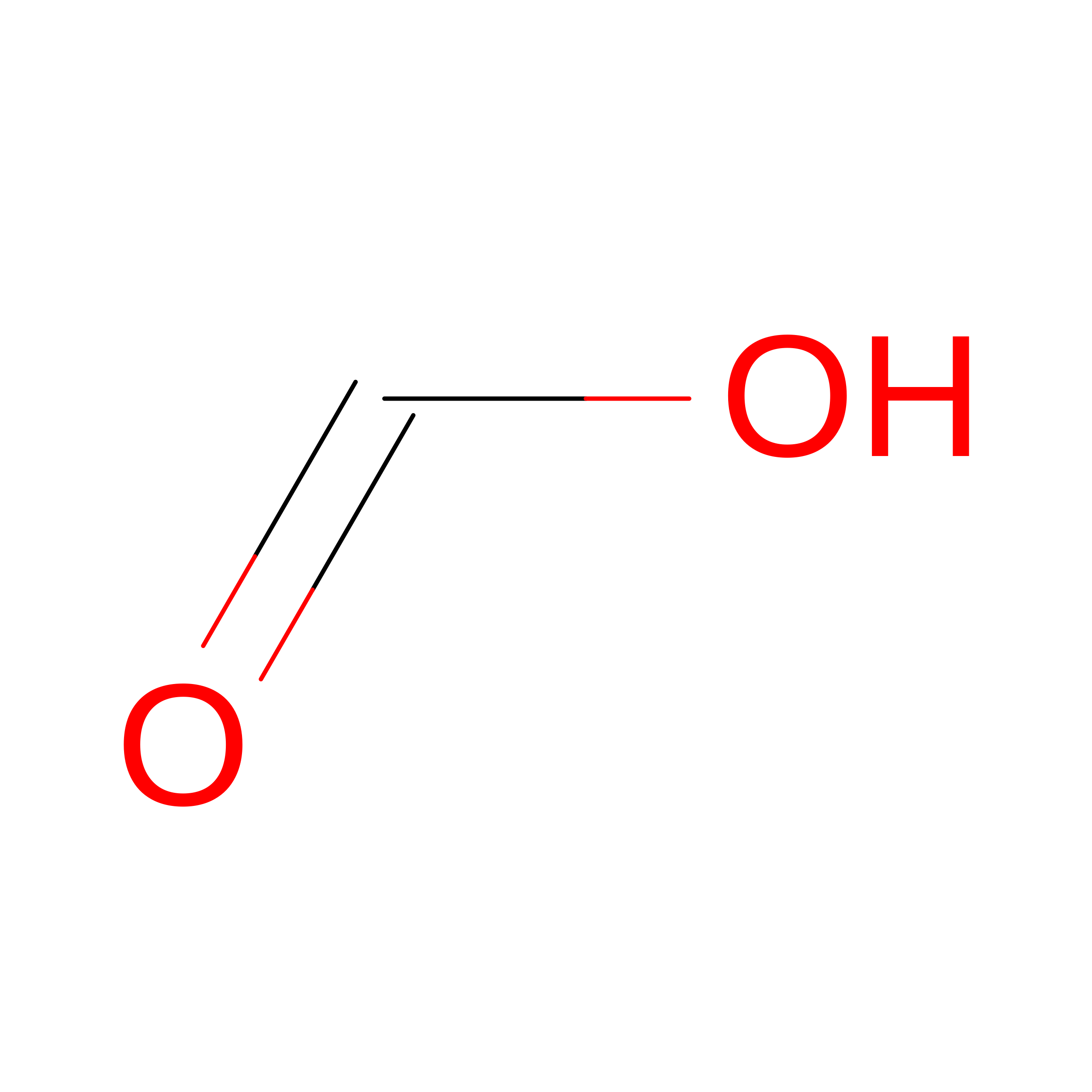
1XEO | pdb_00001xeo

High Resolution Crystals Structure of Cobalt- Peptide Deformylase Bound To Formate


Experimental Data Snapshot

  • Method: X-RAY DIFFRACTION
  • Resolution: 1.30 Å
  • R-Value Free: 
    0.215 (Depositor), 0.209 (DCC) 
  • R-Value Work: 
    0.200 (Depositor), 0.193 (DCC) 
  • R-Value Observed: 
    0.200 (Depositor) 

wwPDB Validation 3D Report Full Report

Validation slider image for 1XEO

This is version 1.3 of the entry. See complete history

Literature

Structures of E. coli peptide deformylase bound to formate: insight into the preference for Fe2+ over Zn2+ as the active site metal

Jain, R.Hao, B.Liu, R.-P.Chan, M.K.

(2005) J Am Chem Soc 127: 4558-4559

  • DOI: https://doi.org/10.1021/ja0503074
  • Primary Citation Related Structures: 
    1XEM, 1XEN, 1XEO

  • PubMed Abstract: 

    E. coli peptide deformylase (PDF) catalyzes the deformylation of nascent polypeptides generated during protein synthesis. While PDF was originally thought to be a zinc enzyme, subsequent studies revealed that the active site metal is iron. In an attempt to understand this unusual metal preference, high-resolution structures of Fe-, Co-, and Zn-PDF were determined in complex with its deformylation product, formate. In all three structures, the formate ion binds the metal and forms hydrogen-bonding interactions with the backbone nitrogen of Leu91, the amide side chain of Gln50, and the carboxylate side chain of Glu133. One key difference, however, is how the formate binds the metal. In Fe-PDF and Co-PDF, formate binds in a bidentate fashion, while in Zn-PDF, it binds in a monodentate fashion. Importantly, these structural results provide the first clues into the origins of PDF's metal-dependent activity differences. On the basis of these structures, we propose that the basis for the higher activity of Fe-PDF stems from the better ability of iron to bind and activate the tetrahedral transition state required for cleavage of the N-terminal formyl group.


  • Organizational Affiliation
    • Departments of Biochemistry and Chemistry, and Ohio State Biophysics Program, The Ohio State University, 484 West 12th Avenue, Columbus, OH 43210, USA.

Macromolecule Content 

  • Total Structure Weight: 19.33 kDa 
  • Atom Count: 1,553 
  • Modeled Residue Count: 165 
  • Deposited Residue Count: 168 
  • Unique protein chains: 1

Macromolecules

Find similar proteins by:|  3D Structure
Entity ID: 1
MoleculeChains  Sequence LengthOrganismDetailsImage
Peptide deformylase168Escherichia coli BL21(DE3)Mutation(s): 0 
EC: 3.5.1.88
UniProt
Find proteins for P0A6K3 (Escherichia coli (strain K12))
Explore P0A6K3 
Go to UniProtKB:  P0A6K3
Entity Groups
Sequence Clusters30% Identity50% Identity70% Identity90% Identity95% Identity100% Identity
UniProt GroupP0A6K3
Sequence Annotations
Expand
Reference Sequence

Experimental Data & Validation

Experimental Data

  • Method: X-RAY DIFFRACTION
  • Resolution: 1.30 Å
  • R-Value Free:  0.215 (Depositor), 0.209 (DCC) 
  • R-Value Work:  0.200 (Depositor), 0.193 (DCC) 
  • R-Value Observed: 0.200 (Depositor) 
Space Group: P 61 2 2
Unit Cell:
Length ( Å )Angle ( ˚ )
a = 54.42α = 90
b = 54.42β = 90
c = 224.43γ = 120
Software Package:
Software NamePurpose
CNSrefinement
DENZOdata reduction
SCALEPACKdata scaling
CNSphasing

Structure Validation

View Full Validation Report


Entry History 

Deposition Data

Revision History  (Full details and data files)

  • Version 1.0: 2005-03-29
    Type: Initial release
  • Version 1.1: 2008-04-30
    Changes: Version format compliance
  • Version 1.2: 2011-07-13
    Changes: Source and taxonomy, Version format compliance
  • Version 1.3: 2024-02-14
    Changes: Data collection, Database references, Derived calculations