1WOE | pdb_00001woe

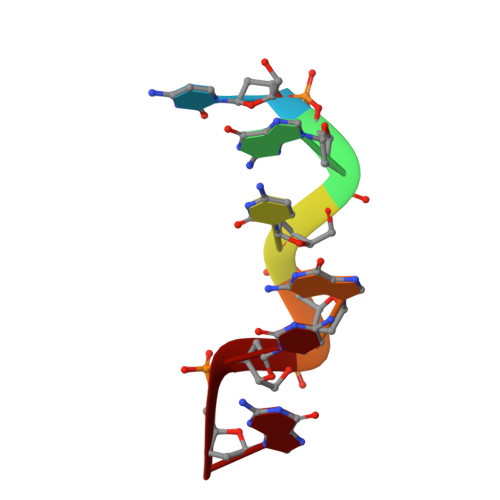
X-ray structure of a Z-DNA hexamer d(CGCGCG)


Experimental Data Snapshot

  • Method: X-RAY DIFFRACTION
  • Resolution: 1.50 Å
  • R-Value Free: 
    0.206 (Depositor), 0.192 (DCC) 
  • R-Value Work: 
    0.176 (Depositor), 0.166 (DCC) 
  • R-Value Observed: 
    0.178 (Depositor) 

wwPDB Validation 3D Report Full Report

Validation slider image for 1WOE

Ligand Structure Quality Assessment 


This is version 1.3 of the entry. See complete history

Literature

The hydration structure of a Z-DNA hexameric duplex determined by a neutron diffraction technique.

Chatake, T.Tanaka, I.Umino, H.Arai, S.Niimura, N.

(2005) Acta Crystallogr D Biol Crystallogr 61: 1088-1098

  • DOI: https://doi.org/10.1107/S0907444905015581
  • Primary Citation Related Structures: 
    1V9G, 1WOE

  • PubMed Abstract: 

    In order to reveal the hydration structure of Z-DNA, a neutron diffraction study has been carried out at 1.8 A resolution on a Z-DNA hexamer d(CGCGCG). Neutron diffraction data were collected with the BIX-3 single-crystal diffractometer at the JRR-3 reactor in the Japan Atomic Energy Research Institute (JAERI) using a large crystal (1.6 mm3) obtained from D2O solution. It has been found that almost all the guanine bases have participated in H/D exchange at the C8-H8 group, consistent with the acidic nature of this bond. 44 water molecules were found in the nuclear density maps, of which 29 showed the entire contour of all three atoms (D-O-D). The remaining 15 water molecules had a simple spherical shape, indicating that they were rotationally disordered. An interesting relationship was found between the orientational disorder of the water molecules and their locations. Almost all water molecules in the minor groove were well ordered in the crystal, while 40% of the water molecules in the major groove were rotationally disordered. The hydrogen-bonding networks in the hydration shells have two structural aspects: flexibility and regularity.


  • Organizational Affiliation
    • Faculty of Pharmaceutical Sciences, Chiba Institute of Science, Choshi, Chiba 288-0025, Japan.

Macromolecule Content 

  • Total Structure Weight: 3.82 kDa 
  • Atom Count: 316 
  • Modeled Residue Count: 12 
  • Deposited Residue Count: 12 
  • Unique nucleic acid chains: 1

Macromolecules

Find similar nucleic acids by:  Sequence
Entity ID: 1
MoleculeChains LengthOrganismImage
Z-DNA hexamer
A, B
6N/A
Sequence Annotations
Expand
Reference Sequence

Small Molecules

Ligands 1 Unique
IDChains Name / Formula / InChI Key2D Diagram3D Interactions
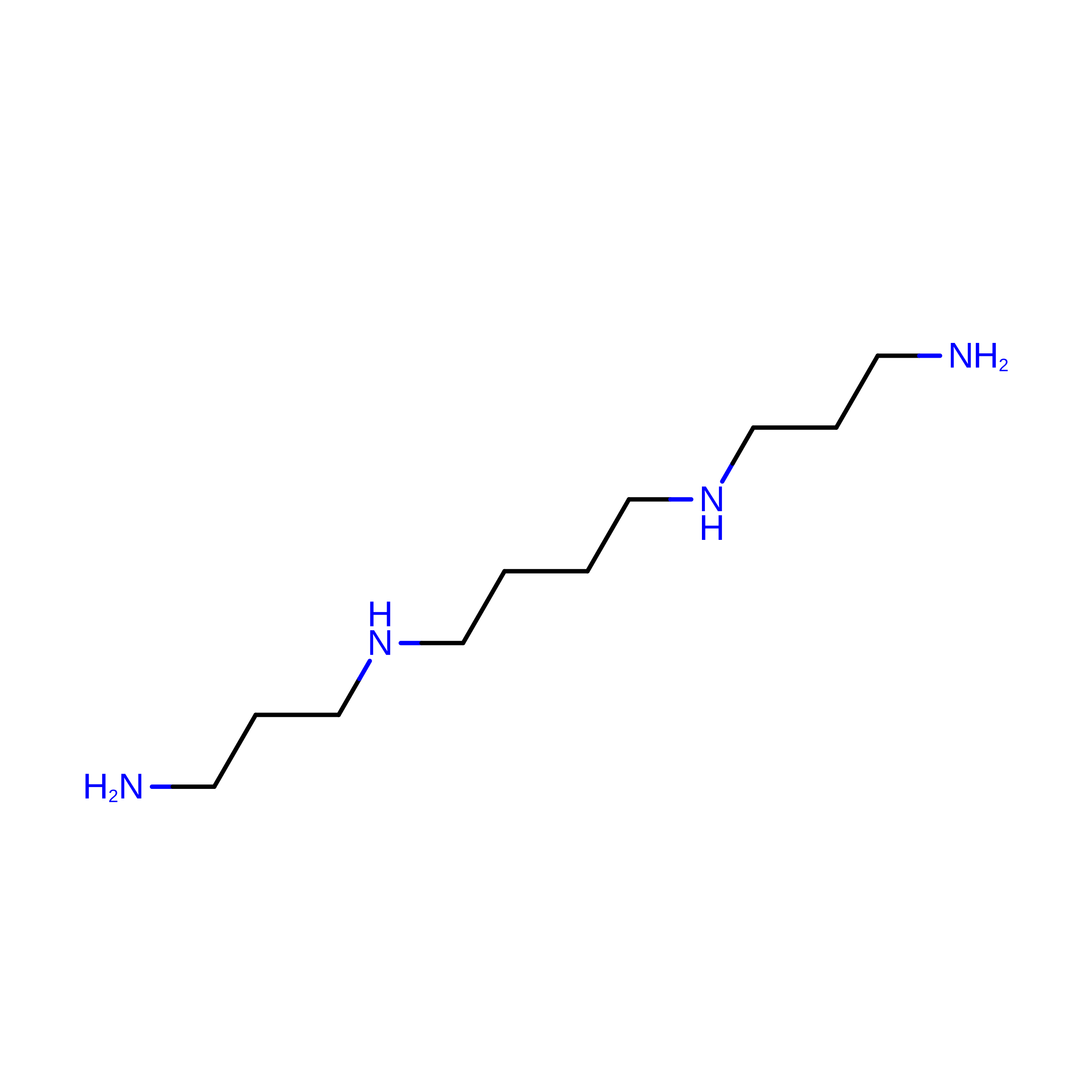
SPM

Query on SPM


Download:Ideal Coordinates CCD File
C [auth A]SPERMINE
C10 H26 N4
PFNFFQXMRSDOHW-UHFFFAOYSA-N

Experimental Data & Validation

Experimental Data

  • Method: X-RAY DIFFRACTION
  • Resolution: 1.50 Å
  • R-Value Free:  0.206 (Depositor), 0.192 (DCC) 
  • R-Value Work:  0.176 (Depositor), 0.166 (DCC) 
  • R-Value Observed: 0.178 (Depositor) 
Space Group: P 21 21 21
Unit Cell:
Length ( Å )Angle ( ˚ )
a = 18.46α = 90
b = 30.76β = 90
c = 43.18γ = 90
Software Package:
Software NamePurpose
DENZOdata reduction
SCALEPACKdata scaling
CNSrefinement
CNSphasing

Structure Validation

View Full Validation Report


Ligand Structure Quality Assessment 


Entry History 

Deposition Data

Revision History  (Full details and data files)

  • Version 1.0: 2005-07-26
    Type: Initial release
  • Version 1.1: 2008-04-30
    Changes: Version format compliance
  • Version 1.2: 2011-07-13
    Changes: Non-polymer description, Version format compliance
  • Version 1.3: 2024-03-13
    Changes: Data collection, Database references, Derived calculations