1WKR | pdb_00001wkr

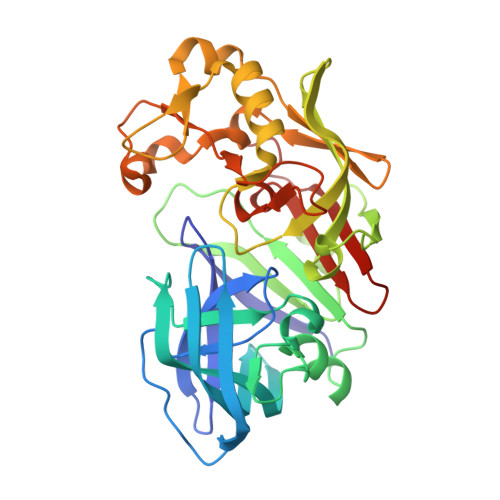
Crystal structure of aspartic proteinase from Irpex lacteus


Experimental Data Snapshot

  • Method: X-RAY DIFFRACTION
  • Resolution: 1.30 Å
  • R-Value Free: 
    0.171 (Depositor), 0.178 (DCC) 
  • R-Value Work: 
    0.147 (Depositor), 0.155 (DCC) 
  • R-Value Observed: 
    0.147 (Depositor) 

Starting Model: experimental
View more details

wwPDB Validation 3D Report Full Report

Validation slider image for 1WKR

This is version 1.6 of the entry. See complete history

Literature

Crystal Structure of Aspartic Proteinase from Irpex lacteus in Complex with Inhibitor Pepstatin

Fujimoto, Z.Fujii, Y.Kaneko, S.Kobayashi, H.Mizuno, H.

(2004) J Mol Biology 341: 1227-1235

  • DOI: https://doi.org/10.1016/j.jmb.2004.06.049
  • Primary Citation Related Structures: 
    1WKR

  • PubMed Abstract: 

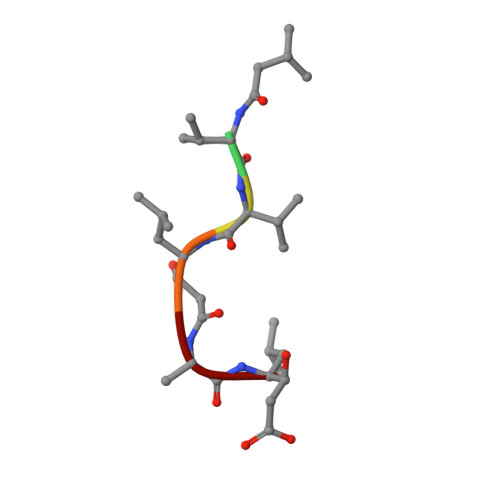
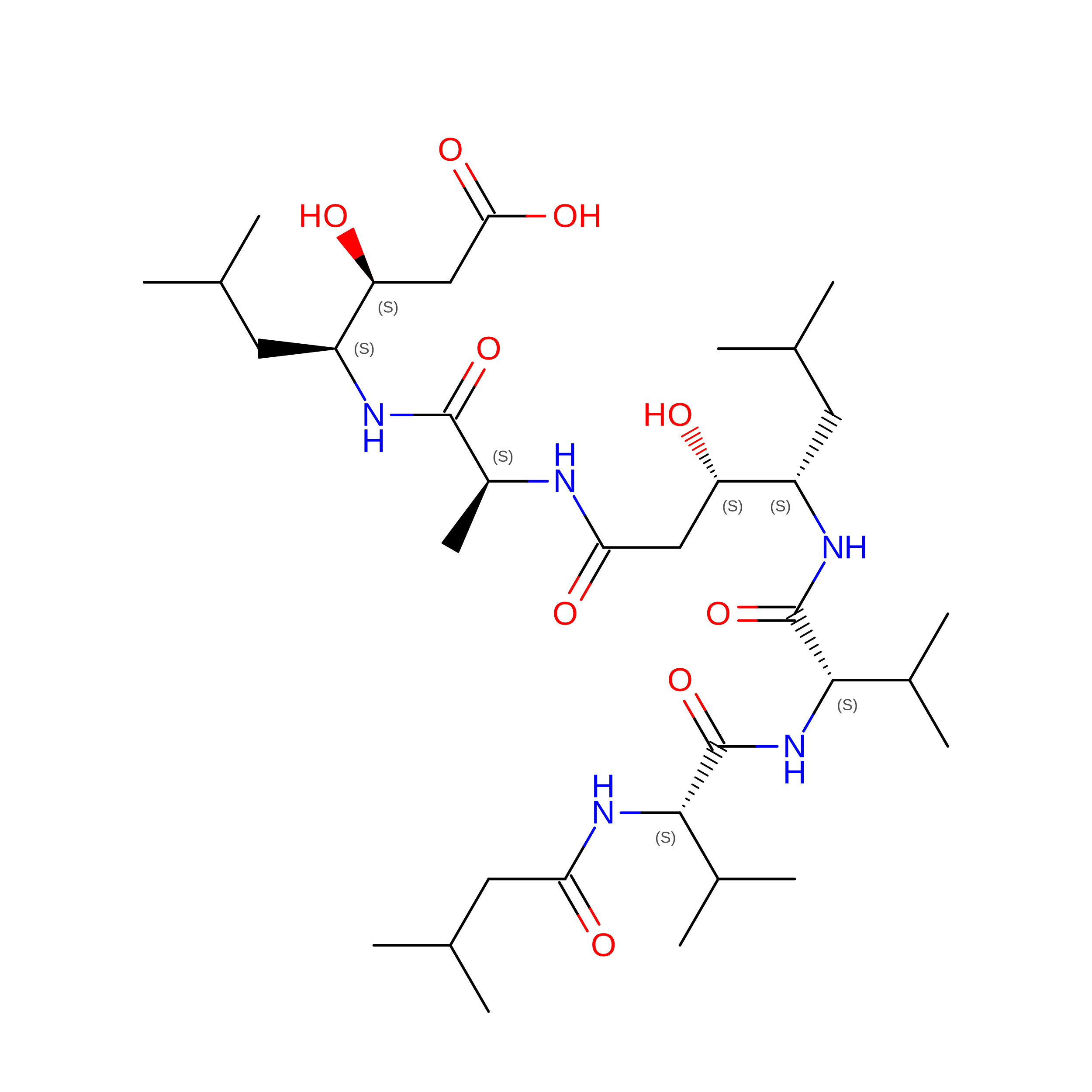
    The crystal structure of Irpex lacteus aspartic proteinase (ILAP) in complex with pepstatin (a six amino acid residue peptide-like inhibitor) was determined at 1.3A resolution. ILAP is a pepsin-like enzyme, widely distributed in nature, with high milk-clotting activity relative to proteolytic activity. The overall structure was in good topological agreement with pepsin and other aspartic proteases. The structure and interaction pattern around the catalytic site were conserved, in agreement with the other aspartic proteinase/inhibitor complex structures reported previously. The high-resolution data also supported the transition state model, as proposed previously for the catalytic mechanism of aspartic proteinase. Unlike the other aspartic proteinases, ILAP was found to require hydrophobic residues either in the P(1) or P(1') site, and also in the P(4) and/or P(3) site(s) for secondary interactions. The inhibitor complex structure also revealed the substrate binding mechanism of ILAP at the P(3) and P(4) site of the substrate, where the inserted loop built up the unique hydrophobic pocket at the P(4) site.


  • Organizational Affiliation
    • Department of Biochemistry, National Institute of Agrobiological Sciences, Tsukuba, Ibaraki 305-8602, Japan. zui@affrc.go.jp

Macromolecule Content 

  • Total Structure Weight: 36.41 kDa 
  • Atom Count: 3,257 
  • Modeled Residue Count: 346 
  • Deposited Residue Count: 346 
  • Unique protein chains: 2

Macromolecules

Find similar proteins by:|  3D Structure
Entity ID: 1
MoleculeChains  Sequence LengthOrganismDetailsImage
Polyporopepsin340Irpex lacteusMutation(s): 0 
EC: 3.4.23.29
UniProt
Find proteins for P17576 (Irpex lacteus)
Explore P17576 
Go to UniProtKB:  P17576
Entity Groups
Sequence Clusters30% Identity50% Identity70% Identity90% Identity95% Identity100% Identity
UniProt GroupP17576
Sequence Annotations
Expand
Reference Sequence
Find similar proteins by:  Sequence   |   3D Structure  
Entity ID: 2
MoleculeChains  Sequence LengthOrganismDetailsImage
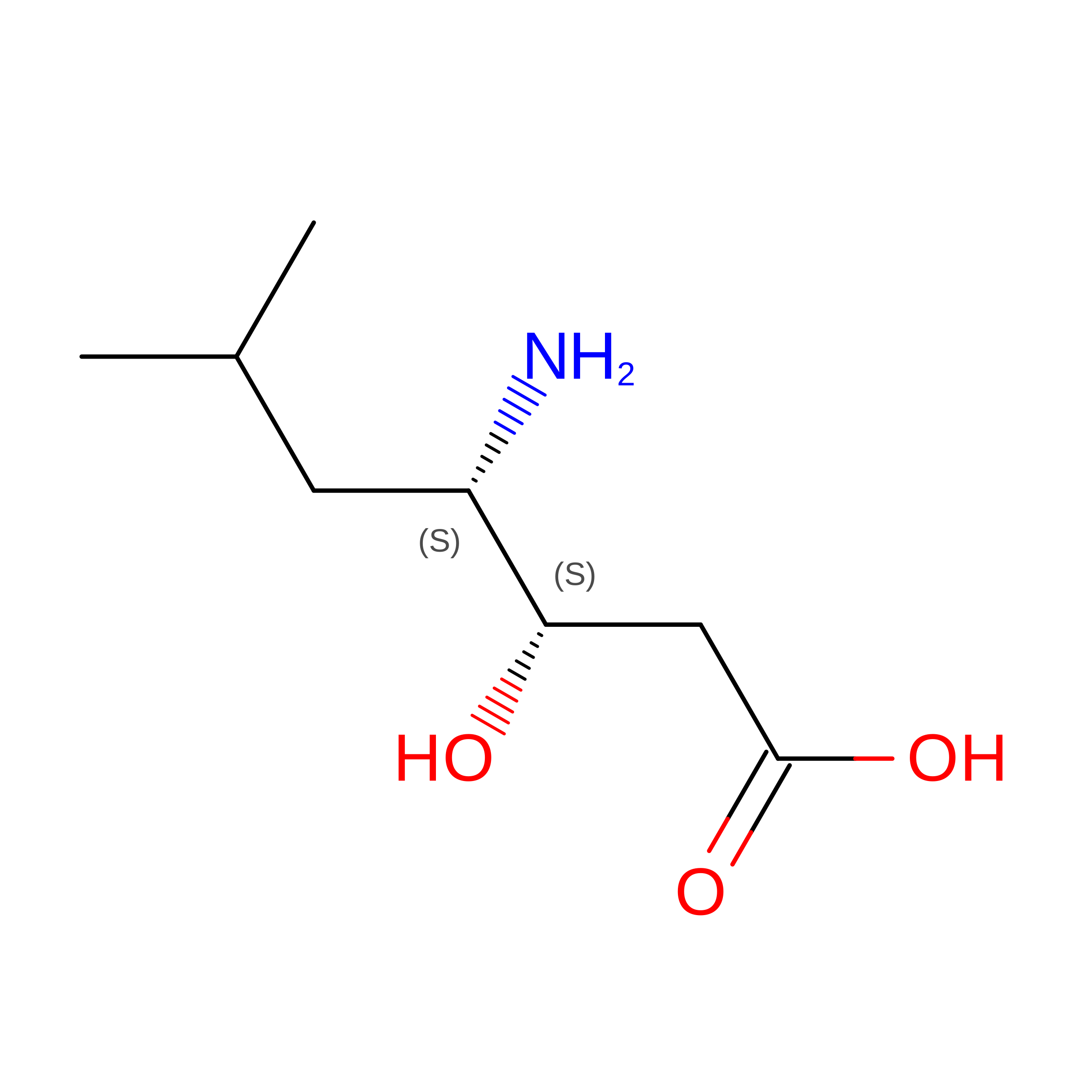
pepstatinB [auth I]6Streptomyces argenteolus subsp. toyonakensisMutation(s): 0 

Biologically Interesting Molecules (External Reference) 

1 Unique

Experimental Data & Validation

Experimental Data

  • Method: X-RAY DIFFRACTION
  • Resolution: 1.30 Å
  • R-Value Free:  0.171 (Depositor), 0.178 (DCC) 
  • R-Value Work:  0.147 (Depositor), 0.155 (DCC) 
  • R-Value Observed: 0.147 (Depositor) 
Space Group: P 1 21 1
Unit Cell:
Length ( Å )Angle ( ˚ )
a = 37.27α = 90
b = 78.898β = 96.71
c = 54.072γ = 90
Software Package:
Software NamePurpose
CNSrefinement
HKL-2000data reduction
SCALEPACKdata scaling
AMoREphasing

Structure Validation

View Full Validation Report


Entry History 

Deposition Data

Revision History  (Full details and data files)

  • Version 1.0: 2004-09-07
    Type: Initial release
  • Version 1.1: 2008-04-30
    Changes: Version format compliance
  • Version 1.2: 2011-07-13
    Changes: Atomic model, Database references, Derived calculations, Non-polymer description, Structure summary, Version format compliance
  • Version 1.3: 2013-02-27
    Changes: Other
  • Version 1.4: 2023-10-25
    Changes: Data collection, Database references, Derived calculations, Refinement description
  • Version 1.5: 2023-11-15
    Changes: Data collection
  • Version 1.6: 2024-10-16
    Changes: Structure summary