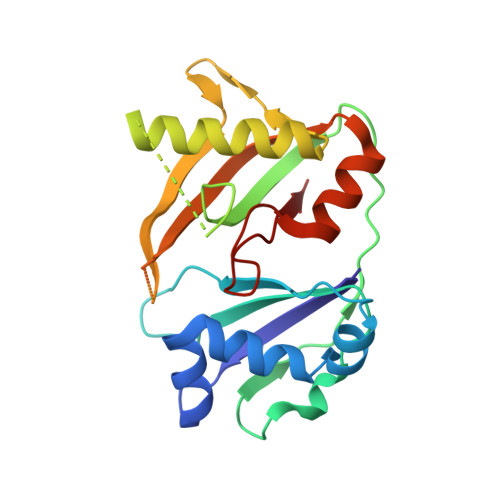
1WJ9 | pdb_00001wj9

Crystal structure of a CRISPR-associated protein from thermus thermophilus


Experimental Data Snapshot

  • Method: X-RAY DIFFRACTION
  • Resolution: 1.90 Å
  • R-Value Free: 
    0.247 (Depositor), 0.244 (DCC) 
  • R-Value Work: 
    0.228 (Depositor), 0.227 (DCC) 
  • R-Value Observed: 
    0.228 (Depositor) 

wwPDB Validation 3D Report Full Report

Validation slider image for 1WJ9

This is version 1.3 of the entry. See complete history

Literature

Crystal structure of hypothetical protein TTHB192 from Thermus thermophilus HB8 reveals a new protein family with an RNA recognition motif-like domain

Ebihara, A.Yao, M.Masui, R.Tanaka, I.Yokoyama, S.Kuramitsu, S.

(2006) Protein Sci 15: 1494-1499

  • DOI: https://doi.org/10.1110/ps.062131106
  • Primary Citation Related Structures: 
    1WJ9

  • PubMed Abstract: 

    We have determined the crystal structure of hypothetical protein TTHB192 from Thermus thermophilus HB8 at 1.9 A resolution. This protein is a member of the Escherichia coli ygcH sequence family, which contains approximately 15 sequence homologs of bacterial origin. These homologs have a high isoelectric point. The crystal structure reveals that TTHB192 consists of two independently folded domains, and that each domain exhibits a ferredoxin-like fold with a four-stranded antiparallel beta-sheet packed on one side by alpha-helices. These two tandem domains face each other to generate a beta-sheet platform. TTHB192 displays overall structural similarity to Sex-lethal protein and poly(A)-binding protein fragments. These proteins have RNA binding activity which is supported by a beta-sheet platform formed by two tandem repeats of an RNA recognition motif domain with signature sequence motifs on the beta-sheet surface. Although TTHB192 does not have the same signature sequence motif as the RNA recognition motif domain, the presence of an evolutionarily conserved basic patch on the beta-sheet platform could be functionally relevant for nucleic acid-binding. This report shows that TTHB192 and its sequence homologs adopt an RNA recognition motif-like domain and provides the first testable functional hypothesis for this protein family.


  • Organizational Affiliation
    • RIKEN SPring-8 Center, Harima Institute, Hyogo 679-5148, Japan.

Macromolecule Content 

  • Total Structure Weight: 23.76 kDa 
  • Atom Count: 1,605 
  • Modeled Residue Count: 188 
  • Deposited Residue Count: 211 
  • Unique protein chains: 1

Macromolecules

Find similar proteins by:|  3D Structure
Entity ID: 1
MoleculeChains  Sequence LengthOrganismDetailsImage
CRISPR-associated protein211Thermus thermophilusMutation(s): 0 
EC: 3.1
UniProt
Find proteins for Q53WG9 (Thermus thermophilus (strain ATCC 27634 / DSM 579 / HB8))
Explore Q53WG9 
Go to UniProtKB:  Q53WG9
Entity Groups
Sequence Clusters30% Identity50% Identity70% Identity90% Identity95% Identity100% Identity
UniProt GroupQ53WG9
Sequence Annotations
Expand
Reference Sequence

Experimental Data & Validation

Experimental Data

  • Method: X-RAY DIFFRACTION
  • Resolution: 1.90 Å
  • R-Value Free:  0.247 (Depositor), 0.244 (DCC) 
  • R-Value Work:  0.228 (Depositor), 0.227 (DCC) 
  • R-Value Observed: 0.228 (Depositor) 
Space Group: P 65
Unit Cell:
Length ( Å )Angle ( ˚ )
a = 76.673α = 90
b = 76.673β = 90
c = 87.494γ = 120
Software Package:
Software NamePurpose
CNSrefinement
HKL-2000data reduction
SCALEPACKdata scaling
SOLVEphasing

Structure Validation

View Full Validation Report


Entry History 

Deposition Data

Revision History  (Full details and data files)

  • Version 1.0: 2004-11-29
    Type: Initial release
  • Version 1.1: 2008-04-30
    Changes: Version format compliance
  • Version 1.2: 2011-07-13
    Changes: Version format compliance
  • Version 1.3: 2024-03-13
    Changes: Data collection, Database references