1WD4 | pdb_00001wd4

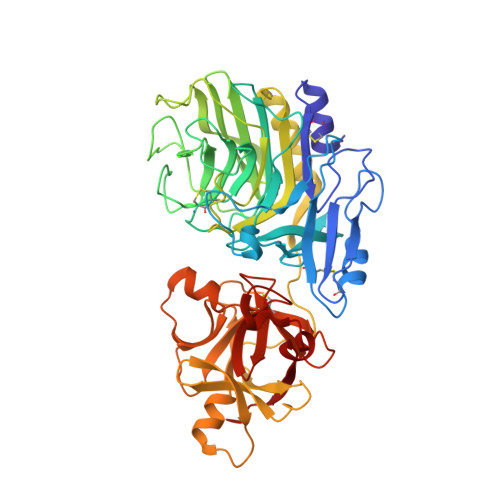
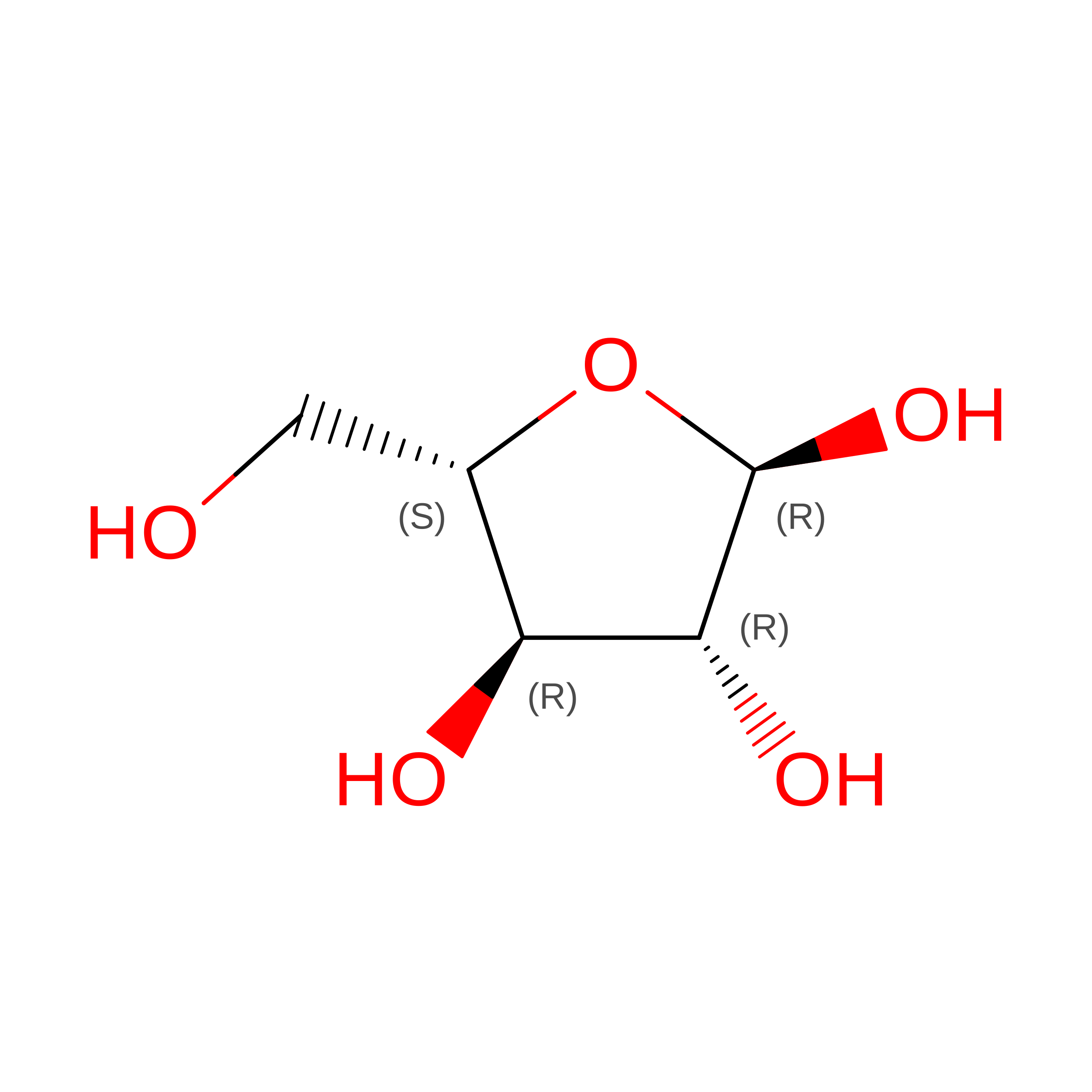
Crystal structure of arabinofuranosidase complexed with arabinose


Experimental Data Snapshot

  • Method: X-RAY DIFFRACTION
  • Resolution: 2.07 Å
  • R-Value Free: 
    0.221 (Depositor), 0.186 (DCC) 
  • R-Value Work: 
    0.188 (Depositor), 0.193 (DCC) 
  • R-Value Observed: 
    0.188 (Depositor) 

wwPDB Validation 3D Report Full Report

Validation slider image for 1WD4

Ligand Structure Quality Assessment 


This is version 2.1 of the entry. See complete history

Literature

Crystal structure of a family 54 alpha-L-arabinofuranosidase reveals a novel carbohydrate-binding module that can bind arabinose

Miyanaga, A.Koseki, T.Matsuzawa, H.Wakagi, T.Shoun, H.Fushinobu, S.

(2004) J Biological Chem 279: 44907-44914

  • DOI: https://doi.org/10.1074/jbc.M405390200
  • Primary Citation Related Structures: 
    1WD3, 1WD4

  • PubMed Abstract: 

    As the first known structures of a glycoside hydrolase family 54 (GH54) enzyme, we determined the crystal structures of free and arabinose-complex forms of Aspergillus kawachii IFO4308 alpha-l-arabinofuranosidase (AkAbfB). AkAbfB comprises two domains: a catalytic domain and an arabinose-binding domain (ABD). The catalytic domain has a beta-sandwich fold similar to those of clan-B glycoside hydrolases. ABD has a beta-trefoil fold similar to that of carbohydrate-binding module (CBM) family 13. However, ABD shows a number of characteristics distinctive from those of CBM family 13, suggesting that it could be classified into a new CBM family. In the arabinose-complex structure, one of three arabinofuranose molecules is bound to the catalytic domain through many interactions. Interestingly, a disulfide bond formed between two adjacent cysteine residues recognized the arabinofuranose molecule in the active site. From the location of this arabinofuranose and the results of a mutational study, the nucleophile and acid/base residues were determined to be Glu(221) and Asp(297), respectively. The other two arabinofuranose molecules are bound to ABD. The O-1 atoms of the two arabinofuranose molecules bound at ABD are both pointed toward the solvent, indicating that these sites can both accommodate an arabinofuranose side-chain moiety linked to decorated arabinoxylans.


  • Organizational Affiliation
    • Department of Biotechnology, The University of Tokyo, 1-1-1 Yayoi, Bunkyo-ku, Tokyo 113-8657, Japan.

Macromolecule Content 

  • Total Structure Weight: 51.76 kDa 
  • Atom Count: 3,867 
  • Modeled Residue Count: 482 
  • Deposited Residue Count: 482 
  • Unique protein chains: 1

Macromolecules

Find similar proteins by:|  3D Structure
Entity ID: 1
MoleculeChains  Sequence LengthOrganismDetailsImage
alpha-L-arabinofuranosidase B482Aspergillus luchuensisMutation(s): 0 
EC: 3.2.1.55
UniProt
Find proteins for Q8NK89 (Aspergillus kawachii (strain NBRC 4308))
Explore Q8NK89 
Go to UniProtKB:  Q8NK89
Entity Groups
Sequence Clusters30% Identity50% Identity70% Identity90% Identity95% Identity100% Identity
UniProt GroupQ8NK89
Glycosylation
Glycosylation Sites: 1
Sequence Annotations
Expand
Reference Sequence

Oligosaccharides

Help  
Entity ID: 2
MoleculeChains Length2D Diagram GlycosylationD Interactions
2-acetamido-2-deoxy-beta-D-glucopyranose-(1-4)-2-acetamido-2-deoxy-beta-D-glucopyranose
B
2N-Glycosylation
Glycosylation Resources
GlyTouCan: G42666HT
GlyCosmos: G42666HT
GlyGen: G42666HT

Experimental Data & Validation

Experimental Data

  • Method: X-RAY DIFFRACTION
  • Resolution: 2.07 Å
  • R-Value Free:  0.221 (Depositor), 0.186 (DCC) 
  • R-Value Work:  0.188 (Depositor), 0.193 (DCC) 
  • R-Value Observed: 0.188 (Depositor) 
Space Group: P 21 21 21
Unit Cell:
Length ( Å )Angle ( ˚ )
a = 39.461α = 90
b = 98.62β = 90
c = 144.135γ = 90
Software Package:
Software NamePurpose
CNSrefinement
HKL-2000data reduction
SCALEPACKdata scaling
SOLVEphasing

Structure Validation

View Full Validation Report


Ligand Structure Quality Assessment 


Entry History 

Deposition Data

Revision History  (Full details and data files)

  • Version 1.0: 2004-09-14
    Type: Initial release
  • Version 1.1: 2008-04-30
    Changes: Version format compliance
  • Version 1.2: 2011-07-13
    Changes: Non-polymer description, Version format compliance
  • Version 2.0: 2020-07-29
    Type: Remediation
    Reason: Carbohydrate remediation
    Changes: Advisory, Atomic model, Data collection, Database references, Derived calculations, Structure summary
  • Version 2.1: 2024-11-20
    Changes: Data collection, Database references, Structure summary