1W3G | pdb_00001w3g

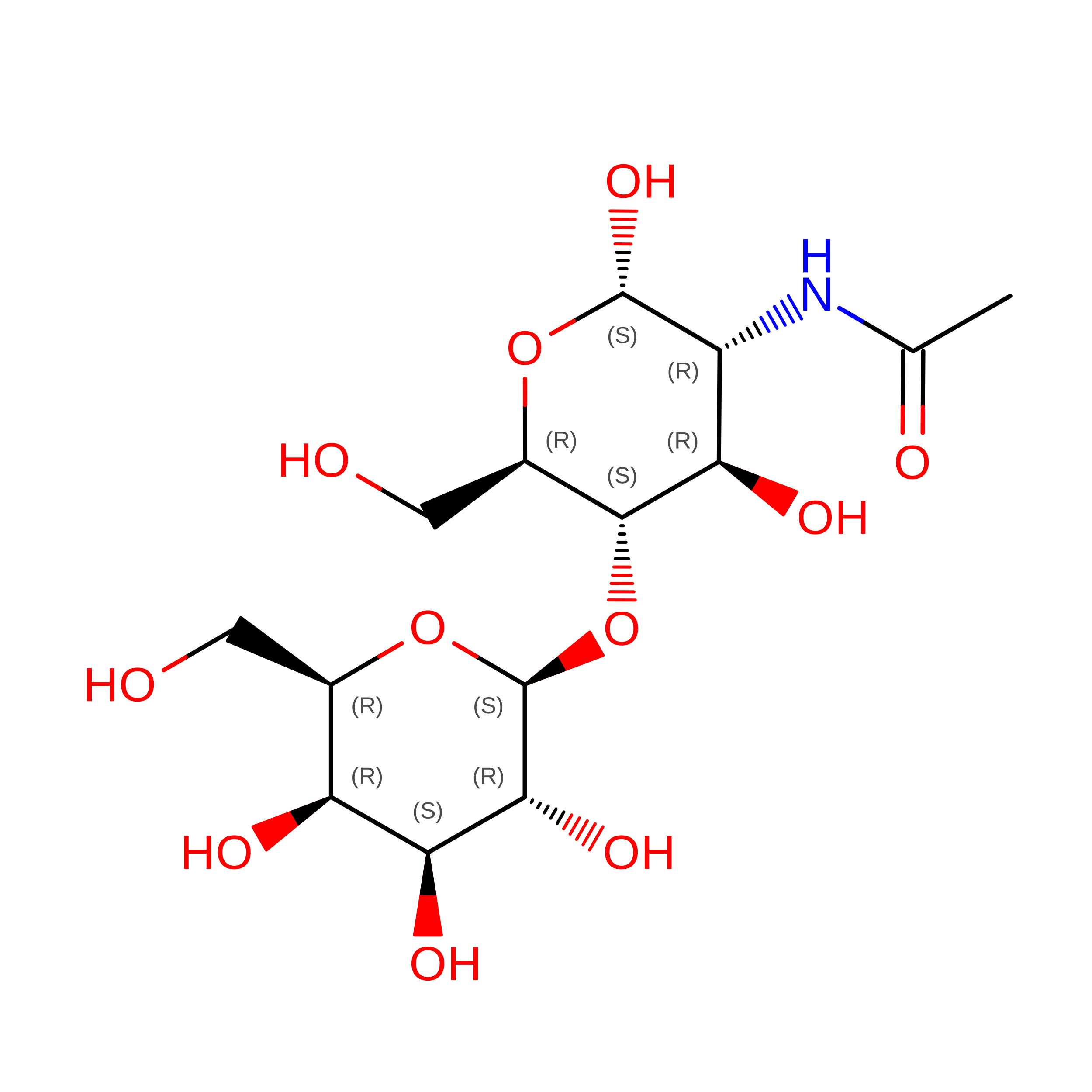
Hemolytic lectin from the mushroom Laetiporus sulphureus complexed with two N-acetyllactosamine molecules.


Experimental Data Snapshot

  • Method: X-RAY DIFFRACTION
  • Resolution: 2.68 Å
  • R-Value Free: 
    0.280 (Depositor), 0.267 (DCC) 
  • R-Value Work: 
    0.226 (Depositor), 0.218 (DCC) 
  • R-Value Observed: 
    0.226 (Depositor) 

Starting Model: experimental
View more details

wwPDB Validation 3D Report Full Report

Validation slider image for 1W3G

This is version 2.1 of the entry. See complete history

Literature

Structural Analysis of the Laetiporus Sulphureus Hemolytic Pore-Forming Lectin in Complex with Sugars

Mancheno, J.M.Tateno, H.Goldstein, I.J.Martinez-Ripoll, M.Hermoso, J.A.

(2005) J Biological Chem 280: 17251

  • DOI: https://doi.org/10.1074/jbc.M413933200
  • Primary Citation Related Structures: 
    1W3A, 1W3F, 1W3G

  • PubMed Abstract: 

    LSL is a lectin produced by the parasitic mushroom Laetiporus sulphureus, which exhibits hemolytic and hemagglutinating activities. Here, we report the crystal structure of LSL refined to 2.6-A resolution determined by the single isomorphous replacement method with the anomalous scatter (SIRAS) signal of a platinum derivative. The structure reveals that LSL is hexameric, which was also shown by analytical ultracentrifugation. The monomeric protein (35 kDa) consists of two distinct modules: an N-terminal lectin module and a pore-forming module. The lectin module has a beta-trefoil scaffold that bears structural similarities to those present in toxins known to interact with galactose-related carbohydrates such as the hemagglutinin component (HA1) of the progenitor toxin from Clostridium botulinum, abrin, and ricin. On the other hand, the C-terminal pore-forming module (composed of domains 2 and 3) exhibits three-dimensional structural resemblances with domains 3 and 4 of the beta-pore-forming toxin aerolysin from the Gram-negative bacterium Aeromonas hydrophila, and domains 2 and 3 from the epsilon-toxin from Clostridium perfringens. This finding reveals the existence of common structural elements within the aerolysin-like family of toxins that could be directly involved in membrane-pore formation. The crystal structures of the complexes of LSL with lactose and N-acetyllactosamine reveal two dissacharide-binding sites per subunit and permits the identification of critical residues involved in sugar binding.


  • Organizational Affiliation
    • Grupo de Cristalografía Macromolecular y Biología Estructural, Instituto Rocasolano, CSIC, Serrano, 119, 28006 Madrid, Spain. xjosemi@iqfr.csic.es

Macromolecule Content 

  • Total Structure Weight: 36.26 kDa 
  • Atom Count: 2,667 
  • Modeled Residue Count: 313 
  • Deposited Residue Count: 315 
  • Unique protein chains: 1

Macromolecules

Find similar proteins by:|  3D Structure
Entity ID: 1
MoleculeChains  Sequence LengthOrganismDetailsImage
HEMOLYTIC LECTIN FROM LAETIPORUS SULPHUREUS315Laetiporus sulphureusMutation(s): 0 
UniProt
Find proteins for Q7Z8V1 (Laetiporus sulphureus)
Explore Q7Z8V1 
Go to UniProtKB:  Q7Z8V1
Entity Groups
Sequence Clusters30% Identity50% Identity70% Identity90% Identity95% Identity100% Identity
UniProt GroupQ7Z8V1
Sequence Annotations
Expand
Reference Sequence

Oligosaccharides

Help  
Entity ID: 2
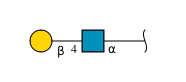
MoleculeChains Length2D Diagram GlycosylationD Interactions
beta-D-galactopyranose-(1-4)-2-acetamido-2-deoxy-alpha-D-glucopyranose
B, C
2N/A
Glycosylation Resources
GlyTouCan: G79333MY
GlyCosmos: G79333MY
GlyGen: G79333MY

Biologically Interesting Molecules (External Reference) 

1 Unique

Experimental Data & Validation

Experimental Data

  • Method: X-RAY DIFFRACTION
  • Resolution: 2.68 Å
  • R-Value Free:  0.280 (Depositor), 0.267 (DCC) 
  • R-Value Work:  0.226 (Depositor), 0.218 (DCC) 
  • R-Value Observed: 0.226 (Depositor) 
Space Group: P 63 2 2
Unit Cell:
Length ( Å )Angle ( ˚ )
a = 101.72α = 90
b = 101.72β = 90
c = 192.91γ = 120
Software Package:
Software NamePurpose
CNSrefinement
MOSFLMdata reduction
SCALEPACKdata scaling
CNSphasing

Structure Validation

View Full Validation Report


Entry History 

Deposition Data

Revision History  (Full details and data files)

  • Version 1.0: 2005-02-01
    Type: Initial release
  • Version 1.1: 2011-05-08
    Changes: Version format compliance
  • Version 1.2: 2011-07-13
    Changes: Version format compliance
  • Version 1.3: 2017-06-28
    Changes: Data collection
  • Version 2.0: 2020-07-29
    Type: Remediation
    Reason: Carbohydrate remediation
    Changes: Atomic model, Data collection, Derived calculations, Non-polymer description, Other, Structure summary
  • Version 2.1: 2023-12-13
    Changes: Data collection, Database references, Refinement description, Structure summary