1W1K | pdb_00001w1k

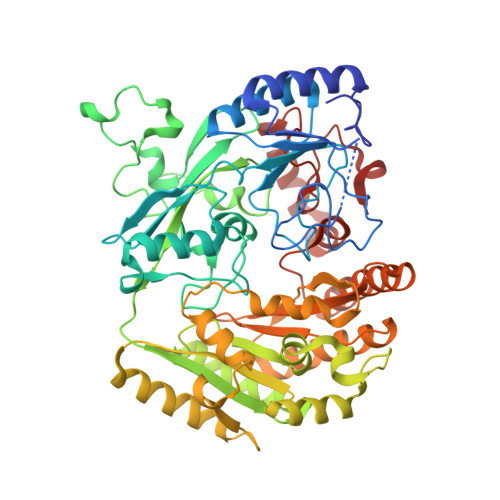
STRUCTURE OF THE OCTAMERIC FLAVOENZYME VANILLYL-ALCOHOL OXIDASE: Ile238Thr Mutant


Experimental Data Snapshot

  • Method: X-RAY DIFFRACTION
  • Resolution: 2.55 Å
  • R-Value Free: 
    0.272 (Depositor), 0.272 (DCC) 
  • R-Value Work: 
    0.207 (Depositor), 0.207 (DCC) 
  • R-Value Observed: 
    0.210 (Depositor) 

Starting Model: experimental
View more details

wwPDB Validation 3D Report Full Report

Validation slider image for 1W1K

Ligand Structure Quality Assessment 


This is version 1.4 of the entry. See complete history

Literature

Laboratory-Evolved Vanillyl-Alcohol Oxidase Produces Natural Vanillin

Van Den Heuvel, R.H.Van Den Berg, W.A.Rovida, S.Van Berkel, W.J.

(2004) J Biological Chem 279: 33492

  • DOI: https://doi.org/10.1074/jbc.M312968200
  • Primary Citation Related Structures: 
    1W1J, 1W1K, 1W1L, 1W1M

  • PubMed Abstract: 

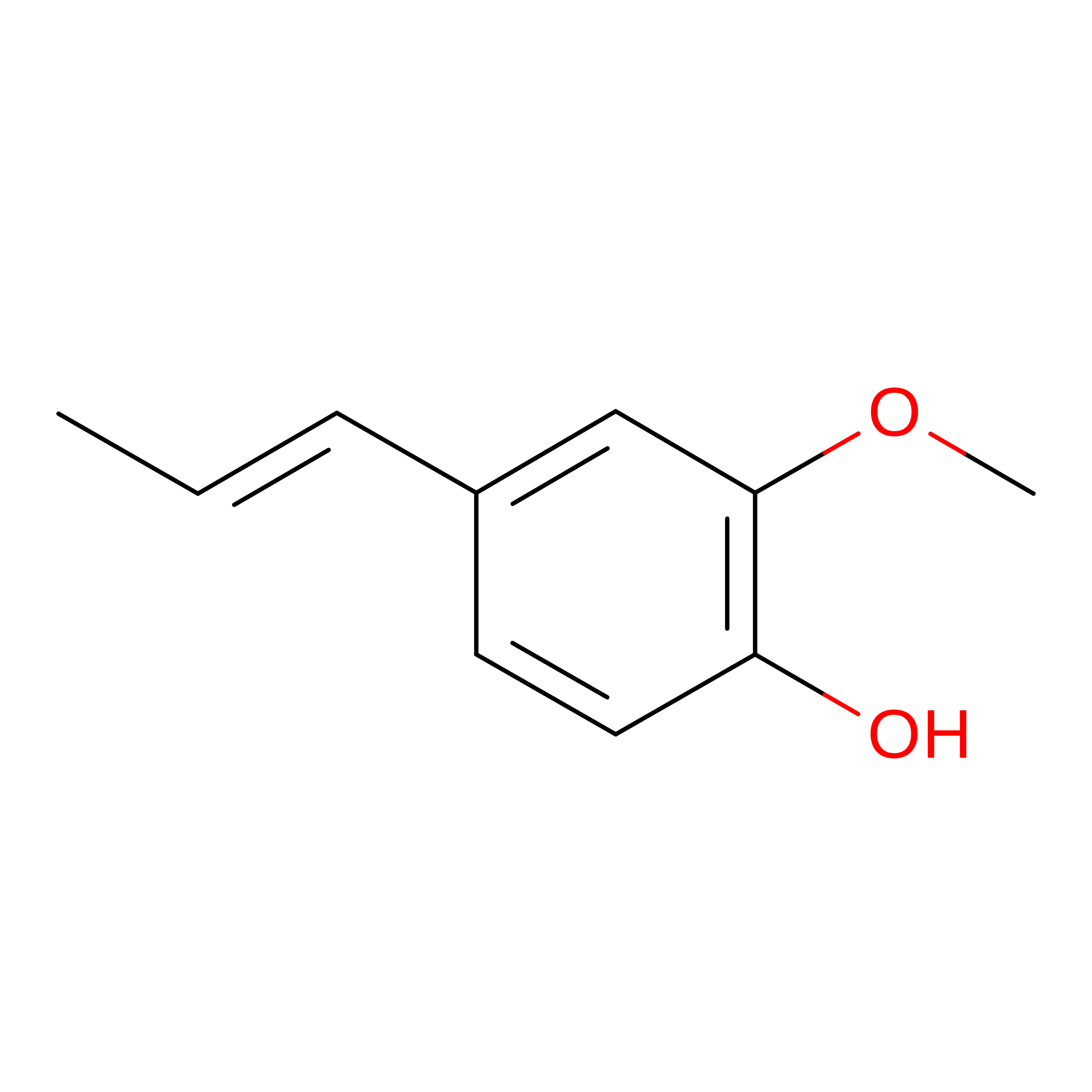
    The flavoenzyme vanillyl-alcohol oxidase was subjected to random mutagenesis to generate mutants with enhanced reactivity to creosol (2-methoxy-4-methylphenol). The vanillyl-alcohol oxidase-mediated conversion of creosol proceeds via a two-step process in which the initially formed vanillyl alcohol (4-hydroxy-3-methoxybenzyl alcohol) is oxidized to the widely used flavor compound vanillin (4-hydroxy-3-methoxybenzaldehyde). The first step of this reaction is extremely slow due to the formation of a covalent FAD N-5-creosol adduct. After a single round of error-prone PCR, seven mutants were generated with increased reactivity to creosol. The single-point mutants I238T, F454Y, E502G, and T505S showed an up to 40-fold increase in catalytic efficiency (kcat/Km) with creosol compared with the wild-type enzyme. This enhanced reactivity was due to a lower stability of the covalent flavin-substrate adduct, thereby promoting vanillin formation. The catalytic efficiencies of the mutants were also enhanced for other ortho-substituted 4-methylphenols, but not for p-cresol (4-methylphenol). The replaced amino acid residues are not located within a distance of direct interaction with the substrate, and the determined three-dimensional structures of the mutant enzymes are highly similar to that of the wild-type enzyme. These results clearly show the importance of remote residues, not readily predicted by rational design, for the substrate specificity of enzymes.


  • Organizational Affiliation
    • Department of Genetics and Microbiology, University of Pavia, via Abbiategrasso 207, 27100 Pavia, Italy.

Macromolecule Content 

  • Total Structure Weight: 128.09 kDa 
  • Atom Count: 8,828 
  • Modeled Residue Count: 1,100 
  • Deposited Residue Count: 1,120 
  • Unique protein chains: 1

Macromolecules

Find similar proteins by:|  3D Structure
Entity ID: 1
MoleculeChains  Sequence LengthOrganismDetailsImage
VANILLYL-ALCOHOL OXIDASE
A, B
560Penicillium simplicissimumMutation(s): 1 
EC: 1.1.3.13 (PDB Primary Data), 1.1.3.38 (UniProt)
UniProt
Find proteins for P56216 (Penicillium simplicissimum)
Explore P56216 
Go to UniProtKB:  P56216
Entity Groups
Sequence Clusters30% Identity50% Identity70% Identity90% Identity95% Identity100% Identity
UniProt GroupP56216
Sequence Annotations
Expand
Reference Sequence

Experimental Data & Validation

Experimental Data

  • Method: X-RAY DIFFRACTION
  • Resolution: 2.55 Å
  • R-Value Free:  0.272 (Depositor), 0.272 (DCC) 
  • R-Value Work:  0.207 (Depositor), 0.207 (DCC) 
  • R-Value Observed: 0.210 (Depositor) 
Space Group: I 4
Unit Cell:
Length ( Å )Angle ( ˚ )
a = 129.896α = 90
b = 129.896β = 90
c = 133.383γ = 90
Software Package:
Software NamePurpose
REFMACrefinement
MOSFLMdata reduction
SCALAdata scaling
CCP4phasing

Structure Validation

View Full Validation Report


Ligand Structure Quality Assessment 


Entry History 

Deposition Data

Revision History  (Full details and data files)

  • Version 1.0: 2004-07-02
    Type: Initial release
  • Version 1.1: 2011-05-08
    Changes: Version format compliance
  • Version 1.2: 2011-07-13
    Changes: Version format compliance
  • Version 1.3: 2023-12-13
    Changes: Data collection, Database references, Derived calculations, Other, Refinement description
  • Version 1.4: 2024-11-20
    Changes: Structure summary