1UET | pdb_00001uet

Divergent evolutions of trinucleotide polymerization revealed by an archaeal CCA-adding enzyme structure


Experimental Data Snapshot

  • Method: X-RAY DIFFRACTION
  • Resolution: 2.00 Å
  • R-Value Free: 
    0.242 (Depositor) 
  • R-Value Work: 
    0.198 (Depositor) 
  • R-Value Observed: 
    0.198 (Depositor) 

wwPDB Validation 3D Report Full Report

Validation slider image for 1UET

This is version 1.3 of the entry. See complete history

Literature

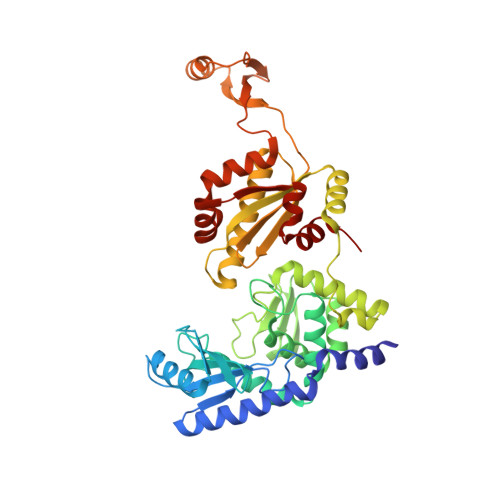
Divergent evolutions of trinucleotide polymerization revealed by an archaeal CCA-adding enzyme structure.

Okabe, M.Tomita, K.Ishitani, R.Ishii, R.Takeuchi, N.Arisaka, F.Nureki, O.Yokoyama, S.

(2003) EMBO J 22: 5918-5927

  • DOI: https://doi.org/10.1093/emboj/cdg563
  • Primary Citation Related Structures: 
    1UET, 1UEU, 1UEV

  • PubMed Abstract: 

    CCA-adding enzyme [ATP(CTP):tRNA nucleotidyltransferase], a template-independent RNA polymerase, adds the defined 'cytidine-cytidine-adenosine' sequence onto the 3' end of tRNA. The archaeal CCA-adding enzyme (class I) and eubacterial/eukaryotic CCA-adding enzyme (class II) show little amino acid sequence homology, but catalyze the same reaction in a defined fashion. Here, we present the crystal structures of the class I archaeal CCA-adding enzyme from Archaeoglobus fulgidus, and its complexes with CTP and ATP at 2.0, 2.0 and 2.7 A resolutions, respectively. The geometry of the catalytic carboxylates and the relative positions of CTP and ATP to a single catalytic site are well conserved in both classes of CCA-adding enzymes, whereas the overall architectures, except for the catalytic core, of the class I and class II CCA-adding enzymes are fundamentally different. Furthermore, the recognition mechanisms of substrate nucleotides and tRNA molecules are distinct between these two classes, suggesting that the catalytic domains of class I and class II enzymes share a common origin, and distinct substrate recognition domains have been appended to form the two presently divergent classes.


  • Organizational Affiliation
    • Department of Biophysics and Biochemistry, Graduate School of Science, University of Tokyo, 7-3-1 Hongo, Bunkyo-ku, Tokyo 113-0033, Japan.

Macromolecule Content 

  • Total Structure Weight: 51.67 kDa 
  • Atom Count: 3,871 
  • Modeled Residue Count: 429 
  • Deposited Residue Count: 437 
  • Unique protein chains: 1

Macromolecules

Find similar proteins by:|  3D Structure
Entity ID: 1
MoleculeChains  Sequence LengthOrganismDetailsImage
tRNA nucleotidyltransferase437Archaeoglobus fulgidusMutation(s): 0 
EC: 2.7.7.25 (PDB Primary Data), 2.7.7.72 (UniProt)
UniProt
Find proteins for O28126 (Archaeoglobus fulgidus (strain ATCC 49558 / DSM 4304 / JCM 9628 / NBRC 100126 / VC-16))
Explore O28126 
Go to UniProtKB:  O28126
Entity Groups
Sequence Clusters30% Identity50% Identity70% Identity90% Identity95% Identity100% Identity
UniProt GroupO28126
Sequence Annotations
Expand
Reference Sequence

Experimental Data & Validation

Experimental Data

  • Method: X-RAY DIFFRACTION
  • Resolution: 2.00 Å
  • R-Value Free:  0.242 (Depositor) 
  • R-Value Work:  0.198 (Depositor) 
  • R-Value Observed: 0.198 (Depositor) 
Space Group: C 1 2 1
Unit Cell:
Length ( Å )Angle ( ˚ )
a = 87.351α = 90
b = 76.548β = 98.33
c = 76.771γ = 90
Software Package:
Software NamePurpose
CNSrefinement
DENZOdata reduction
SCALEPACKdata scaling
MLPHAREphasing

Structure Validation

View Full Validation Report


Entry History 

Deposition Data

Revision History  (Full details and data files)

  • Version 1.0: 2003-12-02
    Type: Initial release
  • Version 1.1: 2008-04-27
    Changes: Version format compliance
  • Version 1.2: 2011-07-13
    Changes: Derived calculations, Version format compliance
  • Version 1.3: 2023-12-27
    Changes: Data collection, Database references, Derived calculations