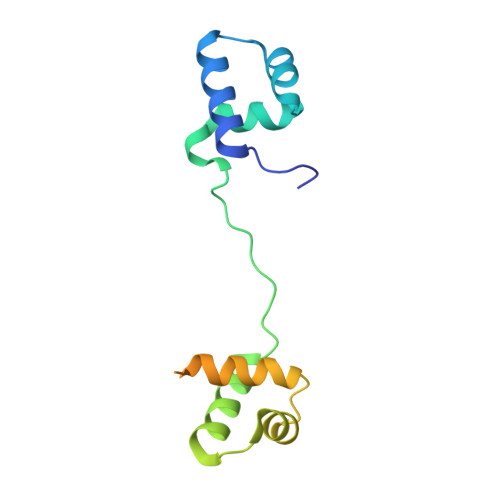
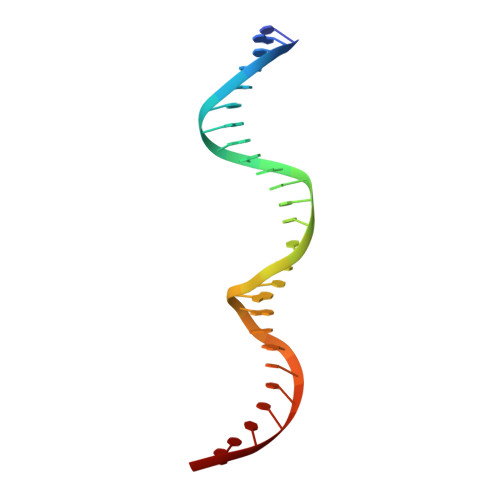
1U78 | pdb_00001u78

Structure of the bipartite DNA-binding domain of Tc3 transposase bound to transposon DNA


Experimental Data Snapshot

  • Method: X-RAY DIFFRACTION
  • Resolution: 2.69 Å
  • R-Value Free: 
    0.273 (Depositor), 0.318 (DCC) 
  • R-Value Work: 
    0.233 (Depositor), 0.286 (DCC) 
  • R-Value Observed: 
    0.235 (Depositor) 

Starting Model: experimental
View more details

wwPDB Validation 3D Report Full Report

Validation slider image for 1U78

This is version 1.4 of the entry. See complete history

Literature

Structural analysis of the bipartite DNA-binding domain of Tc3 transposase bound to transposon DNA

Watkins, S.van Pouderoyen, G.Sixma, T.K.

(2004) Nucleic Acids Res 32: 4306-4312

  • DOI: https://doi.org/10.1093/nar/gkh770
  • Primary Citation Related Structures: 
    1U78

  • PubMed Abstract: 

    The bipartite DNA-binding domain of Tc3 transposase, Tc3A, was crystallized in complex with its transposon recognition sequence. In the structure the two DNA-binding domains form structurally related helix-turn-helix (HTH) motifs. They both bind to the major groove on a single DNA oligomer, separated by a linker that interacts closely with the minor groove. The structure resembles that of the transcription factor Pax6 DNA-binding domain, but the relative orientation of the HTH-domain is different. The DNA conformation is distorted, characterized by local narrowing of the minor groove and bends at both ends. The protein-DNA recognition takes place through base and backbone contacts, as well as shape-recognition of the distortions in the DNA. Charged interactions are primarily found in the N-terminal domain and the linker indicating that these may form the initial contact area. Two independent dimer interfaces could be relevant for bringing together transposon ends and for binding to a direct repeat site in the transposon end. In contrast to the Tn5 synaptic complex, the two Tc3A DNA-binding domains bind to a single Tc3 transposon end.


  • Organizational Affiliation
    • Division of Molecular Carcinogenesis, Netherlands Cancer Institute, Plesmanlaan 121, 1066 CX Amsterdam, The Netherlands.

Macromolecule Content 

  • Total Structure Weight: 32.19 kDa 
  • Atom Count: 1,883 
  • Modeled Residue Count: 155 
  • Deposited Residue Count: 193 
  • Unique protein chains: 1
  • Unique nucleic acid chains: 2

Macromolecules


Find similar proteins by:|  3D Structure
Entity ID: 3
MoleculeChains  Sequence LengthOrganismDetailsImage
transposable element tc3 transposaseC [auth A]141Caenorhabditis elegansMutation(s): 1 
Gene Names: Tc3
UniProt
Find proteins for P34257 (Caenorhabditis elegans)
Explore P34257 
Go to UniProtKB:  P34257
Entity Groups
Sequence Clusters30% Identity50% Identity70% Identity90% Identity95% Identity100% Identity
UniProt GroupP34257
Sequence Annotations
Expand
Reference Sequence
Find similar nucleic acids by:  (by identity cutoff) 
Entity ID: 1
MoleculeChains LengthOrganismImage
26-MERA [auth B]26N/A
Sequence Annotations
Expand
Reference Sequence
Find similar nucleic acids by:  (by identity cutoff) 
Entity ID: 2
MoleculeChains LengthOrganismImage
26-MERB [auth C]26N/A
Sequence Annotations
Expand
Reference Sequence

Experimental Data & Validation

Experimental Data

  • Method: X-RAY DIFFRACTION
  • Resolution: 2.69 Å
  • R-Value Free:  0.273 (Depositor), 0.318 (DCC) 
  • R-Value Work:  0.233 (Depositor), 0.286 (DCC) 
  • R-Value Observed: 0.235 (Depositor) 
Space Group: P 61 2 2
Unit Cell:
Length ( Å )Angle ( ˚ )
a = 93.681α = 90
b = 93.681β = 90
c = 255.558γ = 120
Software Package:
Software NamePurpose
REFMACrefinement
DENZOdata reduction
CCP4data scaling
AMoREphasing

Structure Validation

View Full Validation Report


Entry History 

Deposition Data

Revision History  (Full details and data files)

  • Version 1.0: 2004-08-31
    Type: Initial release
  • Version 1.1: 2008-04-30
    Changes: Version format compliance
  • Version 1.2: 2011-07-13
    Changes: Version format compliance
  • Version 1.3: 2021-11-10
    Changes: Data collection, Database references
  • Version 1.4: 2023-10-25
    Changes: Data collection, Refinement description