1TTJ | pdb_00001ttj

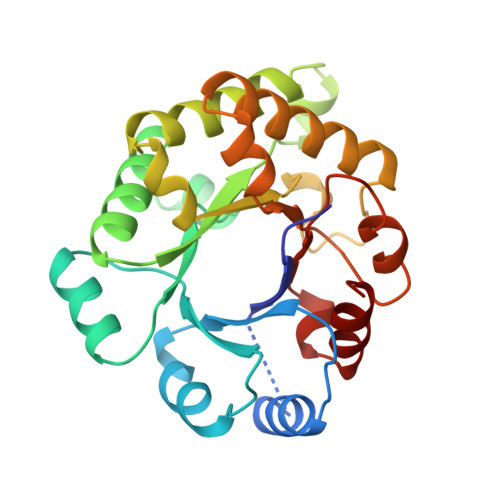
THREE NEW CRYSTAL STRUCTURES OF POINT MUTATION VARIANTS OF MONOTIM: CONFORMATIONAL FLEXIBILITY OF LOOP-1,LOOP-4 AND LOOP-8


Experimental Data Snapshot

  • Method: X-RAY DIFFRACTION
  • Resolution: 2.40 Å
  • R-Value Work: 
    0.178 (Depositor) 

wwPDB Validation 3D Report Full Report

Validation slider image for 1TTJ

This is version 1.6 of the entry. See complete history

Literature

Three new crystal structures of point mutation variants of monoTIM: conformational flexibility of loop-1, loop-4 and loop-8.

Borchert, T.V.Kishan, K.V.Zeelen, J.P.Schliebs, W.Thanki, N.Abagyan, R.Jaenicke, R.Wierenga, R.K.

(1995) Structure 3: 669-679

  • DOI: https://doi.org/10.1016/s0969-2126(01)00202-7
  • Primary Citation Related Structures: 
    1MSS, 1TTI, 1TTJ

  • PubMed Abstract: 

    Wild-type triosephosphate isomerase (TIM) is a very stable dimeric enzyme. This dimer can be converted into a stable monomeric protein (monoTIM) by replacing the 15-residue interface loop (loop-3) by a shorter, 8-residue, loop. The crystal structure of monoTIM shows that two active-site loops (loop-1 and loop-4), which are at the dimer interface in wild-type TIM, have acquired rather different structural properties. Nevertheless, monoTIM has residual catalytic activity. Three new structures of variants of monoTIM are presented, a double-point mutant crystallized in the presence and absence of bound inhibitor, and a single-point mutant in the presence of a different inhibitor. These new structures show large structural variability for the active-site loops, loop-1, loop-4 and loop-8. In the structures with inhibitor bound, the catalytic lysine (Lys13 in loop-1) and the catalytic histidine (His95 in loop-4) adopt conformations similar to those observed in wild-type TIM, but very different from the monoTIM structure. The residual catalytic activity of monoTIM can now be rationalized. In the presence of substrate analogues the active-site loops, loop-1, loop-4 and loop-8, as well as the catalytic residues, adopt conformations similar to those seen in the wild-type protein. These loops lack conformational flexibility in wild-type TIM. The data suggest that the rigidity of these loops in wild-type TIM, resulting from subunit-subunit contacts at the dimer interface, is important for optimal catalysis.


  • Organizational Affiliation
    • EMBL, Heidelberg, Germany.

Macromolecule Content 

  • Total Structure Weight: 26.19 kDa 
  • Atom Count: 1,821 
  • Modeled Residue Count: 235 
  • Deposited Residue Count: 243 
  • Unique protein chains: 1

Macromolecules

Find similar proteins by:|  3D Structure
Entity ID: 1
MoleculeChains  Sequence LengthOrganismDetailsImage
TRIOSEPHOSPHATE ISOMERASE243Trypanosoma brucei bruceiMutation(s): 2 
EC: 5.3.1.1
UniProt
Find proteins for P04789 (Trypanosoma brucei brucei)
Explore P04789 
Go to UniProtKB:  P04789
Entity Groups
Sequence Clusters30% Identity50% Identity70% Identity90% Identity95% Identity100% Identity
UniProt GroupP04789
Sequence Annotations
Expand
Reference Sequence

Small Molecules

Ligands 1 Unique
IDChains Name / Formula / InChI Key2D Diagram3D Interactions
PGH

Query on PGH


Download:Ideal Coordinates CCD File
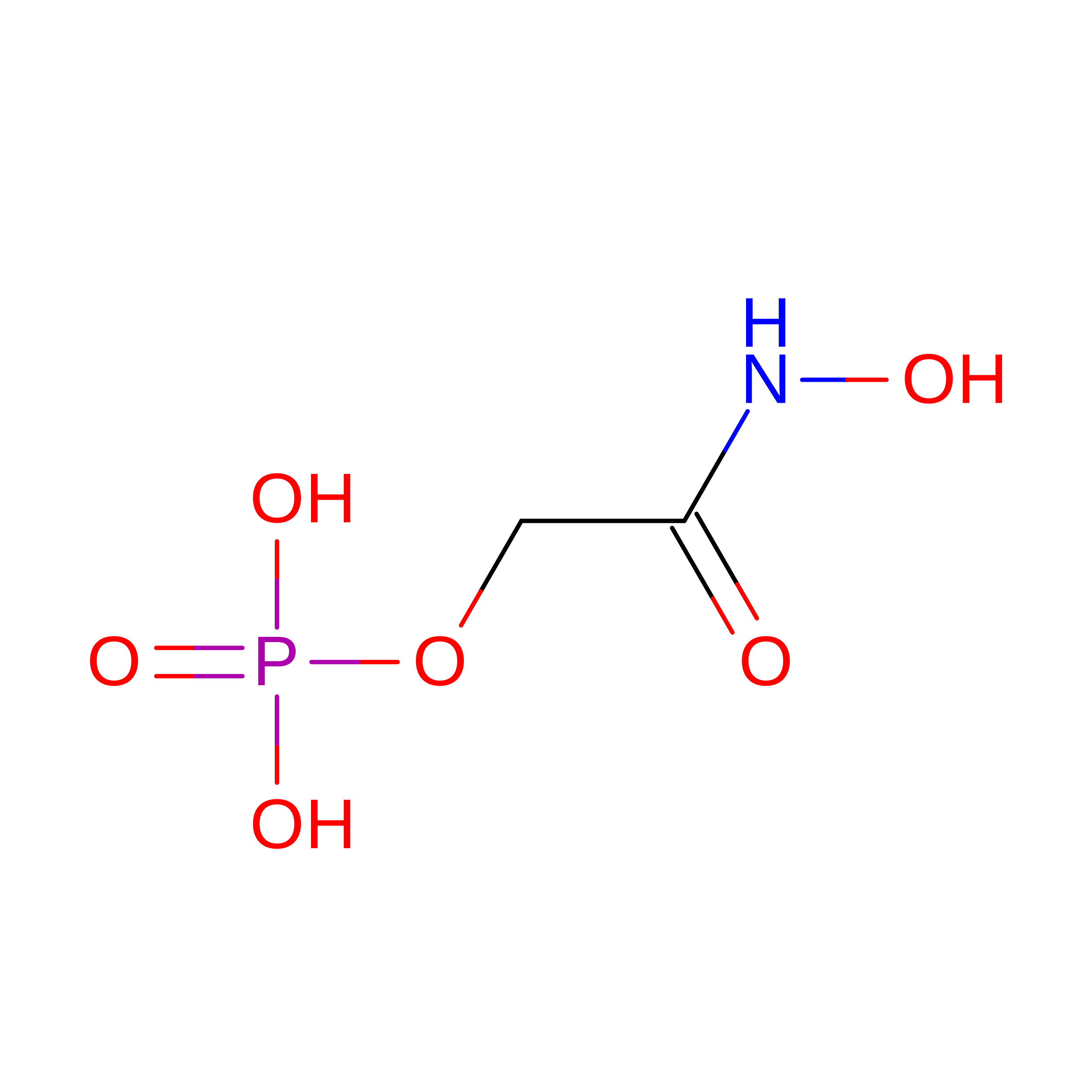
B [auth A]PHOSPHOGLYCOLOHYDROXAMIC ACID
C2 H6 N O6 P
BAXHHWZKQZIJID-UHFFFAOYSA-N

Experimental Data & Validation

Experimental Data

  • Method: X-RAY DIFFRACTION
  • Resolution: 2.40 Å
  • R-Value Work:  0.178 (Depositor) 
Space Group: P 1 21 1
Unit Cell:
Length ( Å )Angle ( ˚ )
a = 47.06α = 90
b = 39.33β = 117.49
c = 68.32γ = 90
Software Package:
Software NamePurpose
X-PLORmodel building
TNTrefinement
X-PLORrefinement
X-PLORphasing

Structure Validation

View Full Validation Report


Entry History 

Deposition Data

Revision History  (Full details and data files)

  • Version 1.0: 1995-09-15
    Type: Initial release
  • Version 1.1: 2008-03-24
    Changes: Version format compliance
  • Version 1.2: 2011-07-13
    Changes: Version format compliance
  • Version 1.3: 2019-07-17
    Changes: Data collection, Other, Refinement description
  • Version 1.4: 2019-08-14
    Changes: Data collection, Refinement description
  • Version 1.5: 2021-11-03
    Changes: Database references, Derived calculations
  • Version 1.6: 2024-02-14
    Changes: Data collection