1TO5 | pdb_00001to5

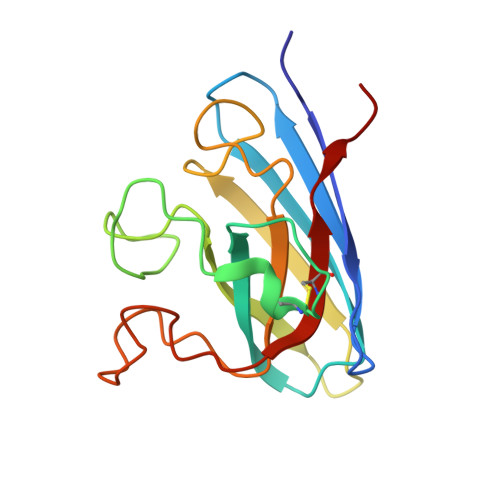
Structure of the cytosolic Cu,Zn SOD from S. mansoni


Experimental Data Snapshot

  • Method: X-RAY DIFFRACTION
  • Resolution: 2.20 Å
  • R-Value Free: 
    0.241 (Depositor), 0.243 (DCC) 
  • R-Value Work: 
    0.176 (Depositor), 0.178 (DCC) 

wwPDB Validation 3D Report Full Report

Validation slider image for 1TO5

This is version 1.3 of the entry. See complete history

Literature

Structure of the cytosolic Cu,Zn superoxide dismutase from Schistosoma mansoni.

Cardoso, R.M.Silva, C.H.Ulian de Araujo, A.P.Tanaka, T.Tanaka, M.Garratt, R.C.

(2004) Acta Crystallogr D Biol Crystallogr 60: 1569-1578

  • DOI: https://doi.org/10.1107/S0907444904016798
  • Primary Citation Related Structures: 
    1TO4, 1TO5

  • PubMed Abstract: 

    Cu,Zn superoxide dismutase (Cu,Zn SOD) is an essential enzyme for protecting cells from the toxic effects of reactive oxygen species. In humans, two distinct Cu,Zn SOD genes are located on chromosomes 4 and 21 and mutations in the latter have been associated with familial amyotrophic lateral sclerosis. Similarly, schistosomes (trematode parasites responsible for the chronically debilitating disease schistosomiasis) also produce two distinct Cu,Zn SODs, in this case one cytosolic and one bearing a signal peptide. The crystal structure of the cytosolic form of the enzyme from the human trematode Schistosoma mansoni (SmCtSOD) was solved and refined to a resolution of 2.2 A (space group P2(1)2(1)2(1), R = 17.6% and R(free) = 24.1%) and 1.55 A (space group P2(1), R = 15.7% and R(free) = 17.1%). This is the first report of a crystal structure of a Cu,Zn superoxide dismutase derived from a human parasite. Alternate positions for the catalytic copper and its water ligand were refined for the 1.55 A SmCtSOD model, but the most interesting structural differences between SmCtSOD and the human homologue reside in the loops used for electrostatic guidance of the substrate to the enzyme active site.


  • Organizational Affiliation
    • Instituto de Física de São Carlos, Universidade de São Paulo, Av. Trabalhador Sãocarlense 400, São Carlos, SP, 13566-590, Brazil.

Macromolecule Content 

  • Total Structure Weight: 64.47 kDa 
  • Atom Count: 5,099 
  • Modeled Residue Count: 624 
  • Deposited Residue Count: 624 
  • Unique protein chains: 1

Macromolecules

Find similar proteins by:|  3D Structure
Entity ID: 1
MoleculeChains  Sequence LengthOrganismDetailsImage
Superoxide dismutase
A, B, C, D
156Schistosoma mansoniMutation(s): 0 
Gene Names: SOD
EC: 1.15.1.1
UniProt
Find proteins for Q01137 (Schistosoma mansoni)
Explore Q01137 
Go to UniProtKB:  Q01137
Entity Groups
Sequence Clusters30% Identity50% Identity70% Identity90% Identity95% Identity100% Identity
UniProt GroupQ01137
Sequence Annotations
Expand
Reference Sequence

Small Molecules

Ligands 3 Unique
IDChains Name / Formula / InChI Key2D Diagram3D Interactions
ZN

Query on ZN


Download:Ideal Coordinates CCD File
E [auth A],
G [auth B],
J [auth C],
L [auth D]
ZINC ION
Zn
PTFCDOFLOPIGGS-UHFFFAOYSA-N
CU

Query on CU


Download:Ideal Coordinates CCD File
F [auth A],
H [auth B],
K [auth C],
M [auth D]
COPPER (II) ION
Cu
JPVYNHNXODAKFH-UHFFFAOYSA-N
ACT

Query on ACT


Download:Ideal Coordinates CCD File
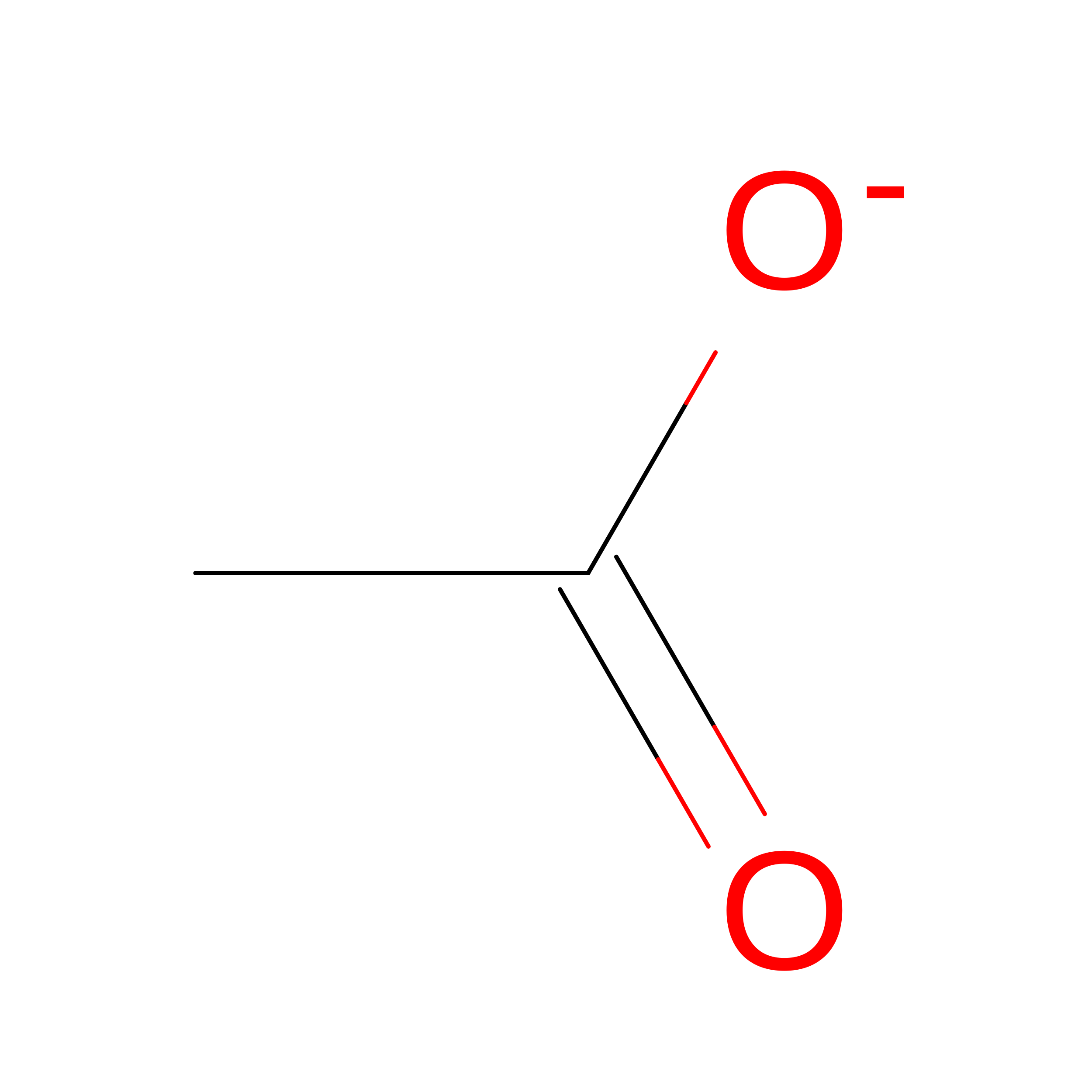
I [auth B]ACETATE ION
C2 H3 O2
QTBSBXVTEAMEQO-UHFFFAOYSA-M

Experimental Data & Validation

Experimental Data

  • Method: X-RAY DIFFRACTION
  • Resolution: 2.20 Å
  • R-Value Free:  0.241 (Depositor), 0.243 (DCC) 
  • R-Value Work:  0.176 (Depositor), 0.178 (DCC) 
Space Group: P 21 21 21
Unit Cell:
Length ( Å )Angle ( ˚ )
a = 74.64α = 90
b = 78.24β = 90
c = 95.18γ = 90
Software Package:
Software NamePurpose
DENZOdata reduction
SCALEPACKdata scaling
AMoREphasing
CNSrefinement

Structure Validation

View Full Validation Report


Entry History 

Deposition Data

Revision History  (Full details and data files)

  • Version 1.0: 2004-08-31
    Type: Initial release
  • Version 1.1: 2008-04-30
    Changes: Version format compliance
  • Version 1.2: 2011-07-13
    Changes: Version format compliance
  • Version 1.3: 2024-11-20
    Changes: Data collection, Database references, Derived calculations, Structure summary