Download Mendeley
Crystallographic structural analysis of phosphoramidates as inhibitors and transition-state analogs of thermolysin.
Tronrud, D.E., Monzingo, A.F., Matthews, B.W.(1986) Eur J Biochem 157: 261-268
- PubMed: 3709536 Search on PubMed
- DOI: https://doi.org/10.1111/j.1432-1033.1986.tb09664.x
- Primary Citation Related Structures:
1TLP, 2TMN - PubMed Abstract:
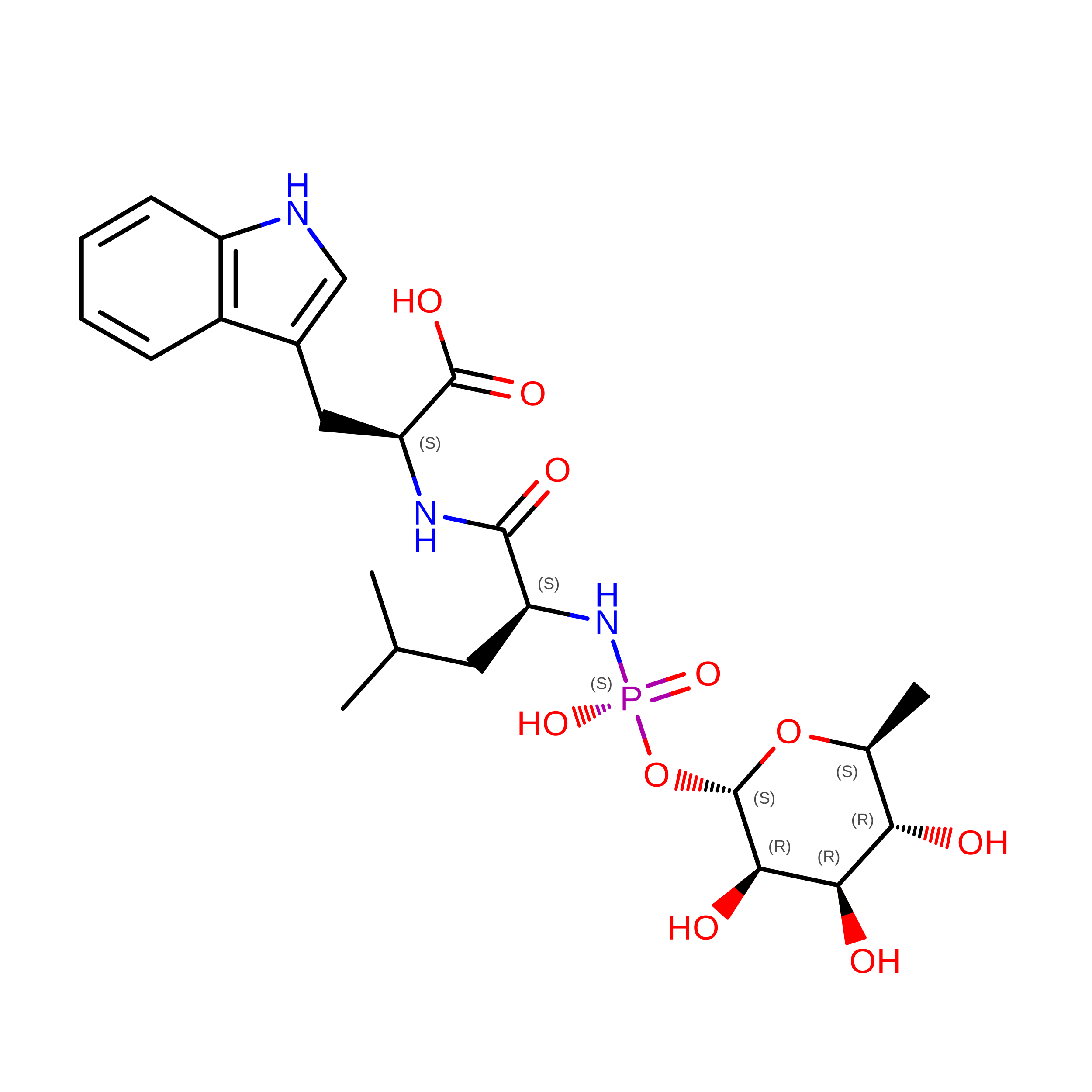
The mode of binding to thermolysin of the unsubstituted phosphoramidate inhibitor N-phosphoryl-L-leucinamide (P-Leu-NH2) has been determined crystallographically and refined at high resolution (R = 17.9% to 0.16-nm resolution). The mode of binding of the naturally occurring thermolysin inhibitor phosphoramidon reported previously [Weaver, L. H., Kester, W. R. and Matthews, B. W. (1977) J. Mol. Biol. 114, 119-132] has also been confirmed by crystallographic refinement (R = 17.4% to 0.23-nm resolution). Phosphoramidon binds to the enzyme with a single oxygen of the phosphoramidate moiety as a zinc ligand. Together with three ligands to the metal from the protein the resultant complex has approximately tetrahedral geometry. However, in the case of P-Leu-NH2, two of the phosphoramidate oxygens interact with the zinc to form a complex that tends towards pentacoordinate. In this respect, P-Leu-NH2 appears to be a better transition-state analog than is phosphoramidon. In addition, the phosphorus-nitrogen bond length in P-Leu-NH2 is 0.18 nm, suggesting that the nitrogen is protonated whereas the same bond in phosphoramidon is much shorter (0.15 nm) suggesting that the nitrogen does not carry a charge. In phosphoramidon the distance from the phosphoramide nitrogen to Glu-143 is 0.39 nm whereas in P-Leu-NH2 this distance decreases to 0.34 nm. Taken together, these observations provide additional evidence in support of the participation of pentacoordinate intermediates in the mechanism of action of thermolysin [Holmes, M. A. and Matthews, B. W. (1981) Biochemistry 20, 6912-6920] and the role of Glu-143 in first promoting the attack of a water molecule on the carbonyl carbon of the scissile bond and subsequently acting as a 'proton shuttle' to transfer the proton to the leaving nitrogen [Monzingo, A. F. and Matthews, B. W. (1984) Biochemistry 23, 5724-5729; Hangauer, D. G., Monzingo, A. F. and Matthews, B. W. (1984) Biochemistry 23, 5730-5741].