1THQ | pdb_00001thq

Crystal Structure of Outer Membrane Enzyme PagP


Experimental Data Snapshot

  • Method: X-RAY DIFFRACTION
  • Resolution: 1.90 Å
  • R-Value Free: 
    0.255 (Depositor) 
  • R-Value Work: 
    0.216 (Depositor), 0.218 (DCC) 
  • R-Value Observed: 
    0.218 (Depositor) 

wwPDB Validation 3D Report Full Report

Validation slider image for 1THQ

Ligand Structure Quality Assessment 


This is version 1.3 of the entry. See complete history

Literature

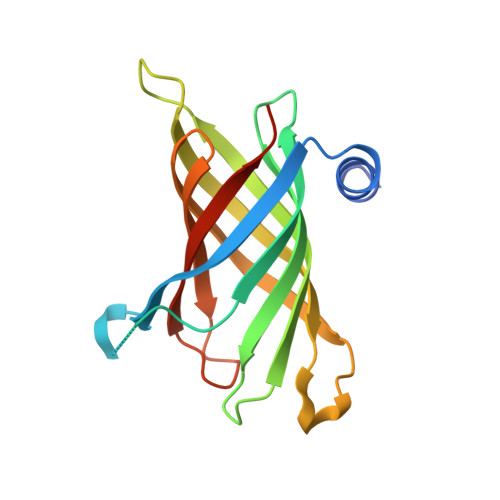
A hydrocarbon ruler measures palmitate in the enzymatic acylation of endotoxin.

Ahn, V.E.Lo, E.I.Engel, C.K.Chen, L.Hwang, P.M.Kay, L.E.Bishop, R.E.Prive, G.G.

(2004) EMBO J 23: 2931-2941

  • DOI: https://doi.org/10.1038/sj.emboj.7600320
  • Primary Citation Related Structures: 
    1THQ

  • PubMed Abstract: 

    The ability of enzymes to distinguish between fatty acyl groups can involve molecular measuring devices termed hydrocarbon rulers, but the molecular basis for acyl-chain recognition in any membrane-bound enzyme remains to be defined. PagP is an outer membrane acyltransferase that helps pathogenic bacteria to evade the host immune response by transferring a palmitate chain from a phospholipid to lipid A (endotoxin). PagP can distinguish lipid acyl chains that differ by a single methylene unit, indicating that the enzyme possesses a remarkably precise hydrocarbon ruler. We present the 1.9 A crystal structure of PagP, an eight-stranded beta-barrel with an unexpected interior hydrophobic pocket that is occupied by a single detergent molecule. The buried detergent is oriented normal to the presumed plane of the membrane, whereas the PagP beta-barrel axis is tilted by approximately 25 degrees. Acyl group specificity is modulated by mutation of Gly88 lining the bottom of the hydrophobic pocket, thus confirming the hydrocarbon ruler mechanism for palmitate recognition. A striking structural similarity between PagP and the lipocalins suggests an evolutionary link between these proteins.


  • Organizational Affiliation
    • Department of Medical Biophysics, University of Toronto, Ontario, Canada.

Macromolecule Content 

  • Total Structure Weight: 21.88 kDa 
  • Atom Count: 1,364 
  • Modeled Residue Count: 147 
  • Deposited Residue Count: 170 
  • Unique protein chains: 1

Macromolecules

Find similar proteins by:|  3D Structure
Entity ID: 1
MoleculeChains  Sequence LengthOrganismDetailsImage
CrcA protein170Escherichia coliMutation(s): 0 
Gene Names: CRCAB0622
EC: 2.3.1.251
Membrane Entity: Yes 
UniProt
Find proteins for P37001 (Escherichia coli (strain K12))
Explore P37001 
Go to UniProtKB:  P37001
Entity Groups
Sequence Clusters30% Identity50% Identity70% Identity90% Identity95% Identity100% Identity
UniProt GroupP37001
Sequence Annotations
Expand
Reference Sequence

Small Molecules

Ligands 3 Unique
IDChains Name / Formula / InChI Key2D Diagram3D Interactions
LDA

Query on LDA


Download:Ideal Coordinates CCD File
G [auth A],
H [auth A],
I [auth A],
J [auth A],
K [auth A]
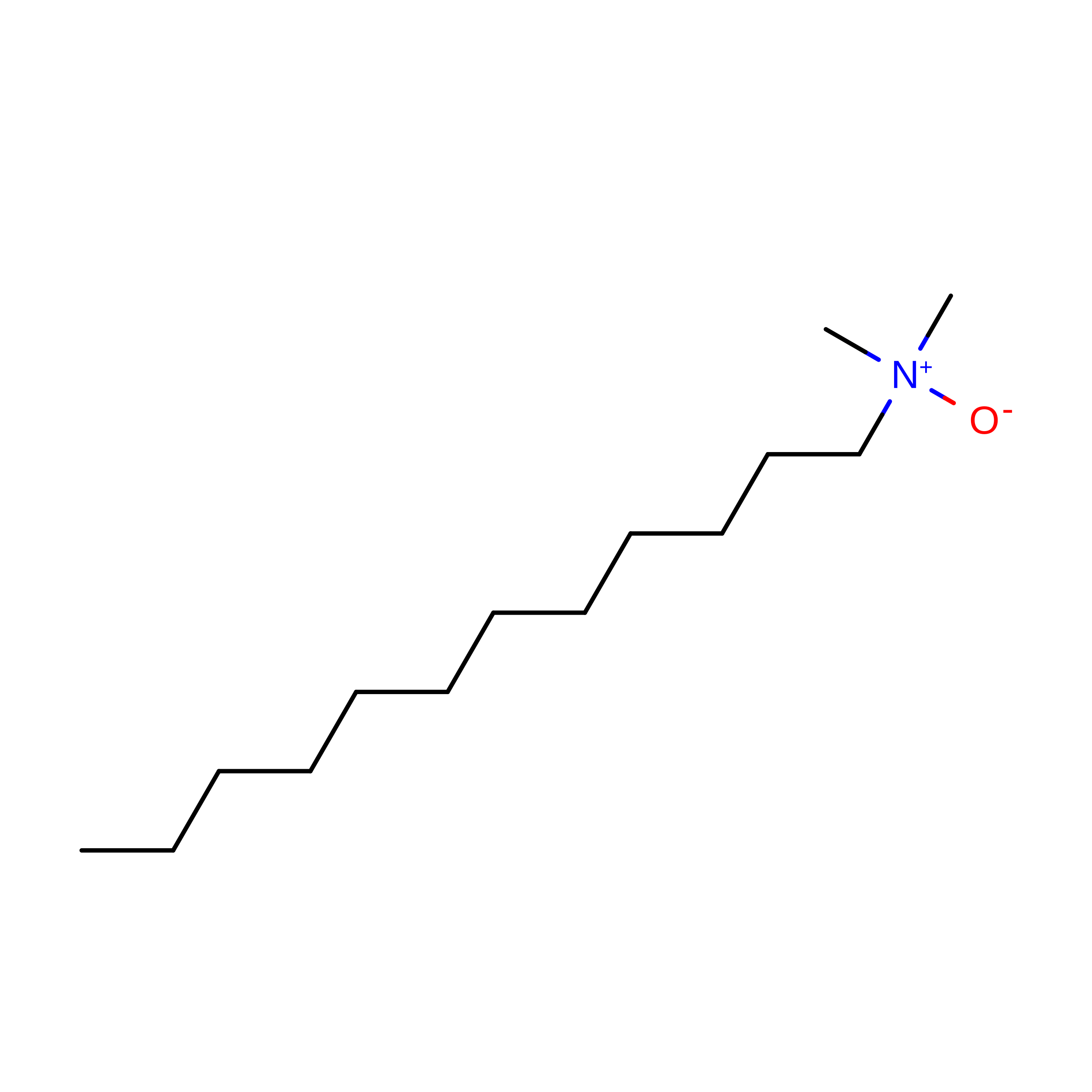
LAURYL DIMETHYLAMINE-N-OXIDE
C14 H31 N O
SYELZBGXAIXKHU-UHFFFAOYSA-N
MPD

Query on MPD


Download:Ideal Coordinates CCD File
L [auth A],
M [auth A]
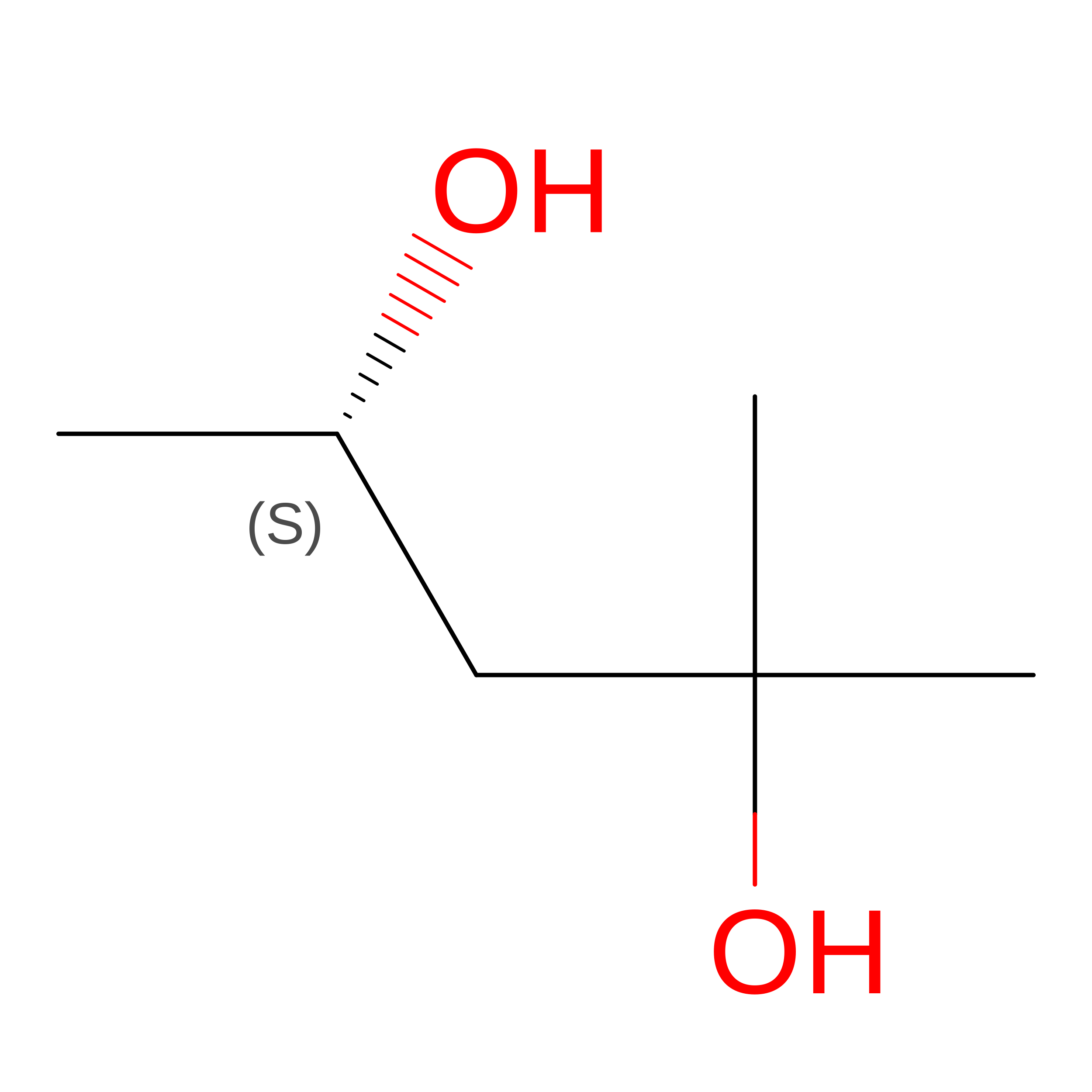
(4S)-2-METHYL-2,4-PENTANEDIOL
C6 H14 O2
SVTBMSDMJJWYQN-YFKPBYRVSA-N
ACT

Query on ACT


Download:Ideal Coordinates CCD File
B [auth A],
C [auth A],
D [auth A],
E [auth A],
F [auth A]
ACETATE ION
C2 H3 O2
QTBSBXVTEAMEQO-UHFFFAOYSA-M

Experimental Data & Validation

Experimental Data

  • Method: X-RAY DIFFRACTION
  • Resolution: 1.90 Å
  • R-Value Free:  0.255 (Depositor) 
  • R-Value Work:  0.216 (Depositor), 0.218 (DCC) 
  • R-Value Observed: 0.218 (Depositor) 
Space Group: P 41 2 2
Unit Cell:
Length ( Å )Angle ( ˚ )
a = 50.67α = 90
b = 50.67β = 90
c = 158.48γ = 90
Software Package:
Software NamePurpose
REFMACrefinement
DENZOdata reduction
SCALEPACKdata scaling
SOLVEphasing

Structure Validation

View Full Validation Report


Ligand Structure Quality Assessment 


Entry History 

Deposition Data

Revision History  (Full details and data files)

  • Version 1.0: 2004-08-10
    Type: Initial release
  • Version 1.1: 2008-04-30
    Changes: Version format compliance
  • Version 1.2: 2011-07-13
    Changes: Advisory, Version format compliance
  • Version 1.3: 2024-02-14
    Changes: Data collection, Database references, Derived calculations