1T2O | pdb_00001t2o

Crystal structure of Se-SrtA, C184-Ala


Experimental Data Snapshot

  • Method: X-RAY DIFFRACTION
  • Resolution: 2.30 Å
  • R-Value Free: 
    0.275 (Depositor), 0.277 (DCC) 
  • R-Value Work: 
    0.221 (Depositor), 0.223 (DCC) 
  • R-Value Observed: 
    0.221 (Depositor) 

wwPDB Validation 3D Report Full Report

Validation slider image for 1T2O

This is version 1.4 of the entry. See complete history

Literature

Crystal structures of Staphylococcus aureus sortase A and its substrate complex

Zong, Y.Bice, T.W.Ton-That, H.Schneewind, O.Narayana, S.V.

(2004) J Biological Chem 279: 31383-31389

  • DOI: https://doi.org/10.1074/jbc.M401374200
  • Primary Citation Related Structures: 
    1T2O, 1T2P, 1T2W

  • PubMed Abstract: 

    The cell wall envelope of staphylococci and other Gram-positive pathogens is coated with surface proteins that interact with human host tissues. Surface proteins of Staphylococcus aureus are covalently linked to the cell wall envelope by a mechanism requiring C-terminal sorting signals with an LPXTG motif. Sortase (SrtA) cleaves surface proteins between the threonine (T) and the glycine (G) of the LPXTG motif and catalyzes the formation of an amide bond between threonine at the C-terminal end of polypeptides and cell wall cross-bridges. The active site architecture and catalytic mechanism of sortase A has hitherto not been revealed. Here we present the crystal structures of native SrtA, of an active site mutant of SrtA, and of the mutant SrtA complexed with its substrate LPETG peptide and describe the substrate binding pocket of the enzyme. Highly conserved proline (P) and threonine (T) residues of the LPXTG motif are held in position by hydrophobic contacts, whereas the glutamic acid residue (E) at the X position points out into the solvent. The scissile T-G peptide bond is positioned between the active site Cys(184) and Arg(197) residues and at a greater distance from the imidazolium side chain of His(120). All three residues, His(120), Cys(184), and Arg(197), are conserved in sortase enzymes from Gram-positive bacteria. Comparison of the active sites of S. aureus sortase A and sortase B provides insight into substrate specificity and suggests a universal sortase-catalyzed mechanism of bacterial surface protein anchoring in Gram-positive bacteria.


  • Organizational Affiliation
    • Center for Biophysical Sciences and Engineering, School of Optometry, University of Alabama, Birmingham, Alabama 35294, USA.

Macromolecule Content 

  • Total Structure Weight: 49.67 kDa 
  • Atom Count: 3,425 
  • Modeled Residue Count: 425 
  • Deposited Residue Count: 438 
  • Unique protein chains: 1

Macromolecules

Find similar proteins by:|  3D Structure
Entity ID: 1
MoleculeChains  Sequence LengthOrganismDetailsImage
sortase
A, B, C
146Staphylococcus aureusMutation(s): 3 
Gene Names: srt
UniProt
Find proteins for Q9S446 (Staphylococcus aureus)
Explore Q9S446 
Go to UniProtKB:  Q9S446
Entity Groups
Sequence Clusters30% Identity50% Identity70% Identity90% Identity95% Identity100% Identity
UniProt GroupQ9S446
Sequence Annotations
Expand
Reference Sequence

Small Molecules

Modified Residues  1 Unique
IDChains TypeFormula2D DiagramParent
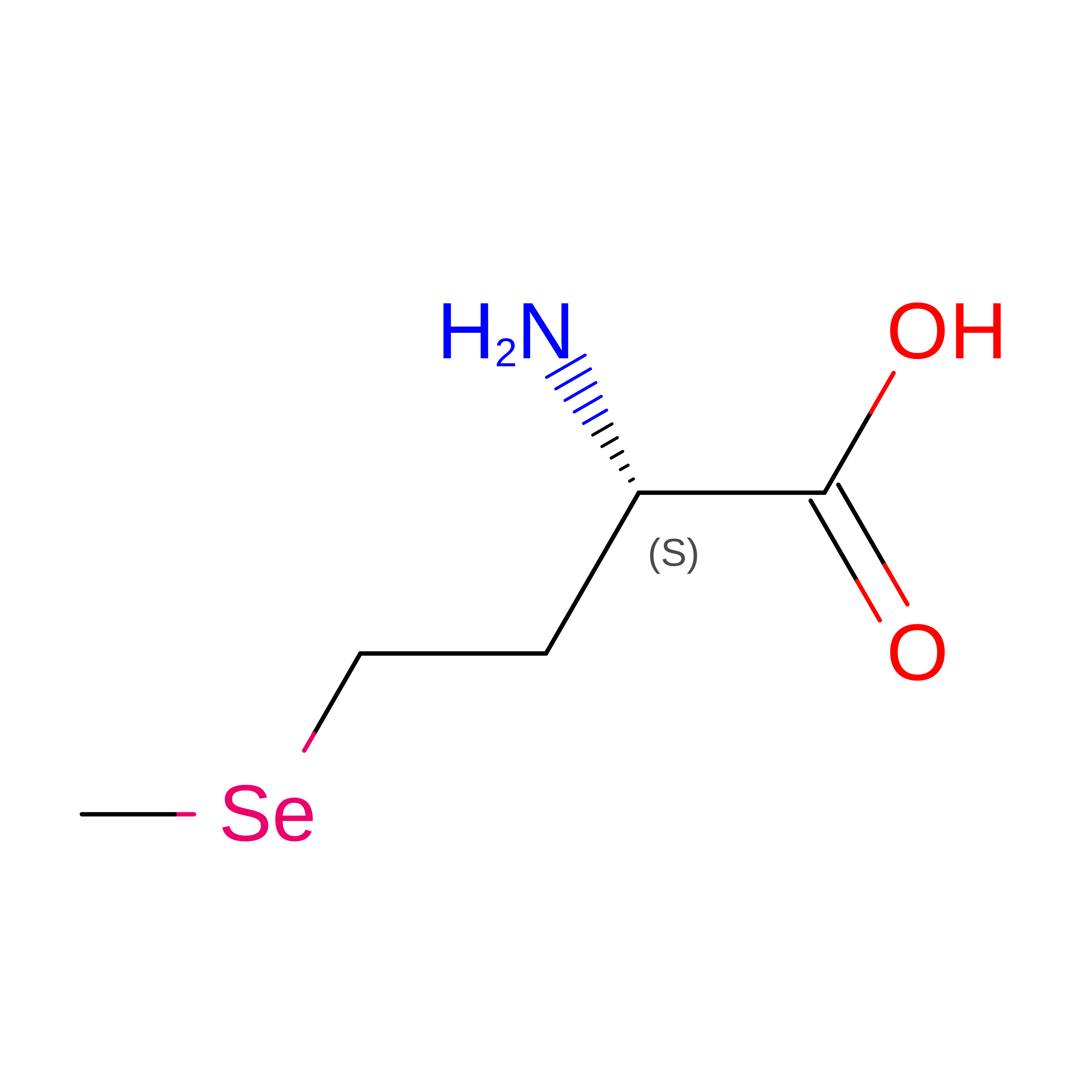
MSE
Query on MSE
A, B, C
L-PEPTIDE LINKINGC5 H11 N O2 SeMET

Experimental Data & Validation

Experimental Data

  • Method: X-RAY DIFFRACTION
  • Resolution: 2.30 Å
  • R-Value Free:  0.275 (Depositor), 0.277 (DCC) 
  • R-Value Work:  0.221 (Depositor), 0.223 (DCC) 
  • R-Value Observed: 0.221 (Depositor) 
Space Group: P 1 21 1
Unit Cell:
Length ( Å )Angle ( ˚ )
a = 46.553α = 90
b = 82.407β = 104.17
c = 56.112γ = 90
Software Package:
Software NamePurpose
CNSrefinement
DENZOdata reduction
SCALEPACKdata scaling
CNSphasing

Structure Validation

View Full Validation Report


Entry History 

Deposition Data

Revision History  (Full details and data files)

  • Version 1.0: 2004-09-07
    Type: Initial release
  • Version 1.1: 2008-04-30
    Changes: Version format compliance
  • Version 1.2: 2011-07-13
    Changes: Version format compliance
  • Version 1.3: 2021-10-27
    Changes: Database references, Derived calculations
  • Version 1.4: 2024-10-16
    Changes: Data collection, Structure summary