1SWX | pdb_00001swx

Crystal structure of a human glycolipid transfer protein in apo-form


Experimental Data Snapshot

  • Method: X-RAY DIFFRACTION
  • Resolution: 1.65 Å
  • R-Value Free: 
    0.226 (Depositor), 0.273 (DCC) 
  • R-Value Work: 
    0.172 (Depositor) 
  • R-Value Observed: 
    0.175 (Depositor) 

wwPDB Validation 3D Report Full Report

Validation slider image for 1SWX

This is version 1.3 of the entry. See complete history

Literature

Structural basis for glycosphingolipid transfer specificity.

Malinina, L.Malakhova, M.L.Teplov, A.Brown, R.E.Patel, D.J.

(2004) Nature 430: 1048-1053

  • DOI: https://doi.org/10.1038/nature02856
  • Primary Citation Related Structures: 
    1SWX, 1SX6

  • PubMed Abstract: 

    Lipid transfer proteins are important in membrane vesicle biogenesis and trafficking, signal transduction and immunological presentation processes. The conserved and ubiquitous mammalian glycolipid transfer proteins (GLTPs) serve as potential regulators of cell processes mediated by glycosphingolipids, ranging from differentiation and proliferation to invasive adhesion, neurodegeneration and apoptosis. Here we report crystal structures of apo-GLTP (1.65 A resolution) and lactosylceramide-bound (1.95 A) GLTP, in which the bound glycosphingolipid is sandwiched, after adaptive recognition, within a previously unknown two-layer all-alpha-helical topology. Glycosphingolipid binding specificity is achieved through recognition and anchoring of the sugar-amide headgroup to the GLTP recognition centre by hydrogen bond networks and hydrophobic contacts, and encapsulation of both lipid chains, in a precisely oriented manner within a 'moulded-to-fit' hydrophobic tunnel. A cleft-like conformational gating mechanism, involving two interhelical loops and one alpha-helix of GLTP, could enable the glycolipid chains to enter and leave the tunnel in the membrane-associated state. Mutation and functional analyses of residues in the glycolipid recognition centre and within the hydrophobic tunnel support a framework for understanding how GLTPs acquire and release glycosphingolipids during lipid intermembrane transfer and presentation processes.


  • Organizational Affiliation
    • Structural Biology Program, Memorial Sloan-Kettering Cancer Center, New York, New York 10021, USA.

Macromolecule Content 

  • Total Structure Weight: 23.96 kDa 
  • Atom Count: 1,854 
  • Modeled Residue Count: 198 
  • Deposited Residue Count: 209 
  • Unique protein chains: 1

Macromolecules

Find similar proteins by:|  3D Structure
Entity ID: 1
MoleculeChains  Sequence LengthOrganismDetailsImage
Glycolipid transfer protein209Homo sapiensMutation(s): 0 
Gene Names: GLTP
UniProt & NIH Common Fund Data Resources
Find proteins for Q9NZD2 (Homo sapiens)
Explore Q9NZD2 
Go to UniProtKB:  Q9NZD2
PHAROS:  Q9NZD2
GTEx:  ENSG00000139433 
Entity Groups
Sequence Clusters30% Identity50% Identity70% Identity90% Identity95% Identity100% Identity
UniProt GroupQ9NZD2
Sequence Annotations
Expand
Reference Sequence

Small Molecules

Ligands 1 Unique
IDChains Name / Formula / InChI Key2D Diagram3D Interactions
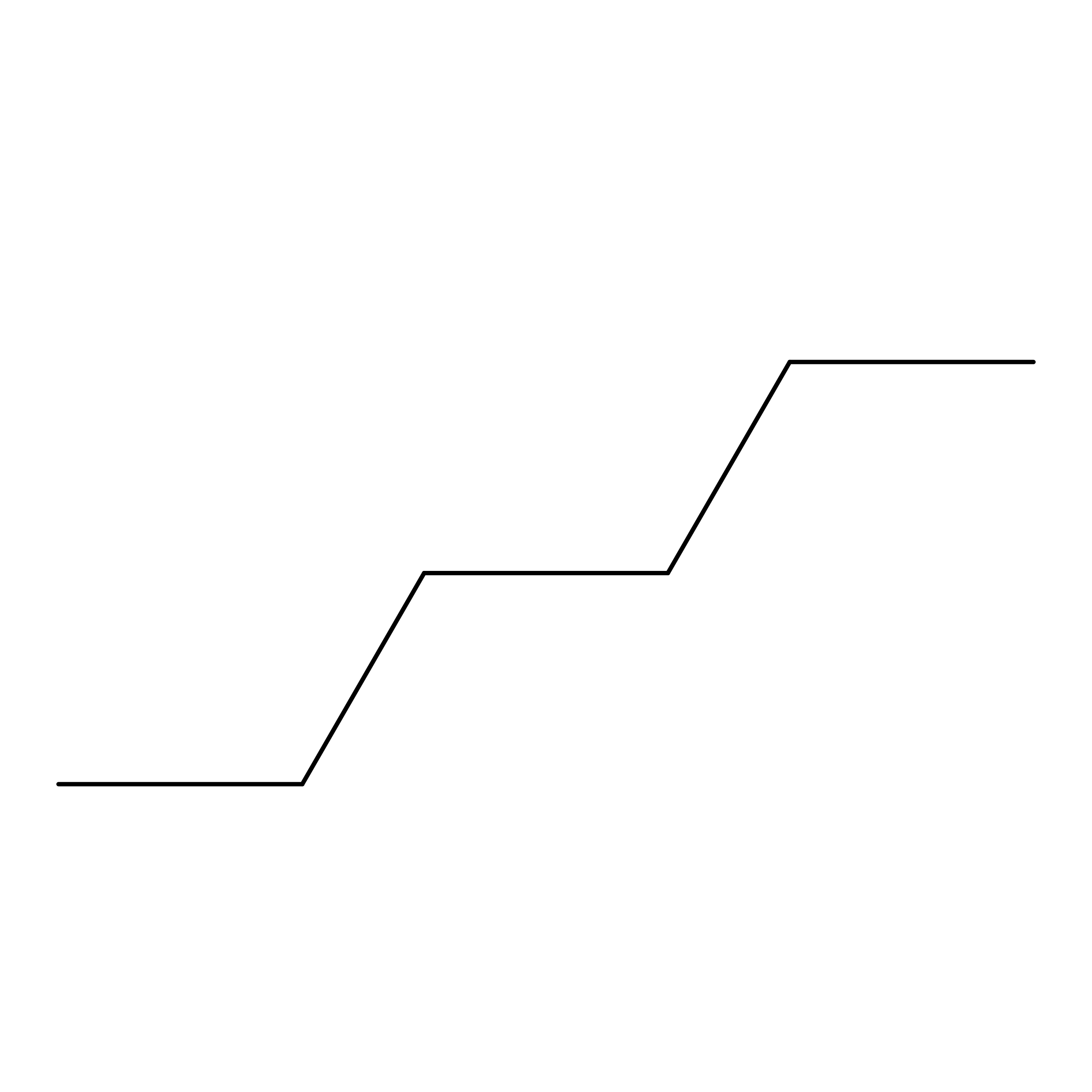
HEX

Query on HEX


Download:Ideal Coordinates CCD File
B [auth A]HEXANE
C6 H14
VLKZOEOYAKHREP-UHFFFAOYSA-N

Experimental Data & Validation

Experimental Data

  • Method: X-RAY DIFFRACTION
  • Resolution: 1.65 Å
  • R-Value Free:  0.226 (Depositor), 0.273 (DCC) 
  • R-Value Work:  0.172 (Depositor) 
  • R-Value Observed: 0.175 (Depositor) 
Space Group: P 1 21 1
Unit Cell:
Length ( Å )Angle ( ˚ )
a = 55.439α = 90
b = 35.259β = 115.82
c = 57.507γ = 90
Software Package:
Software NamePurpose
REFMACrefinement
CrystalCleardata reduction
SCALEPACKdata scaling
SOLVEphasing

Structure Validation

View Full Validation Report


Entry History 

Deposition Data

Revision History  (Full details and data files)

  • Version 1.0: 2004-08-31
    Type: Initial release
  • Version 1.1: 2008-04-30
    Changes: Version format compliance
  • Version 1.2: 2011-07-13
    Changes: Version format compliance
  • Version 1.3: 2024-02-14
    Changes: Data collection, Database references