1SMB | pdb_00001smb

Crystal Structure of Golgi-Associated PR-1 protein


Experimental Data Snapshot

  • Method: X-RAY DIFFRACTION
  • Resolution: 1.55 Å
  • R-Value Free: 
    0.197 (Depositor), 0.191 (DCC) 
  • R-Value Work: 
    0.188 (Depositor), 0.184 (DCC) 

wwPDB Validation 3D Report Full Report

Validation slider image for 1SMB

This is version 1.3 of the entry. See complete history

Literature

Structural analysis of the human Golgi-associated plant pathogenesis related protein GAPR-1 implicates dimerization as a regulatory mechanism

Serrano, R.L.Kuhn, A.Hendricks, A.Helms, J.B.Sinning, I.Groves, M.R.

(2004) J Mol Biology 339: 173-183

  • DOI: https://doi.org/10.1016/j.jmb.2004.03.015
  • Primary Citation Related Structures: 
    1SMB

  • PubMed Abstract: 

    The plant pathogenesis related proteins group 1 (PR-1) and a variety of related mammalian proteins constitute a PR-1 protein family that share sequence and structural similarities. GAPR-1 is a unique family member as thus far it is the only PR-1 family member that is not co-translationally targeted to the lumen of the endoplasmic reticulum before trafficking to either vacuoles or secretion. Here we report that GAPR-1 may form dimers in vitro and in vivo, as determined by yeast two-hybrid screening, biochemical and biophysical assays. The 1.55A crystal structure demonstrates that GAPR-1 is structurally homologous to the other PR-1 family members previously solved (p14a and Ves V 5). Through an examination of inter-molecular interactions between GAPR-1 molecules in the crystal lattice, we propose a number of the highly conserved amino acid residues of the PR-1 family to be involved in the regulation of dimer formation of GAPR-1 with potential implications for other PR-1 family members. We show that mutagenesis of these conserved amino acid residues leads to a greatly increased dimer population. A recent report suggests that PR-1 family members may exhibit serine protease activity and further examination of the dimer interface of GAPR-1 indicates that a catalytic triad similar to that of serine proteases may be formed across the dimer interface by residues from both molecules within the dimer.


  • Organizational Affiliation
    • Biochemie-Zentrum Heidelberg, University of Heidelberg, Im Neuenheimerfeld 328, 69120 Heidelberg, Germany.

Macromolecule Content 

  • Total Structure Weight: 17.34 kDa 
  • Atom Count: 1,449 
  • Modeled Residue Count: 149 
  • Deposited Residue Count: 154 
  • Unique protein chains: 1

Macromolecules

Find similar proteins by:|  3D Structure
Entity ID: 1
MoleculeChains  Sequence LengthOrganismDetailsImage
17kD fetal brain protein154Homo sapiensMutation(s): 2 
Gene Names: CAC12812
UniProt & NIH Common Fund Data Resources
Find proteins for Q9H4G4 (Homo sapiens)
Explore Q9H4G4 
Go to UniProtKB:  Q9H4G4
PHAROS:  Q9H4G4
GTEx:  ENSG00000122694 
Entity Groups
Sequence Clusters30% Identity50% Identity70% Identity90% Identity95% Identity100% Identity
UniProt GroupQ9H4G4
Sequence Annotations
Expand
Reference Sequence

Small Molecules

Modified Residues  1 Unique
IDChains TypeFormula2D DiagramParent
OCS
Query on OCS
A
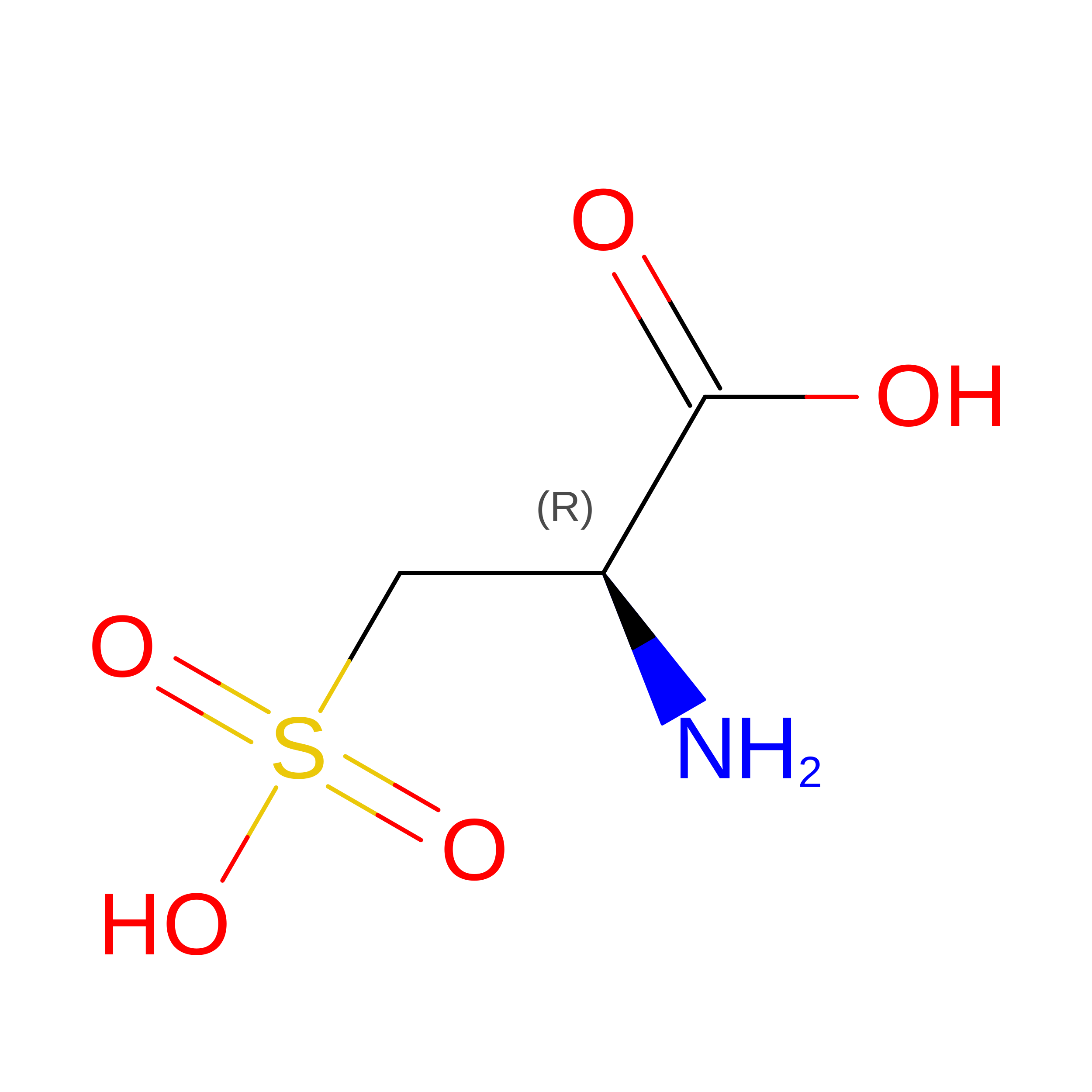
L-PEPTIDE LINKINGC3 H7 N O5 SCYS

Experimental Data & Validation

Experimental Data

  • Method: X-RAY DIFFRACTION
  • Resolution: 1.55 Å
  • R-Value Free:  0.197 (Depositor), 0.191 (DCC) 
  • R-Value Work:  0.188 (Depositor), 0.184 (DCC) 
Space Group: P 31 2 1
Unit Cell:
Length ( Å )Angle ( ˚ )
a = 73.662α = 90
b = 73.662β = 90
c = 63.363γ = 120
Software Package:
Software NamePurpose
CNSrefinement
MOSFLMdata reduction
CCP4data scaling
SHARPphasing

Structure Validation

View Full Validation Report


Entry History 

Deposition Data

Revision History  (Full details and data files)

  • Version 1.0: 2004-09-14
    Type: Initial release
  • Version 1.1: 2008-04-29
    Changes: Version format compliance
  • Version 1.2: 2011-07-13
    Changes: Version format compliance
  • Version 1.3: 2025-03-26
    Changes: Data collection, Database references, Derived calculations, Structure summary