1SFI | pdb_00001sfi

High resolution structure of a potent, cyclic protease inhibitor from sunflower seeds


Experimental Data Snapshot

  • Method: X-RAY DIFFRACTION
  • Resolution: 1.65 Å
  • R-Value Free: 
    0.204 (Depositor) 
  • R-Value Work: 
    0.175 (Depositor) 

Starting Model: experimental
View more details

wwPDB Validation 3D Report Full Report

Validation slider image for 1SFI

This is version 1.5 of the entry. See complete history

Literature

High-resolution structure of a potent, cyclic proteinase inhibitor from sunflower seeds.

Luckett, S.Garcia, R.S.Barker, J.J.Konarev, A.V.Shewry, P.R.Clarke, A.R.Brady, R.L.

(1999) J Mol Biology 290: 525-533

  • DOI: https://doi.org/10.1006/jmbi.1999.2891
  • Primary Citation Related Structures: 
    1SFI

  • PubMed Abstract: 

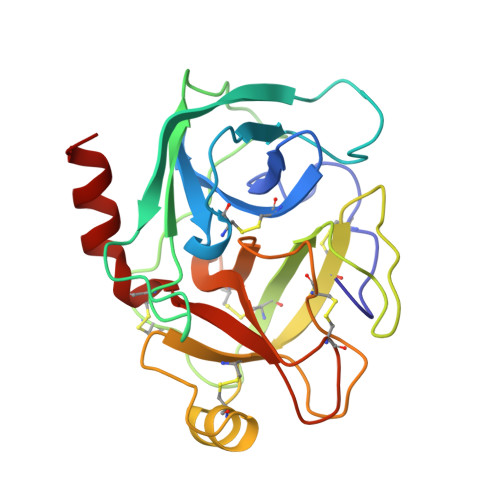
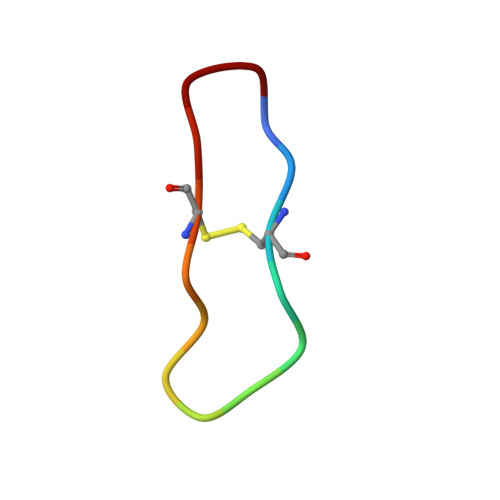
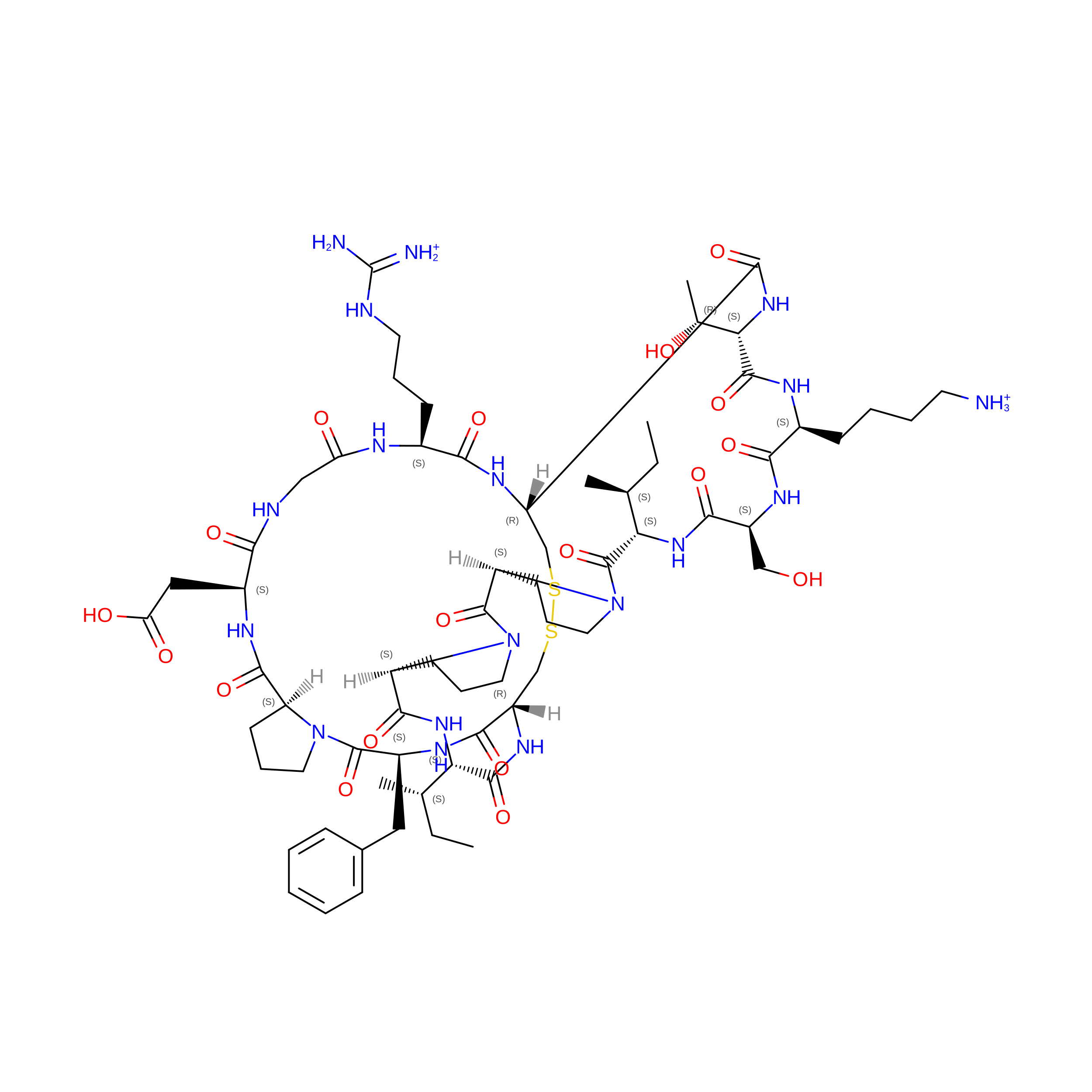
    Proteinaceous serine proteinase inhibitors are widespread throughout the plant kingdom where they play an important role in protection against pests and pathogens. Here, we describe the isolation and characterisation of a novel 14 amino acid residue cyclic peptide from sunflower seeds, which is a potent inhibitor of trypsin (Ki=100 pM). The crystal structure of this peptide in complex with bovine beta-trypsin shows both sequence and conformational similarity with the trypsin-reactive loop of the Bowman-Birk family of serine proteinase inhibitors. This inhibitor, however, is unique in being monofunctional, cyclic and far shorter (14 amino acid residues) than inhibitors belonging to this family (typically 60-70 amino acid residues). The high potency of this peptide is likely to arise from the considerable structural rigidity achieved through its cyclic nature which is further stabilised by a single internal disulphide bond. This study helps delineate the minimal unit required for effective peptide inhibitors of serine proteinases, and will assist in the further design of inhibitors to this widespread class of enzymes.


  • Organizational Affiliation
    • Department of Biochemistry, University of Bristol, Bristol, BS8 1TD, UK.

Macromolecule Content 

  • Total Structure Weight: 25.19 kDa 
  • Atom Count: 2,126 
  • Modeled Residue Count: 237 
  • Deposited Residue Count: 237 
  • Unique protein chains: 2

Macromolecules

Find similar proteins by:|  3D Structure
Entity ID: 1
MoleculeChains  Sequence LengthOrganismDetailsImage
TRYPSIN223Bos taurusMutation(s): 0 
EC: 3.4.21.4
UniProt
Find proteins for P00760 (Bos taurus)
Explore P00760 
Go to UniProtKB:  P00760
Entity Groups
Sequence Clusters30% Identity50% Identity70% Identity90% Identity95% Identity100% Identity
UniProt GroupP00760
Sequence Annotations
Expand
Reference Sequence
Find similar proteins by:  Sequence   |   3D Structure  
Entity ID: 2
MoleculeChains  Sequence LengthOrganismDetailsImage
Trypsin inhibitor 1B [auth I]14Helianthus annuusMutation(s): 0 
UniProt
Find proteins for Q4GWU5 (Helianthus annuus)
Explore Q4GWU5 
Go to UniProtKB:  Q4GWU5
Entity Groups
Sequence Clusters30% Identity50% Identity70% Identity90% Identity95% Identity100% Identity
UniProt GroupQ4GWU5
Sequence Annotations
Expand
Reference Sequence

Biologically Interesting Molecules (External Reference) 

1 Unique

Experimental Data & Validation

Experimental Data

  • Method: X-RAY DIFFRACTION
  • Resolution: 1.65 Å
  • R-Value Free:  0.204 (Depositor) 
  • R-Value Work:  0.175 (Depositor) 
Space Group: P 21 21 21
Unit Cell:
Length ( Å )Angle ( ˚ )
a = 60.61α = 90
b = 64.43β = 90
c = 70.62γ = 90
Software Package:
Software NamePurpose
DENZOdata reduction
SCALEPACKdata scaling
AMoREphasing
REFMACrefinement

Structure Validation

View Full Validation Report


Entry History 

Deposition Data

Revision History  (Full details and data files)

  • Version 1.0: 1999-07-09
    Type: Initial release
  • Version 1.1: 2008-03-03
    Changes: Version format compliance
  • Version 1.2: 2011-07-13
    Changes: Atomic model, Database references, Derived calculations, Non-polymer description, Structure summary, Version format compliance
  • Version 1.3: 2016-11-09
    Changes: Structure summary
  • Version 1.4: 2023-08-09
    Changes: Database references, Derived calculations, Refinement description
  • Version 1.5: 2024-10-30
    Changes: Data collection, Structure summary